One-Stop Border Posts: How Joint Clearance Works in Southern Africa
November 16, 2026
Read the story
Please submit your details below and one of our logistics experts will reach out within one business day. Thank you.


At a traditional border post, a truck stops twice. It clears exit formalities with one country's customs, immigration and inspection agencies, crosses the line, then queues again to clear entry with the neighbouring country's agencies. Both sides check much of the same paperwork, and either side may inspect the load.
A one-stop border post (OSBP) combines those two stops into one. Officials from both countries work from a shared control area, and a truck completes exit and entry formalities at a single point. Southern Africa's first OSBP opened at Chirundu in 2009. Several of the region's busiest crossings now use the model, are piloting it or have plans to introduce it.
This article explains how joint clearance works and why results vary so much between crossings. It also shows where OSBPs stand on the main freight corridors and what shippers need in place to benefit.
An OSBP runs on a set of operating principles that border agencies across East and Southern Africa apply. The Tanzania Revenue Authority's summary of the model lists the core principles:
● Traffic stops once for both exit and entry clearance.
● Both countries' controls take place inside a common control zone.
● Vehicles drive directly to the control zone of the country they are entering.
● Exit procedures are completed before entry procedures begin.
● Each country names a lead agency to coordinate management of the post.
The legal basis is extraterritorial jurisdiction. A Zambian customs officer working in a facility on Botswana's side of the border has to be able to apply Zambian law there, and the same applies in reverse.
That requires a bilateral agreement between the two governments and matching legislation in each country. Negotiating those terms takes time, and many OSBPs spend years between announcement and opening. Namibia and Zambia, for example, adopted a draft implementation plan for a Katima Mulilo OSBP in June 2025, and the crossing still operates as two separate posts.
For shippers, the main effect is that clearance becomes one joint process. Agencies from both countries share information and, where the arrangement works as designed, inspect a load once. One document error then holds the truck for both countries at the same time.
OSBPs follow one of three physical layouts:
● Juxtaposed. Each country hosts the other's officials in its own facility, and traffic clears at the facility of the country of entry. This is the most common model, and it suits crossings separated by a river or a bridge.
● Straddling. A single building sits across the border line, and both countries share it.
● Single country. One shared facility sits entirely inside one country and houses officers from both.
At a juxtaposed post, northbound and southbound traffic clears at different facilities, so one side can back up while the other moves freely. Kazungula showed this in March 2026. Northbound trucks queued about 10 kilometres into Botswana during a Zambian system outage, while southbound trucks, mostly empty, cleared quickly on the Botswana side.
Results from OSBPs vary widely. Fesarta, the regional road transport federation, reported that OSBPs in East Africa have cut crossing times by as much as 80%, while crossing times at Chirundu doubled after its 2009 conversion.
According to Fesarta, the difference comes down to a working single-window system, staff trained in OSBP procedures, ongoing training for new staff and regular staff rotation between border posts.
Approach roads matter as well. Tunduma-Nakonde launched as an OSBP in 2019, but without adequate access roads connecting the two sides, it never fully operated as one.
At Kazungula, clearance times have depended on the shared systems inside the building. Trucks averaged around 30 hours to clear in the crossing's first few months. A survey published in 2023 found cargo clearance time had dropped to about 12 hours. During the March 2026 outage, the Zambia Revenue Authority (ZRA) adjusted its risk engine to route more consignments through the green channel without inspection. It also pointed transporters to its accredited transport program, which lets qualifying operators fast-track their documents.
Pre-clearance has caused disputes at Kazungula. During one backlog, ZRA took the position that it could refuse entry to cargo that hadn't been pre-cleared. Transport operators challenged this under the OSBP Act, which requires vehicles to proceed directly to the country of entry. Pre-clearing cargo keeps a shipment out of that dispute.
Beitbridge shows the reverse case. Its rebuilt Zimbabwean facilities already clear up to 60% of commercial cargo in under three hours, and joint clearance has yet to start there. Infrastructure and process reform are separate steps, and a crossing can advance on one well ahead of the other.
What this means for planning:
● Plan around a crossing's recent clearance times and treat its OSBP status as background.
● The speed of joint clearance depends on agency systems and staffing, both of which can fail on a given day.
OSBPs on Southern Africa's Main Freight Corridors
The table shows the status of OSBPs at the main corridor crossings as of November 2026.
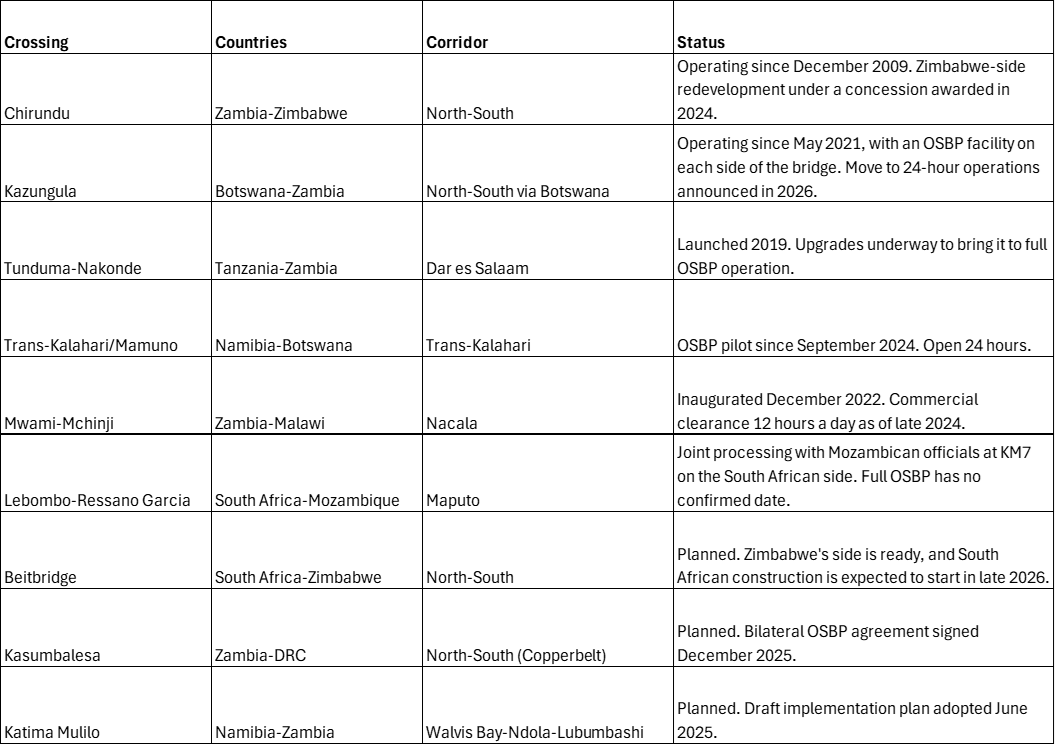
Most routes mix both types of crossing. Cargo routed through Kazungula to avoid Beitbridge still enters Botswana from South Africa at Groblersbrug or Kopfontein. Kasumbalesa, the main road crossing into the DRC's Copperbelt, averaged more than 100 hours to cross in 2026, according to TradeMark Africa's corridor monitoring.
At an OSBP, both countries' requirements must be met at the same time. These are the items to confirm before a truck leaves the yard:
● Pre-lodged declarations. Export, transit and import declarations lodged electronically before arrival let officers on both sides process the file before the truck reaches the control zone. Uncleared trucks are the ones most likely to be held.
● One consistent document set. The documents a truck need before it reaches any border still apply. At an OSBP, the invoice, packing list, permits and declarations also have to match each other and meet both countries' requirements, because a discrepancy found in a joint inspection holds the truck for both exit and entry clearance.
● A transit guarantee accepted on both sides. Cargo crossing a country in transit needs a customs bond covering the duty at risk for that leg. The choice between transit and import clearance determines which countries require one.
● Clearing agents who can act for both countries. Using one agent with authority on both sides, or two agents working from the same file, keeps exit and entry formalities moving together.
● Road charges paid in advance. Tolls, road user charges and carbon tax apply at many crossings, and paying them on arrival adds another queue.
● Timing that fits the whole route. Check the commercial operating hours at the OSBP and at every other crossing on the route. A truck that clears a 24-hour OSBP quickly can still wait overnight at the next border.
Responsibility for each of these item’s rests with whoever manages the clearance file and the truck schedule. When one provider handles customs clearing alongside the transport leg, declarations, bonds and arrival times come from the same file.
If conditions deteriorate on one route, the paperwork can be reissued for another, such as a switch from Beitbridge and Chirundu to Kazungula.
South Africa is rebuilding its main land ports, including Beitbridge and Lebombo, with joint processing built into the design and construction timelines spanning several years. Kasumbalesa and Katima Mulilo have signed agreements and implementation plans, with no confirmed opening dates. Until those crossings open as OSBPs, most freight moving into Zambia and the DRC will still pass through at least one two-stop border.
Key takeaways:
● An OSBP replaces two clearances with one joint process, so preparation for both countries has to be complete before the truck arrives.
● Performance depends on shared agency systems, staffing and approach roads, and varies widely between OSBPs.
● Beitbridge, Kasumbalesa and Katima Mulilo remain two-stop posts with OSBP plans in progress.
● Route planning needs to cover every crossing on the route, including the two-stop posts between OSBPs.