AfCFTA and Customs Reality: What Free Movement of Goods Requires at the Border
October 19, 2026
Read the story
Please submit your details below and one of our logistics experts will reach out within one business day. Thank you.


Nakonde handles about 20 percent of Zambia's trade, moving through a single crossing on the Tanzania border. For anyone shipping copper out of the Copperbelt or fuel in from Dar es Salaam, getting cargo through this crossing efficiently is crucial for planning.
This article covers what actually moves through the crossing, the documents and timing that decide how fast a shipment clears, and what the recent border-post and weighbridge upgrades change for a shipment being planned today.
The crossing clears roughly 500 to 800 trucks a day, carrying copper exports south and fuel, fertilizer, and vehicles north. Over 70 percent of the cargo passing through the Port of Dar es Salaam to neighboring countries crosses here.
Most of that cargo doesn't stay in Zambia. A 2021 review by Zambia's Ministry of Commerce put transit cargo, freight continuing on to the DRC, Zimbabwe, and beyond, at roughly 65 percent of the total, against 35 percent destined for Zambia itself.
For a lot of the freight passing through this border post, Nakonde is a midpoint on the way to the final destination.
● Form CE 20 through ASYCUDA. Zambia clears cargo through this automated customs system. With complete, correct paperwork, clearance can be accomplished within hours.
Missing supporting documents or an incomplete form are what turn hours into a multi-day wait, so the document itself is usually the cause of the bottleneck.
● A customs transit bond, for cargo continuing past Zambia. Freight bound for the DRC, Malawi, or Zimbabwe needs a bond or an equivalent cash deposit, refundable at the exit border once transit is confirmed complete.
Historically, that bond has had to be raised anew in every transit country, tying up working capital at each border. COMESA's Regional Customs Transit Guarantee scheme is designed to replace that with a single bond valid across the region, though implementation is still rolling out country by country, worth confirming with a clearing agent rather than assumed.
● Carbon tax and road toll, paid on the Zambian side. This charge, calculated by engine capacity, is paid at Nakonde, not on the Tanzanian side.
● A yellow fever certificate, for entry into Tanzania. Checked at the same building as customs.
Cargo type determines whether arrival time even matters at Tunduma-Nakonde. The cargo scanner runs a 12-hour window, 9am to 9pm, for containerized cargo. Outside that window, only tankers and loose, non-containerized cargo can cross.
A container arriving at 10pm will need to wait until the scanner reopens the next morning. A fuel tanker or a load of loose bulk cargo has no such restriction.
The crossing was first launched as a One-Stop Border Post in October 2019, but a lack of adequate access roads connecting the two sides meant it never fully operated as one. Trucks settled into a routine dwell time of 64 hours, close to two and a half days, to clear.
Tanzania began a UK-funded upgrade to the Tunduma OSBP, including new X-ray scanners, and delivered a 40 percent cut in cargo processing time.
Phase one in Zambia broke ground in October 2024, funded by a $10 million UK government grant delivered through TradeMark Africa, with China Railway Construction as contractor. President Hakainde Hichilema commissioned it in March 2026, a year past its original March 2025 target. The new scanner clears a vehicle in as little as 30 seconds, down from roughly 30 minutes, with a rated capacity of more than 100 trucks an hour. The British High Commissioner to Zambia has put the expected transport cost savings at around $95 million a year for businesses using the border.
TradeMark Africa's own track record sets a useful benchmark for how far this still has to go. Its completed OSBPs across East Africa have shown an average 70 percent reduction in overall border crossing time, not just scanning time. Nakonde's phase one only addressed the scanner. Phase two, a roughly $20 million World Bank grant under the TRACER project, covers the terminal building itself and remains underway.
Scanning speed is not the only capacity constraint here, either. Zambia's Road Development Agency has also been building the country's first weigh-in-motion weighbridge at the T2/D1 intersection in Nakonde district, screening trucks for overloading while they keep moving rather than stopping every vehicle for a static weigh-in.
An overloaded truck is flagged, redirected to static weighing, charged, and sent to a holding area to transfer the excess load onto a second vehicle. The project was targeting a December 2024 completion, and its current status isn't confirmed in what's publicly available, so it's worth checking directly with Zambian authorities before assuming it's operational.
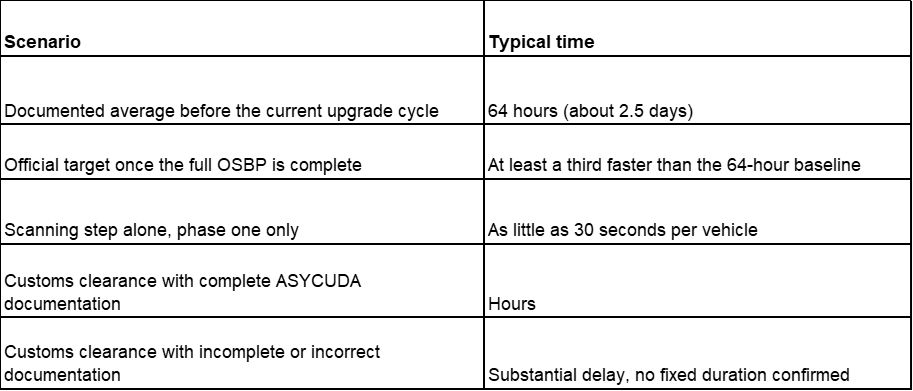
The gap between the second and third rows is the typical situation right now. A faster scanner doesn't by itself deliver the ‘third faster’ target, since that target assumes the whole OSBP, terminal building included, is finished.
● An overloaded shipment needs a second vehicle standing by, not just cash for a fine. If the weigh-in-motion system is live, only flagged trucks face this. If it isn't, static weighing remains the fallback, and either way the excess load has to go somewhere.
● Complete paperwork matters more than which side of the border is faster. Form CE 20 through ASYCUDA clears in hours when it's correct and complete. An incomplete form is a bigger risk to a shipment's timeline than the crossing's own infrastructure.
● Cargo continuing past Zambia needs its transit bond sorted before arrival, and it's worth asking a clearing agent whether COMESA's regional guarantee already applies on this route or whether a fresh bond is still required.
● Container cargo is locked to a 9am-to-9pm scanning window. Tankers and loose cargo aren't. Knowing which category a shipment falls into changes whether arrival timing needs planning around at all.
● Phase two isn't finished, so the terminal building can still produce a queue that the new scanner alone can't fix. Track official completion announcements rather than treating the March 2026 milestone as the finish line.
● The carbon tax and road toll are paid on the Zambian side, not the Tanzanian side, worth getting right when budgeting a route rather than assuming it's a Tanzanian charge.
Nakonde is partway through the biggest change in its history. The scanner has already been rebuilt, but there is work remaining to be done.
The upgrade's real payoff for shippers is a 30-second scan instead of a 30-minute one, and roughly $95 million a year in transport savings across the border as a whole.