AfCFTA and Customs Reality: What Free Movement of Goods Requires at the Border
October 19, 2026
Read the story
Please submit your details below and one of our logistics experts will reach out within one business day. Thank you.
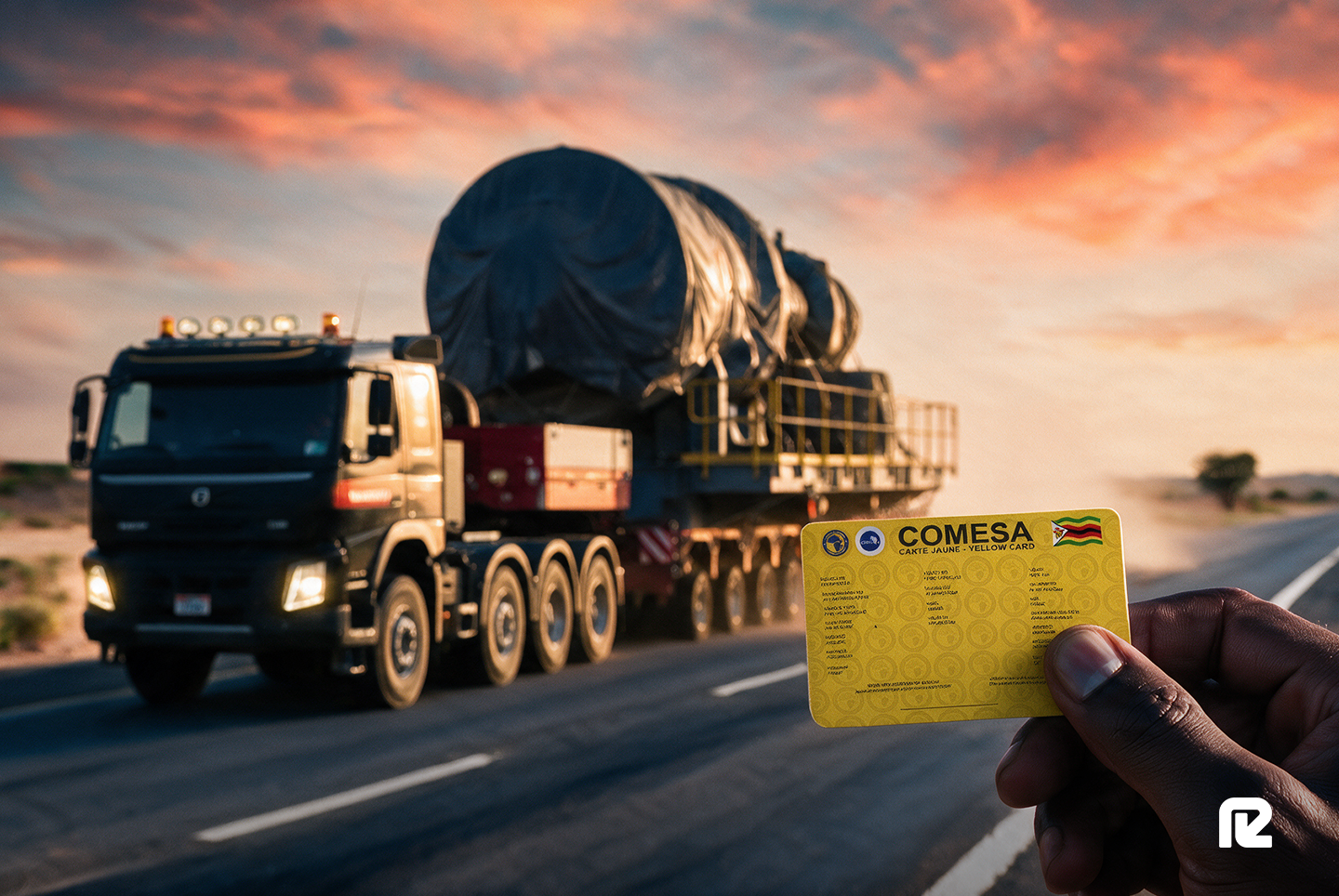

A truck carrying mining consumables from Dar es Salaam to the DRC Copperbelt passes through three countries. Each one requires third-party motor insurance for foreign vehicles.
Without a regional arrangement, the driver would buy a separate local policy at every border post on the route. The Common Market for Eastern and Southern Africa (COMESA) Yellow Card was set up to replace those separate purchases with a single certificate.
In practice, the scheme works well on some routes and unevenly on others. This article explains what the Yellow Card covers, where it is valid, how operators buy and verify it, and what happens when a truck reaches a border without valid cover.
The Yellow Card is a regional third-party motor insurance certificate. It was established under a 1986 protocol signed in Addis Ababa. It allows a vehicle to travel through participating countries on cover bought in its home country.
Operators buy the card from the insurer that already holds the vehicle's domestic third-party or comprehensive policy. The card extends that cover to the countries listed on it, for the period of the planned journey. Each participating country runs a national bureau that issues cards and handles claims for accidents involving visiting vehicles.
The scheme operates at considerable scale. In 2022/2023, it issued more than 308,000 certificates and generated over $17 million in premiums.
The Yellow Card provides two types of cover:
● Third-party legal liability. This pays claims for death, injury, or property damage caused to others by the insured vehicle. Payouts are capped at the statutory limits of the country where the accident happens, so an accident in Zambia and one in Kenya can carry different maximum awards.
● Medical expenses for the vehicle's occupants. The card pays medical costs for the driver and passengers if they are injured in an accident involving the insured vehicle.
Damage to the truck itself sits outside the Yellow Card, as does loss of or damage to the cargo. Cargo is protected through freight insurance, which is arranged separately, either per shipment or under an annual policy.
The COMESA Yellow Card system lists 13 countries that recognize the card: Burundi, Djibouti, the DRC, Eritrea, Ethiopia, Kenya, Malawi, Rwanda, Sudan, Tanzania, Uganda, Zambia, and Zimbabwe. Tanzania takes part as a non-COMESA country. Insurers in South Africa, Mozambique, and South Sudan also issue the card to motorists traveling into the scheme area.
For trucks on Southern and East African corridors, these countries matter most:
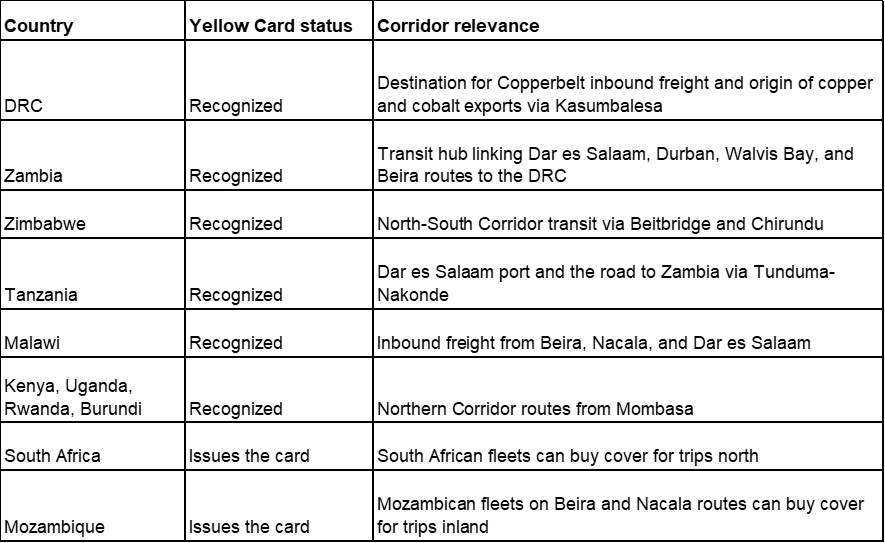
In South Africa and Mozambique, the card serves outbound fleets. A South African operator can buy it for a trip into Zimbabwe or Zambia. Both countries sit off the recognition list, so trucks entering them follow national third-party rules.
Trucks leaving Durban or Walvis Bay start their journeys in countries outside the scheme, and some routes cross a third. Botswana requires non-resident drivers of foreign-registered vehicles to pay for third-party cover on entry, valid for 90 days. Namibia's Motor Vehicle Accident Fund is financed through a fuel levy, and the fund has proposed a separate levy on foreign-registered vehicles.
Most Yellow Card problems start at the planning stage and surface at the border. A few checks before dispatch reduce the risk:
● Match the card to the route. The card lists the countries it covers and its validity dates. Both need to match the planned journey, including the return leg and an allowance for delays at congested crossings.
● Keep the domestic policy current. The Yellow Card extends the vehicle's home policy, so a lapsed domestic policy leaves the card without valid backing.
● Hold local cover for the country of registration. The card applies only outside the country where it was issued, so a Zambian truck still needs Zambian third-party cover at home.
● Use digital verification. Yellow Card operations moved to a digital system in November 2018. A mobile app lets law enforcement confirm a card's validity and lets motorists check the status of their cards. Operators can use it to confirm that a card bought through a broker or agent is registered before the truck leaves the yard. Zimbabwe has added a USSD code, *538#, that police and border officials can use on a basic handset.
Shippers who hand road freight to a transport provider can ask how the provider confirms vehicle insurance for each country on the route. Cargo waits at the border for as long as the truck does.
When a truck arrives without cover recognized by the country it is entering, the driver has to buy a local third-party policy before the vehicle can proceed. The truck waits while the policy is arranged. The operator pays an unplanned cost at every crossing where this happens.
Missing or doubtful cover creates several risks:
● Delay at the crossing. A truck that needs cover bought on arrival joins the same queues already slowed by document checks, inspections, and system downtime.
● Fines and offenses. Botswana's regulations make driving a foreign vehicle without paying for entry cover an offense that carries a fine. Police also check insurance documents inland, and penalty amounts vary by country and change over time. Operators should confirm current requirements for each country before dispatch.
● Detention over suspect documents. A card that officials cannot verify can hold up a vehicle. In 2025, Zimbabwean investigators traced 22 counterfeit Yellow Cards issued to trucks from a Mozambican transport company through the Forbes border post.
● Uninsured liability. A forged card leaves the vehicle uninsured. If the truck is involved in an accident, the owner carries any third-party claims directly.
The Yellow Card has drawn steady criticism from road freight associations. A 2020 Freight News report quoted the Road Freight Association and the Federation of East and Southern African Road Transport Associations on several problems:
● Rates are set by the issuing country, so cover for the same route can cost very different amounts depending on where the truck is registered.
● Some countries have raised concerns about forgery and the card's security features.
● Claims are difficult to get paid, and many operators buy local third-party cover in each country as a result.
COMESA's own figures reflect the claims problem. Between July 2019 and June 2020, the scheme received 967 claims and paid 298.
Parts of that picture have changed since 2020. South African insurers now issue the card, which the 2020 report described as unavailable there. Digitization is the scheme's main response to the remaining problems.
At its 64th Management Committee meeting in Dar es Salaam, delegates discussed harmonized digital systems for sharing claims data and detecting fraud. Zimbabwe's verification code is one example of those systems already in use.
● The Yellow Card extends a vehicle's home third-party policy to the countries listed on it, so the domestic policy needs to stay current.
● It covers third-party liability up to each country's statutory limits, plus medical costs for the driver and passengers. Damage to the truck and its cargo needs separate insurance.
● It is recognized in 13 countries, including the DRC, Zambia, Zimbabwe, Tanzania, and Malawi. South African and Mozambican insurers issue it for journeys into those countries.
● Countries outside the scheme, such as Botswana and Namibia, apply their own charges or levies to foreign vehicles.
● Missing or unverifiable cover means buying local insurance at the border, possible fines, and delays that hold the cargo along with the truck.
● Checking cards through digital verification before dispatch reduces the risk of forged or invalid certificates.