AfCFTA and Customs Reality: What Free Movement of Goods Requires at the Border
October 19, 2026
Read the story
Please submit your details below and one of our logistics experts will reach out within one business day. Thank you.
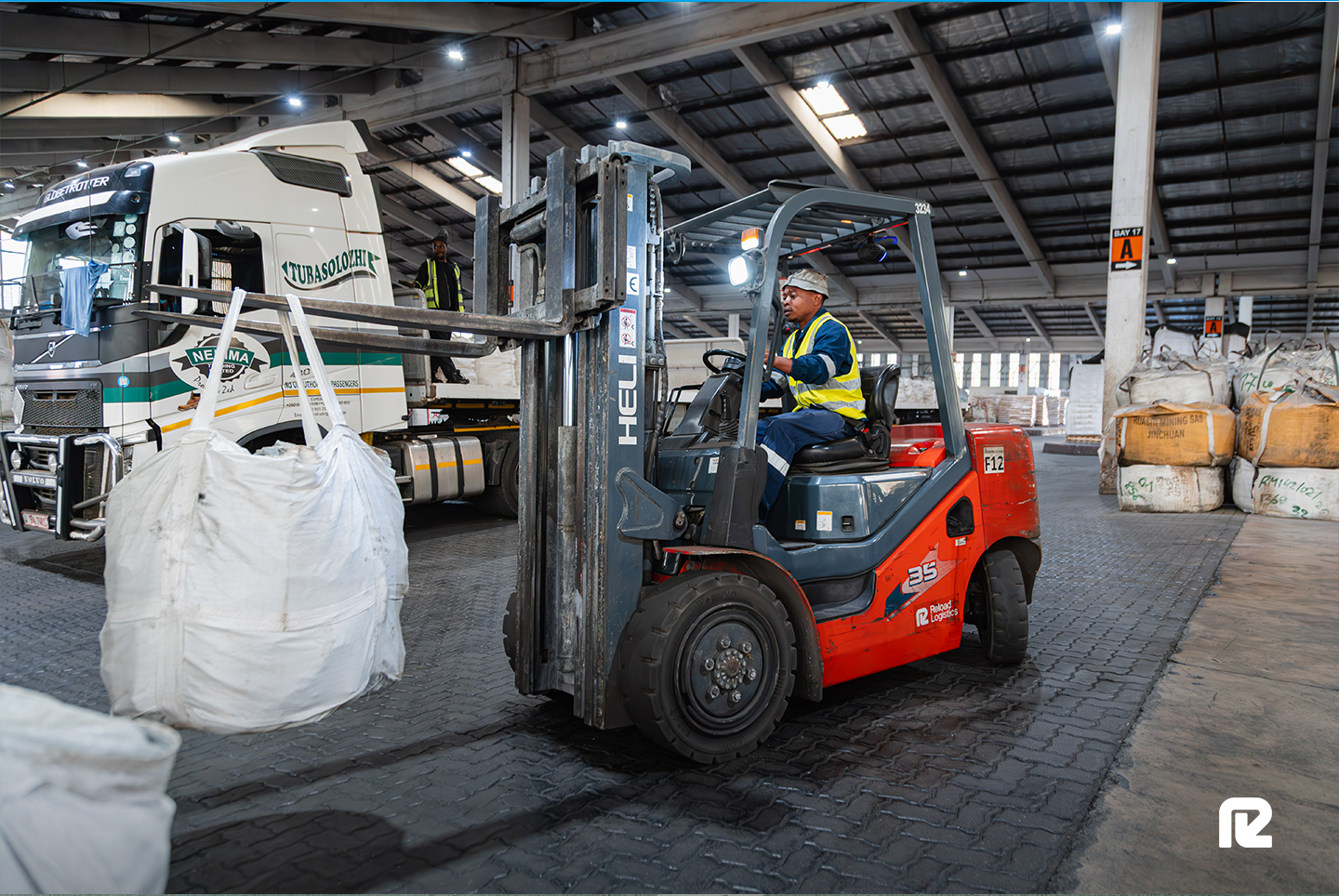

A truck carrying goods between two African Continental Free Trade Area member states still needs a certificate of origin, a customs declaration, and clearance from a national customs administration to cross, the same requirements that existed before the agreement's tariff cuts took effect.
The agreement promises a single market across 54 countries, more than 1.4 billion people and a combined GDP exceeding $3.4 trillion. Its rules of origin negotiations, the legal backbone that decides which goods actually qualify for that market, only won final approval from the AU Assembly in July 2026.
This article covers what AfCFTA actually commits countries to, how duty-free trade currently works through the Guided Trade Initiative, the certificate every shipper needs, and the non-tariff barriers that matter more than tariffs do.
AfCFTA's promises of single market, free movement of goods, and tariffs progressively eliminated, describe the agreement in principle.
What a shipment actually meets at a border depends on which two countries are trading, whether a matched pairing exists between them, and how far each country's own customs and standards agencies have gotten.
This table summarizes some of the key differences.
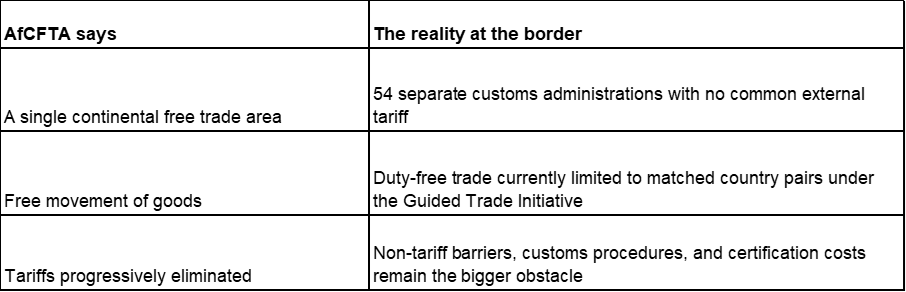
AfCFTA is not a customs union. Member states keep their own customs administrations and don't share a common external tariff toward the rest of the world. What they've committed to is eliminating tariffs on 90 percent of tariff lines, phased over 5 years for most countries and 10 years for least-developed countries.
Non-tariff barrier reduction is a separate commitment, structured through its own part of the agreement. The Protocol on Trade in Goods runs through nine annexes, and three of them, covering non-tariff barriers generally, technical barriers to trade, and sanitary and phytosanitary measures, exist specifically because tariff elimination alone doesn't resolve how goods actually get inspected, certified, and cleared.
Tariff elimination and border-procedure simplification are two different processes with two different sets of institutions behind them, and assuming progress on one means progress on the other is the most common misreading of what the agreement actually does.
AfCFTA builds on top of existing regional agreements rather than replacing them. SADC and COMESA preferential tariff schemes continue operating alongside it, and for a trade lane already covered by one of those, using the established regional agreement can still be the more reliable path than AfCFTA, which remains mid-rollout in comparison.
Duty-free trade under AfCFTA starts through the Guided Trade Initiative, which launched in October 2022 with eight pilot countries, Cameroon, Egypt, Ghana, Kenya, Mauritius, Rwanda, Tanzania, and Tunisia, trading an initial 96 products. The mechanism only connects specific country pairs that have both published approved tariff offers and met the agreement's requirements.
The pilot's product list was specific rather than sweeping: ceramic tiles, batteries, tea, coffee, processed meat, corn starch, sugar, pasta, glucose syrup, dried fruit, and sisal fiber among them.
Rwanda shipped the first consignment under the initiative, a load of coffee to Ghana, in September 2022. The process behind that shipment is the template a shipper still follows today: an exporter applies for a Certificate of Origin from their national Customs Service Department, attaching an invoice and packing list, and the department evaluates the application before issuing the certificate.
That list of participating countries has grown substantially since. 24 additional countries were set to join in 2024 alone, out of 47 that had ratified the agreement at that point, and current implementation reporting now covers South Africa among the countries actively trading under GTI terms.
For a Southern African shipper, that matters directly: which two countries are trading determines whether AfCFTA terms apply today.
A Certificate of Origin, issued by a Designated Competent Authority in the exporting country, is what lets a shipment claim AfCFTA's preferential tariff treatment.
For shipments valued under $5,000, a self-issued origin declaration is sufficient instead, a genuine shortcut for smaller consignments. As of March 2026, more than 12,000 certificates of origin had been issued and notified to the AfCFTA Secretariat, a real, if still modest, scale of actual usage relative to the volume of trade the agreement is meant to eventually cover.
Rules of origin negotiations, while approved in July 2026, still leave gaps in specific sectors, including textiles, processed foods, and some industrial products. A product in one of those categories can't qualify for preferential treatment yet, regardless of whether the two trading countries have a GTI pairing in place.
Tariff elimination receives most of the attention, but customs procedures, border documentation, and standards compliance are what actually slow a shipment down.
One regional trade official put a number on it directly: almost 70 percent of reported non-tariff barriers in the region consist of technical barriers to trade and sanitary and phytosanitary measures, not customs delays in the ordinary sense.
Those barriers tend to fall into three categories.
● Legal frameworks for standards and inspection aren't harmonized across countries, so a product accepted in one market can be rejected in another for reasons that have nothing to do with quality.
● Institutional capacity is uneven, with inconsistent technical expertise and inspection capacity from one country's border agency to the next.
● Infrastructure, storage, laboratories, testing facilities, is often the actual bottleneck behind a rejected shipment, whatever the regulation is trying to achieve.
Ghana's government began developing national frameworks for exactly this reason in 2025, aiming to cut the export rejections its own agricultural exporters were facing.
The cost lands on individual traders. One small exporter described paying $300 just to obtain a certificate proving a product meets destination-country standards, a cost with nothing to do with tariffs at all.
A Mutual Recognition Agreement, which would let certificates and conformity assessments issued in one country be accepted in another, has been approved at the technical level by AfCFTA's Technical Barriers to Trade Committee. It isn't fully implemented yet, so a certificate obtained in one country still can't be assumed to satisfy another's requirements, a pattern that shows up elsewhere in AfCFTA's non-tariff work too: reforms reaching technical-level approval and then sitting there while the institutions needed to actually operate them get built out.
● Confirm both countries have a matched GTI pairing before assuming preferential tariff treatment applies. The agreement's existence doesn't guarantee it for any specific trade lane.
● Check whether the product's category has finalized rules of origin. Textiles, processed foods, and some industrial goods remain unresolved, so confirming this before shipping avoids a shipment that can't qualify no matter how correctly the paperwork is filed.
● Use the $5,000 threshold correctly. Below it, a self-issued declaration replaces the full Certificate of Origin process, a genuine time saver for smaller shipments.
● Budget certification costs separately from tariff savings. A standards or conformity certificate can cost hundreds of dollars on its own, and that cost doesn't disappear just because a tariff does.
● Don't assume a certificate from one country satisfies another's requirements. The Mutual Recognition Agreement that would guarantee this is approved in principle but not yet operating.
● Agricultural and food exporters carry an extra layer of risk. Sanitary and phytosanitary requirements vary by destination country, and harmonization work here is still behind the tariff timeline. Confirming a specific market's standards before shipping avoids a rejection that has nothing to do with tariffs or rules of origin at all.
● Expect a border procedure regardless. AfCFTA isn't a customs union, so each country's own customs administration still processes every shipment, tariff preference or not.
● Check whether SADC or COMESA already covers the trade lane. Those agreements are more established than AfCFTA's current rollout, and where one already applies, it may offer more certainty than switching to AfCFTA terms that are still being finalized.
That border procedure still runs through the same customs bond and transit arrangements that applied before AfCFTA's tariff cuts. A preferential rate changes what a shipment owes at the border, but the clearance process around it stays the same.