AfCFTA and Customs Reality: What Free Movement of Goods Requires at the Border
October 19, 2026
Read the story
Please submit your details below and one of our logistics experts will reach out within one business day. Thank you.
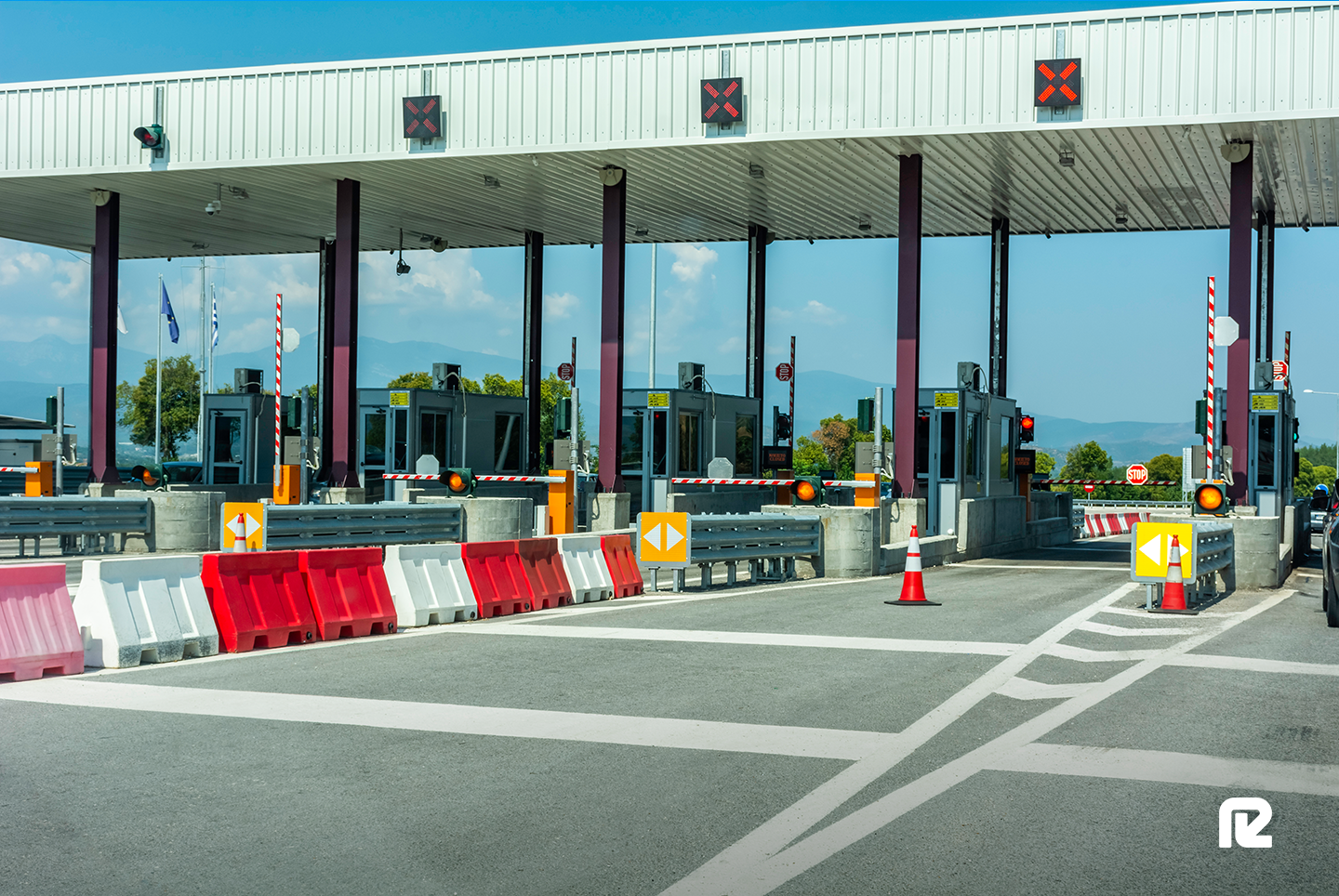

A truck hauling copper cathodes between Kolwezi in the Democratic Republic of Congo (DRC) and the port of Dar es Salaam pays road charges in three countries.
Each country sets its charges in its own currency and revises them on its own schedule. Tanzania charges foreign trucks by distance. Zambia charges at each toll plaza, and the DRC collects concession tolls that are among the highest in the region.
On a single trip, these charges can reach several hundred dollars before fuel, driver costs or border fees are counted. They are collected at plazas, border posts and permit offices along the route, which makes them easy to underestimate in a quote.
When a toll rises mid-contract, or a charge is paid in a different currency from the freight invoice, the gap lands on the cargo owner's margin in the same way as unplanned demurrage and detention.
This article explains the main types of road user charges on Southern African corridors and how they differ by country. It then shows how they add up on a long-haul route between Dar es Salaam and the DRC Copperbelt.
Road user charges in the region take several forms, and one trip usually involves more than one of them.
● Toll fees are paid per passage and priced by vehicle class, usually based on axle count. Most main trunk roads in South Africa, Zimbabwe, Zambia and Mozambique use this model.
● Distance-based transit charges are calculated per 100 km traveled. Tanzania's transit charges law sets $16 per 100 km for heavy foreign vehicles. Namibia levies Mass Distance Charges on heavy vehicles based on weight and distance.
● Entry or cross-border charges are flat fees paid each time a foreign-registered vehicle enters a country. In Namibia, a truck tractor with four or more axles pays N$2,548 per entry, and trailers are charged separately.
● Bridge and border access tolls apply at specific crossings. At Beitbridge, the border concessionaire charges goods vehicles $213 following its February 2025 adjustment.
● Reciprocal charges target trucks from a specific country in response to that country's own charges. Zambia has charged DRC-registered trucks a $1,000 transit fee since 2021 in response to DRC toll levels.
The charges that apply depend on where a truck is registered as well as where it travels. A Zambian-registered truck pays domestic toll rates in Zambia and foreign-vehicle charges in every other country on its route.
Rates and structures vary widely between neighboring countries, and several changed during the past year.
Tanzania charges foreign-registered trucks under its Foreign Vehicles Transit Charges Act. The Act sets $16 per 100 km for heavy vehicles, payable at the point of entry. The rate has shifted through regional negotiation before.
In 2021, Tanzania moved to a $152 flat rate during a dispute with Rwanda over transit fees. Operators on the Tunduma route should confirm the rate being applied at entry before quoting.
Zambia's National Road Fund Agency (NRFA) operates toll plazas across the trunk road network. Heavy vehicle tolls rose on January 1, 2026, and a heavy articulated truck with four or more axles now pays K300 at standard plazas.
The Michael Chilufya Sata plaza on the T3 between Ndola and Kitwe charges more. The same truck pays K600 there. The T3 is the main road toward the Kasumbalesa border post, so DRC-bound traffic from the Great North Road passes through this plaza.
The DRC has the highest road tolls in the region. On the roughly 410 km between the Kasumbalesa border post and Kolwezi, tolls are reported at around $900. Reports differ on whether this figure covers one way or the round trip.
The tolls are collected under a road concession, so operators budget from reported figures. The Southern African Development Community (SADC) benchmark averages about $10 per 100 km, which would put the same stretch under $50.
The South African National Roads Agency (SANRAL) and the private concessionaires adjust toll tariffs each March in line with inflation.
The 2026 adjustment was 3.12%, published in the Government Gazette on February 5. A Class 4 truck, the category for heavy vehicles with five or more axles, pays R324 at the Mooi mainline plaza on the N3 between Johannesburg and Durban.
The Zimbabwe National Road Administration (ZINARA) collects tolls at plazas across the national network. Bridge tolls and the Beitbridge access toll are charged separately.
In July 2026, the government removed the Road Access Fee through Statutory Instrument 113 of 2026 and described it as duplicative of the national toll system. Under the previous arrangement, haulage trucks entering at Beitbridge paid a $27.50 bridge toll plus coupons calculated on distance traveled.
On the N6 between Beira and the Machipanda border post, the road operator Rede Viária de Moçambique (REVIMO) runs three toll plazas. A Class 4 truck pays 300 meticais at Dondo, 880 at Nhamatanda and 1,100 at Chimoio. That totals 2,280 meticais each way.
Namibia combines a flat entry fee with a distance charge. Foreign trucks pay the Cross-Border Charge on every entry. They also pay Mass Distance Charges based on weight and distance traveled inside the country, and the Road Fund Administration sets both.
The table below shows the road charges a Zambian-registered heavy articulated truck would pay on a one-way run between the port of Dar es Salaam and Kolwezi, at the rates above. It covers road charges only. Border clearance fees, transit bonds, permits, insurance and fuel sit outside it.
The Tanzanian leg runs about 925 km between the port and the Tunduma border post.
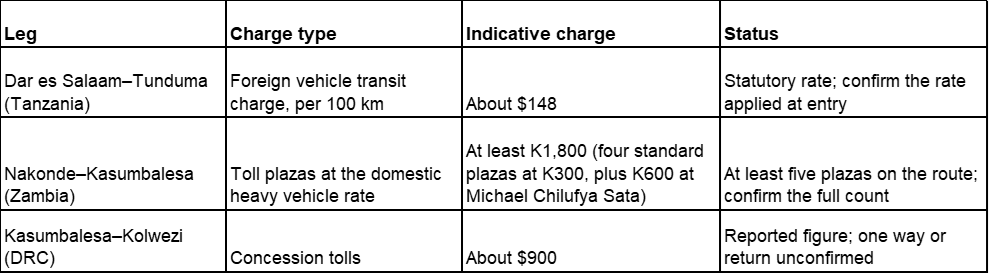
The DRC leg is the shortest and the most expensive. At the reported figure, it costs roughly 7 to 14 times as much per kilometer as the Tanzanian leg. The multiple depends on whether the $900 covers one way or the round trip.
The charges are paid in two currencies across three countries. Tanzania sets its charge in US dollars, Zambia tolls in kwacha, and the DRC in dollars. A quote that converts every charge at one date's exchange rate will drift as the kwacha moves.
Zambian and DRC toll points charge per passage in each direction, so the return leg doubles that part of the bill, whether the truck runs loaded or empty.
The picture changes with the truck's registration. The Tanzanian transit charge applies only to foreign vehicles, so a Tanzanian-registered truck is exempt from it and pays foreign-vehicle charges in Zambia. A DRC-registered truck pays Zambia's $1,000 reciprocal transit fee. That single fee is larger than the Tanzanian and Zambian road charges in the table combined.
Rates change on different schedules. South Africa adjusts tolls every March, and Zambia raised heavy vehicle tolls through its January 2026 budget measures. Zimbabwe removed a border fee in July 2026. Tanzania's rate has moved through regional negotiation. A rate agreed in one quarter can be out of date by the next.
Payment adds its own cost. Charges are collected in several currencies, often in cash or through prepaid accounts. To keep drivers from carrying large sums, operators on the Kolwezi–Kasumbalesa road increasingly prepay tolls through banks. Cash handling and prepayment arrangements rarely appear as separate lines on a quote.
Toll points also add time. The same report found more than 200 semi-trailers waiting at the Kanyaka toll, halfway between Lubumbashi and the Zambian border. Each day a loaded truck spends in a queue extends the transit time the cargo owner is paying for. On imports, it also pushes back the date containers are returned and warehouse space is released.
Many trucking quotes fold road charges into an all-in rate. That keeps the invoice simple, but it hides whether a rate increase comes from a toll change or from something else, such as the surcharges carriers apply for fuel or congestion.
Where one provider runs cross-border transport across every border on a route, the road charges for each country sit in one trip costing. That provider can then reprice when any country on the route changes its rates.
● Ask for itemized road charges. Request a breakdown by country and charge type, even when the final price is all-in, so you can trace rate changes.
● Confirm the currency and effective date. Check which currency each charge is quoted in and when the rate took effect. This matters most for Zambia, South Africa and Zimbabwe, which all changed charges in 2026.
● Match the axle class. Tolls are priced by vehicle class, and an extra axle or an abnormal load moves a truck into a higher band. In Zambia, an abnormal load vehicle pays K1,000 at standard plazas.
● Check the vehicle's registration. Registration decides which transit, entry and reciprocal charges apply on the route.
● Include the return leg. Per-passage tolls apply in both directions, and an empty return still pays them.
● Hold a buffer for rate changes. A contract longer than a year will span at least one annual toll review in most countries on a Southern African route.
● Compare rail on the longest legs. Rail removes per-passage road tolls on the section it covers, which can cut total road charges on a long corridor. Our guide to multimodal freight covers the tradeoffs.
● Road user charges in Southern Africa include toll plaza fees, distance-based transit charges, entry fees and border access tolls, and a single trip usually involves several of them.
● On the Dar es Salaam–Kolwezi route, the DRC leg costs the most per kilometer by a wide margin.
● Each country revises its charges on its own schedule, and Zambia, South Africa and Zimbabwe all made changes in 2026.
● A truck's registration decides which charges apply, and reciprocal fees can outweigh every other road charge on the route.
● Itemized quotes, current rates and a buffer for annual reviews make road charges easier to budget.