Kazungula Bridge: What It Means for Zambia-Bound Freight
September 15, 2026
Read the story
Please submit your details below and one of our logistics experts will reach out within one business day. Thank you.
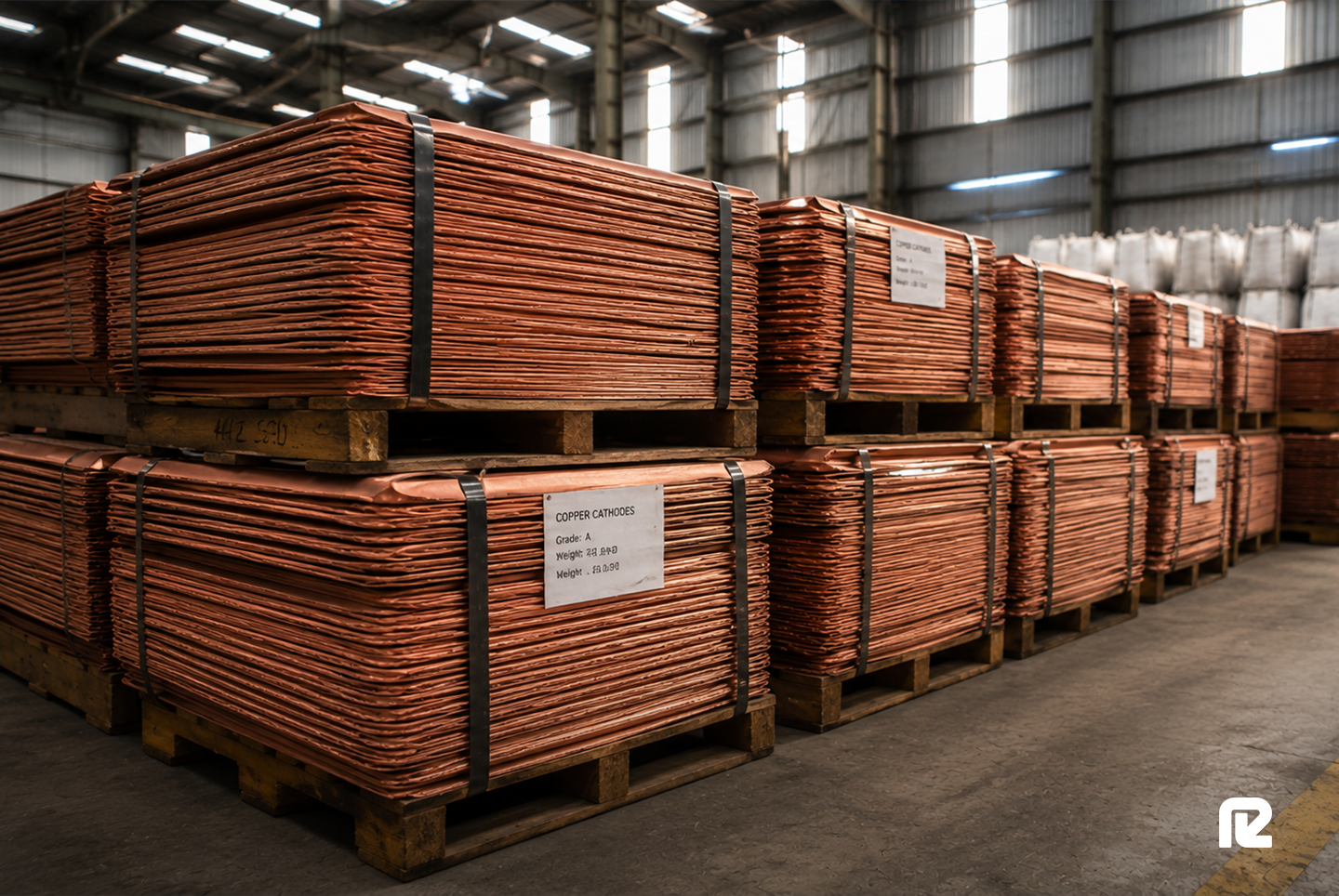

Copper cathode storage requires more than covered warehouse space. Cathode is dense, high-value, and unforgiving of poor handling, so even a small error in storage, counting, or security can create a costly loss.
This guide explains the main warehouse requirements for copper cathodes, the most common causes of loss, and the checks traders, producers, lenders, and logistics teams should make before placing high-value metal stock into storage.
Copper cathodes are cast as flat rectangular sheets and bundled into strapped units for handling and transport. Each bundle carries significant weight in a small footprint, which shapes almost every physical requirement a warehouse needs to meet.
A suitable copper cathode warehouse should meet four basic requirements: strong floors, dry covered storage, stable stacking limits, and handling equipment rated for dense metal bundles. Floors must withstand concentrated point loads from stacked cathode and repeated forklift movement. Storage areas must remain dry because moisture can lead to surface oxidation and reduce the cathode’s saleable condition.
Stacking limits should reflect bundle weight and stability, not just available floor space. Handling equipment also needs the right attachments and rated capacity, because standard pallet handling gear is not always suitable for material this dense.
None of these requirements are unusual on their own. What makes cathode storage demanding is that all of them need to hold consistently, bundle after bundle, without the shortcuts that lower-value cargo can sometimes tolerate.
"Dry and covered" means something different depending on where the warehouse sits. A facility in the drier interior of South Africa faces a different moisture load than one near Beira, Dar es Salaam, or Walvis Bay, where humidity and coastal air bring a higher risk of surface oxidation.
A warehouse may be leak-free and still unsuitable if humid air moves freely through the building. Roofing, wall seals, ventilation, and condensation control all matter, particularly during wet seasons or overnight temperature swings. For longer storage periods, some facilities use dehumidification to reduce the risk of surface staining before inspection.
Floor design plays a role too. A concrete floor that draws moisture up from the ground beneath it can create localized humidity at the base of a stack even when the wider building stays dry, which is why floor construction and damp-proofing matter as much as roofing when a facility is being assessed for cathode storage.
The practical test is straightforward: a warehouse built for general cargo in a coastal, humid location is not automatically suitable for cathode without additional climate controls, even if it meets every other physical requirement covered above.
Cathode's value density — high worth in a compact, easily moved form — makes it a target in a way that bulkier or lower-value cargo generally is not. A warehouse holding cathode needs security measures built around that specific risk.
Effective security for copper cathode storage should go beyond perimeter fencing. Access control should limit who can physically reach cathode stock, with logged entry rather than open floor access. CCTV should cover loading bays, storage racks, weighbridges, and other points where cathode is moved, counted, or transferred.
Seals and tags applied at origin need to be checked and recorded on arrival and again before dispatch, since a broken or missing seal is often the first sign that something has gone wrong.
Loss in cathode storage tends to happen in a small number of predictable areas, which is exactly why prevention is possible.
Theft, substitution, weight discrepancies, handling damage, and documentation gaps are the main loss risks in cathode storage. These risks are easier to prevent when access is controlled, every movement is logged, and discrepancies are investigated instead of treated as normal variance.
Poor handling or unstable stacking can reduce the value of cathode that is still physically present. Documentation gaps create a different problem: they allow missing signatures, unrecorded movements, or unreconciled counts to go unnoticed until a full stock take finally exposes the difference.
Physical security keeps unauthorized people away from cathode stock. Staff controls address a different risk: the possibility that loss happens through, or with the knowledge of, someone who has legitimate access.
Segregation of duties is the core control. The person who counts and weighs cathode on intake or dispatch should not be the same person who records that count in the system. This creates a second check before any error or deliberate misstatement becomes part of the permanent stock record.
High-value or high-volume movements should also require a second sign-off, so no single person can authorize a stock movement independently.
Training matters beyond the obvious safety requirements. Staff handling cathode need to understand why seals, documentation, and reconciliation procedures exist, not just that they are required, since a team that treats a procedure as a formality is more likely to skip it under time pressure. Rotating staff through different points in the storage and dispatch process also reduces the risk that a gap in the system goes unnoticed simply because the same person has managed that step, unchecked, for years.
None of these controls assumes dishonesty on the part of any individual. They exist because a system that depends on one person's judgment, with no second check, is a system with a single point of failure.
Weighing and counting on intake gives a warehouse its baseline. Every bundle needs its weight and count recorded against the accompanying documentation before it is accepted into store, and any discrepancy at that point needs to be resolved before the stock is signed for, not after.
Condition should be recorded at the same time, since a bundle that arrives with surface damage or a compromised seal needs to be noted immediately, both to protect the warehouse from a later dispute and to flag stock that may need separate handling.
Physical stock needs to reconcile against the paper record on a regular cycle, not only at year-end. For cathode held as collateral against trade finance, that reconciliation is not a formality. A lender relying on a warehouse receipt as security needs confidence that the stock behind it actually exists in the quantity and condition recorded, and a warehouse that cannot demonstrate consistent reconciliation puts that financing arrangement at risk.
Bonded storage is often important for copper cathodes moving into export channels. Under bond, cathode remains under customs control, and import duties are not payable until it leaves the facility. This is especially useful when metal may move between jurisdictions before its final destination is confirmed.
Bonded warehouse status also gives a clear, auditable chain of custody from the point the cathode enters the warehouse to the point it leaves, which supports both customs compliance and the verification a collateral manager or lender needs.
Before choosing a copper cathode warehouse, check the facility’s infrastructure, security, insurance, verification procedures, and location. These checks are essential before the first bundle arrives.
Security accreditation and insurance cover for the value of metal stock held should be confirmed, not assumed. Weighing and verification procedures need to be clear and consistently applied, since inconsistent counting practices are where discrepancies start.
Facilities aligned with recognized industry standards, including the contract and warrant specifications set by the London Metal Exchange for LME-registered cathode, give both traders and lenders a reference point for what proper handling and documentation should look like. Proximity to port or border reduces the handling steps between production, storage, and export, and each additional handling step is another point where damage or a count error can occur.
For traders, producers, lenders, and logistics teams, the right warehousing partner protects more than the metal itself. It protects the value, documentation, chain of custody, and financing arrangements that depend on accurate copper cathode storage.