Moving Copper Concentrate: Bulk, Bags, or Containers?
November 6, 2026
Read the story
Please submit your details below and one of our logistics experts will reach out within one business day. Thank you.

Copper concentrate exported from the Copperbelt travels in one of three formats: loose bulk, bulk bags, or containers. Each format has different implications for moisture control, cargo losses, and cost, and the choice made at the mine shapes every handover that follows.
When Kamoa-Kakula began exporting concentrate in 2021, it bagged the product at the mine. Each bag was weighed, sampled, and sealed in front of DRC customs officers before the trucks left for Durban.
This article explains why the handling format matters for concentrate, compares the three options on moisture, loss control, and cost, and sets out what to weigh when choosing between them.
Copper concentrate is a fine, damp powder produced by crushing, milling, and flotation. It still needs smelting and refining, and its chemistry varies from mine to mine. Buyers pay based on the copper content, so the concentrate’s condition at each transfer has a direct impact on its value.
Moisture. Under the International Maritime Solid Bulk Cargoes (IMSBC) Code, copper concentrate shipped in bulk is a Group A cargo: ship motion can turn a damp load into a slurry that shifts in the hold. Before loading, the shipper must give the master a signed certificate of the transportable moisture limit (TML) and a moisture declaration, and the cargo’s moisture content must sit below the TML.
Classification. The International Copper Association estimates that around 85% of copper concentrates fall outside the IMO’s “harmful to the marine environment” category, and some lots are declared UN 3077, Class 9. A classified lot needs hazmat-compliant trucks and must follow the rules for shipping dangerous goods by sea. The supplier’s assay and safety data sheet confirm the status of each lot.
Weight. Payment rests on wet mass, moisture content, and assay. Every change of format adds a point where concentrate can be spilled, stolen, or wetted, and where the recorded weight can drift.
In a bulk chain, concentrate moves by enclosed tipper or rail wagon to a port stockpile, then onto a bulk carrier via a shiploader.
Moisture. The TML applies in full. Rain at inland yards and port stockpiles is the main risk, so covered storage at both ends of the road leg protects the moisture result. Insurers also advise against loading in rain and recommend testing within seven days of loading.
Loss control. Each transfer creates dust and spillage, and wet concentrate sticks in tipper bodies. Bulk loads are also the easiest to substitute on the road: Copperbelt investigators have reported drivers swapping high-grade loads for low-grade ore or earth. A substituted load can match the original weight, so weighbridge checks need assays behind them.
Cost drivers. Bulk has no packaging cost and is the fastest to load, but it needs a bulk berth, covered port storage, and dedicated trailers. Return loads help reduce costs; for example, combination trailers can bring sulphuric acid back from the smelter.
Concentrate is packed at a bagging plant at or near the mine, usually in bags holding one to two tonnes, and loaded onto flatdeck trucks. At the port, the bags are shipped as breakbulk cargo or stuffed into containers.
Moisture. A bag shields concentrate from rain on the road and in yards. Woven polypropylene degrades under long exposure to sun, so bags still need covered storage when waits run long. Bagged cargo also falls under a different set of shipping rules. The IMSBC Code governs solid cargo loaded directly into a ship's cargo spaces without intermediate packaging, while packaged dangerous goods fall under the IMDG Code. Moisture still matters commercially, because the sales contract sets a moisture limit and the buyer pays on dry weight.
Loss control. Each bag is a unit that can be counted, weighed, sampled, and sealed. This provides a simple check at every handover, and a shortfall can be traced to a specific bag and leg of the journey. The weak points are physical: forklift tines can puncture bags, lifting loops can tear, and a single bag is easy to remove from a truck. Seal checks and bag counts at each transfer address most of these risks.
Cost drivers. Bags add packaging costs per tonne, as well as the costs of a bagging plant, labour, and slower loading. Export bags are usually single-trip, while reusable bags suit short local runs to a smelter. Bag supplies need to be planned alongside production, since dispatch stops when bags run out.
Containers carry concentrate in three ways: bags stuffed into a standard box, loose concentrate poured into a sealed liner inside a box, or rotating containers that a port crane tips directly into a bulk carrier's hold.
Moisture. A closed box keeps rain off for the whole road leg, and no open stockpile sits between the truck and the vessel. The risk inside the box is condensation. Temperature swings cause “container rain”, and an estimated 10% of containerised traffic experiences moisture-related problems. Dry loading conditions, sound door seals, and liners reduce the risk. Concentrate tipped from a rotating container into a hold becomes bulk cargo at that point, so the TML certificate and moisture declaration apply as they would for any bulk shipment.
Loss control. Concentrate stays enclosed until discharge, which removes most spillage at transfers, and the seal provides evidence of tampering. Seals can still be defeated. Containers of copper cathode shipped through Beira in 2020 reached China filled with sand of a similar weight. A concentrate substitution of the same kind would pass a weight check, so sampling and assay at loading and discharge are the controls that catch it. Recording seal numbers and inspecting doors and side panels at each handover adds a further check.
Cost drivers. Containers need a supply of boxes inland and a plan for returning empties, which adds cost on long corridors with uneven trade flows. Concentrate is dense, so a box reaches its weight limit with space to spare, and axle limits on the road leg can restrict the payload to below the container's rating. Rotating containers avoid the cost of building a bulk export terminal. One mine in Eritrea built its system for about a third of the cost of a dedicated bulk port. The trade-offs are the need for a fleet of specialised boxes and a port crane fitted with a tipping attachment.
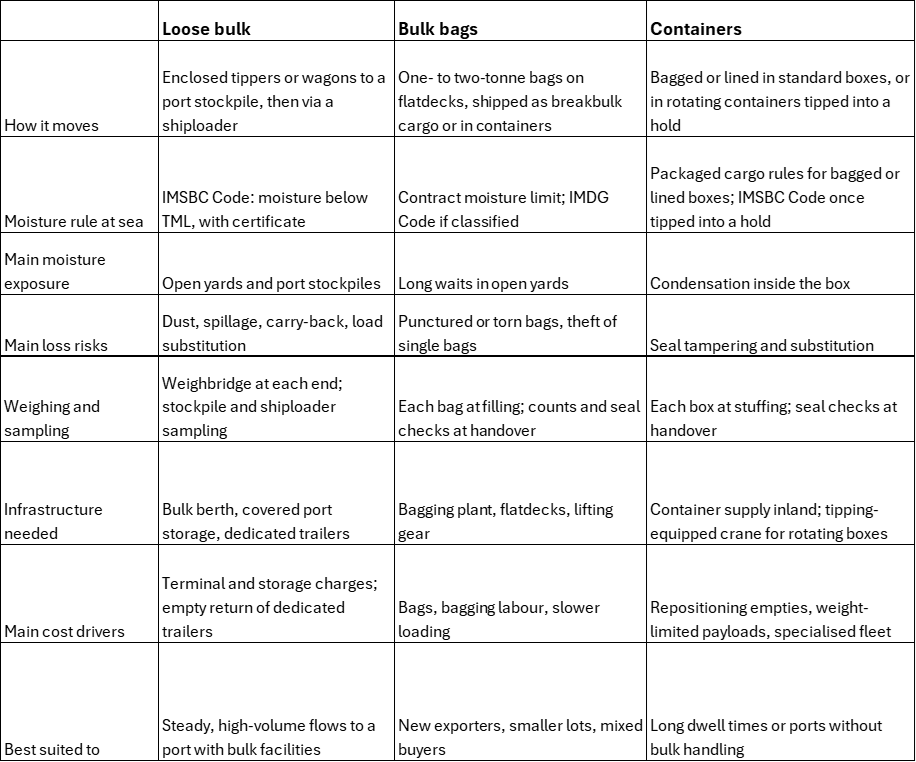
The table below sets the three formats side by side. Use it to check which one fits your port, contract terms, and route before booking transport.
The export port sets the first limit. A bulk chain depends on a bulk berth and covered storage at the port, while rotating containers depend on a terminal with tipping equipment. Check what both the intended port and a fallback port can handle before committing to a format.
The sales contract sets the second. Where a buyer takes delivery at the mine under FCA terms, the buyer's freight plan may already fix the format. Moisture limits, weighing points, and the agreed sampling method all belong in the contract, and each one depends on how the concentrate will move.
Season and dwell time come next. Border queues and port waits in the rainy season leave cargo standing for days. Sealed formats protect moisture results through those waits, and bulk chains need covered storage at every point where loads stop.
Every change of format adds a transfer. Bagging at an inland depot or stuffing bags into containers at the port creates a handover that needs its own weighing, sampling, and seal record. Shippers who entrust covered warehousing, bagging, container stuffing, and transport to one operator keep a single weight and moisture record for each lot through every format change.
The right format depends on the export port, the sales contract, and how long cargo will wait along the route. Bulk needs bulk berths and covered port storage, and rotating containers need tipping equipment at the terminal. Bags fit almost any port, but they add packaging and loading costs.
Moisture rules also change with the format. The TML governs concentrate shipped in bulk. Bagged cargo is subject to the moisture limit in the sales contract and, if the lot is classified, to the IMDG Code. Each lot’s assay and safety data sheet confirm its classification, which determines the road equipment and documents needed before booking.
Loss control rests on a few checks at every handover:
● Sample as well as weigh. A substituted load can match the original weight, and assays at loading and discharge will show the difference.
● Record seals and counts. Seal numbers, bag counts, and physical inspections show that a load arrived intact.
● Cover cargo during waits. Covered storage and sealed formats protect moisture results when border or port delays hold cargo for days in the rainy season.