Lebombo Border Post: What’s Holding Up Trucks on the Maputo Corridor?
October 26, 2026
Read the story
Please submit your details below and one of our logistics experts will reach out within one business day. Thank you.
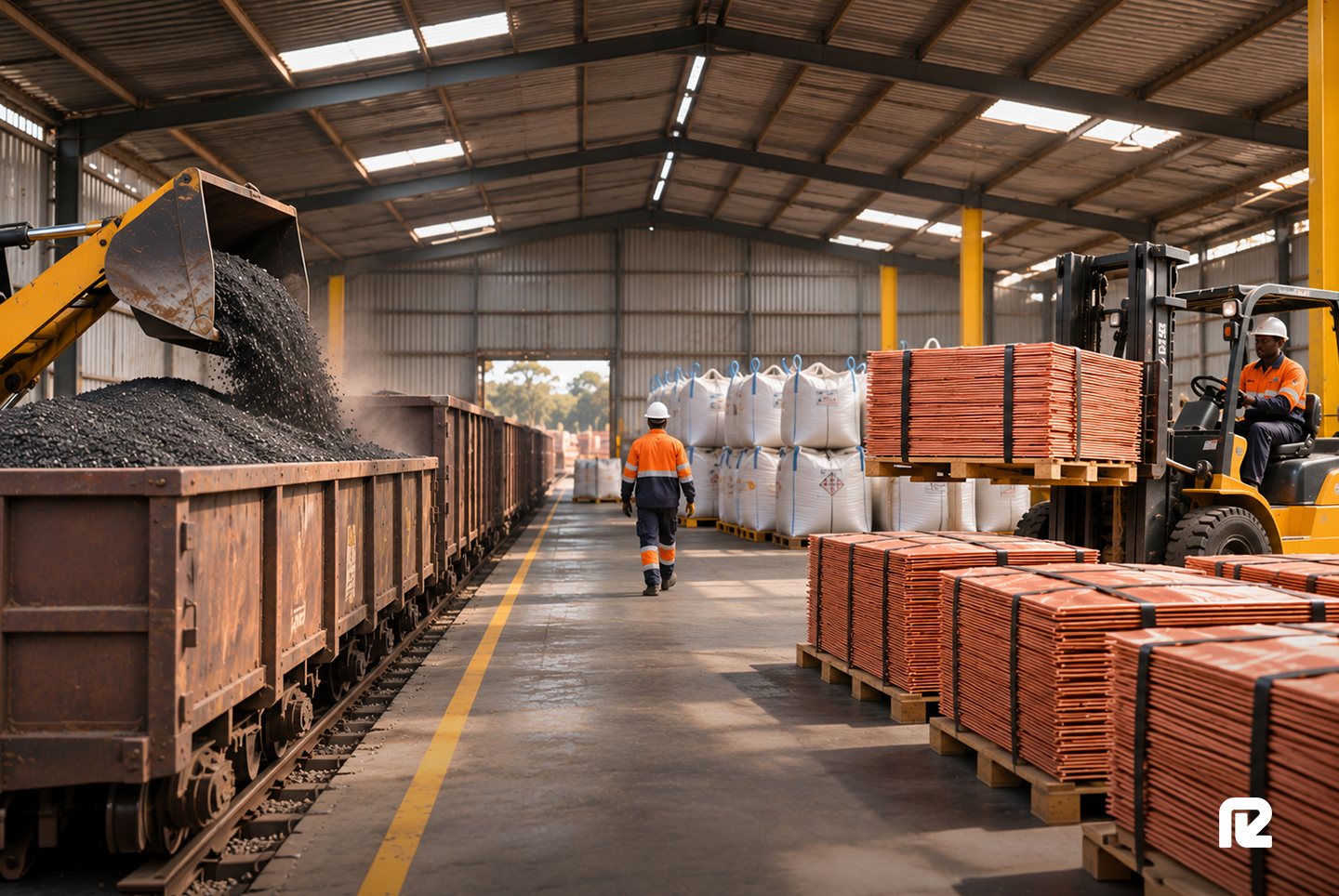

On the Copperbelt corridors, copper usually means cathode: refined metal strapped in bundles and loaded on a flat deck. Concentrate is a damp mineral powder with its own hazard checks, moisture rules, export duties and paperwork. Equipment and documents prepared for cathode will fall short when the cargo is concentrate.
In 2026, extended smelter outages in Zambia left miners holding concentrate they would normally have refined locally. The government suspended its export duty on concentrate to help clear the stockpiles, which put more of it on export routes usually dominated by cathode.
In this article, we’ll compare cathode and concentrate side by side, then look at the hazard checks, moisture limits, vessel documents and export rules that apply to concentrate, and what the 2026 outages mean for shippers planning ahead.
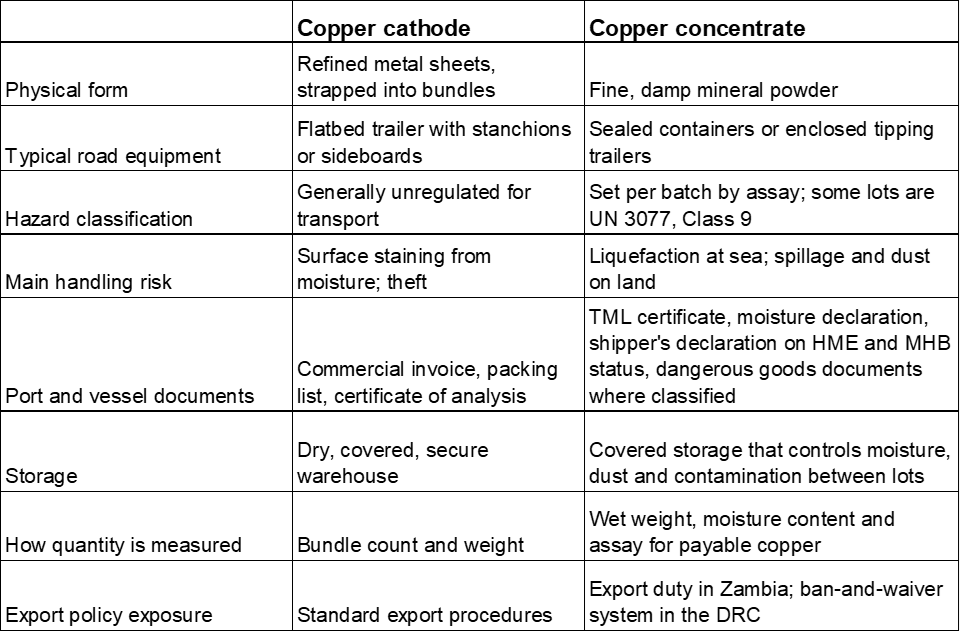
Copper cathode is refined metal. It comes out of a refinery or an SX-EW (solvent extraction and electrowinning) plant as flat sheets, which are strapped into bundles for handling. Each bundle is dense, uniform and easy to count, and the same bundle behaves the same way in any truck, warehouse or ship hold.
Copper concentrate is the fine, damp powder a mine produce by crushing, milling and floating ore to separate copper-bearing minerals from waste rock, and it still must be smelted and refined into metal.
Because concentrate’s moisture content and chemistry vary, each lot must be tested before it moves. Those test results decide how it is classified, which trucks can carry it, and what documents the vessel will need.
Experience with cathode alone is not enough to manage concentrate classification and moisture control.
Cathode has a settled hazard profile. Producer safety data sheets list it as unregulated for transport, so the same truck and document set work load after load.
Concentrate is classified batch by batch, because its composition and mineralogy vary so widely. The International Copper Association estimates that around 85% of copper concentrates worldwide fall outside the IMO's "harmful to the marine environment" (HME) category. The rest meet the HME criteria, and some are declared as UN 3077, Class 9 environmentally hazardous substances.
On land, a concentrate classed as dangerous goods needs a carrier, vehicle and driver that meet hazmat requirements, plus the right placarding and transport documents. Trucking operators on the Copperbelt advise against standard open tippers for concentrate and use sealed containers or enclosed tipping trailers instead.
The practical rule is to get the classification before the booking. A supplier's assay and safety data sheet should state:
● whether the material is classified as dangerous goods, and under which UN number
● whether it is declared HME
● whether it is declared MHB (materials hazardous only in bulk)
Each mine's concentrate needs its own classification, even when the product name on the paperwork is identical.
Copper concentrates shipped in bulk are Group A cargoes under the IMSBC Code, meaning they can liquefy if their moisture content is too high. Vibration and ship motion can turn a damp, apparently solid cargo into a slurry that shifts in the hold and destabilizes the vessel.
The control point is the transportable moisture limit (TML). Under IMO rules, the shipper must give the master a signed TML certificate and a signed declaration of the cargo's moisture content before loading. The moisture content must sit below the TML, and a master can refuse concentrate that arrives without these documents or above the limit.
Where a concentrate is also classified, the wider rules for shipping dangerous goods by sea apply on top of the IMSBC requirements.
Inland handling is also part of the marine risk, as concentrate that sits uncovered at a rail siding, border yard or port stack during the rainy season can absorb enough water to fail its moisture test at the quay. Covered storage, sealed trucks and sampling close to loading all protect the shipment well before it reaches the vessel.
Cathode faces a smaller moisture problem. Damp storage can cause surface staining that affects saleable condition, a warehousing issue that a dry, well-sealed facility controls.
Governments in the region tax or restrict concentrate exports to keep smelting and refining at home. Cathode is the product they want to export, so its export path is the familiar one.
Zambia applies a 10% export duty on copper concentrate. The government first suspended the duty in August 2025 and later extended the suspension to September 30, 2026, allocating duty-free quotas to named producers to help clear stockpiles while major smelters were under maintenance. That waiver lapsed with no extension announced, and Konkola Copper Mines has since asked for a new waiver limited to concentrate whose metallurgy Zambian smelters are unable to handle.
The DRC has banned exports of copper and cobalt concentrates since 2013, and limited smelting capacity has led the government to grant repeated waivers. Waiver terms and holders change, so the current position needs checking for each contract.
For shippers, export status is part of the cargo's paperwork. A truck carrying concentrate under an expired waiver, or against a quota that has already been used, can be held at the border or at port while duty or permits are resolved.
The tariff classification, export permit and duty position should be confirmed with the customs clearing team before the truck leaves the mine.
Copper smelters normally shut for about 30 days a year for routine maintenance. In 2026, several Copperbelt smelters ran much longer outages. Mopani was scheduled to close for about 40 to 45 days between August and mid-September, Chambishi for around two months, and KCM's Nchanga smelter was offline until its restart around the end of September.
Mines built up concentrate stockpiles while local smelters were offline, which is why the duty waiver mattered. Zambia's smelters are also the region's main source of sulfuric acid, which SX-EW plants use to produce cathode.
Industry analysis from SMM estimates that around 70% of copper output in the DRC and Zambia region comes from SX-EW processes, and the DRC relies heavily on Zambian acid. Fewer smelters running meant less acid for cathode producers, at a time when global acid supply was already tight.
The outages pushed concentrate into export channels that usually carry mostly cathode. With the Zambian waiver ended and KCM's request pending, the balance could shift again. Shippers moving copper through Zambia or the DRC should expect the mix to keep changing with smelter maintenance schedules, acid supply and export policy.
Start by identifying the product. Bundled metal sheets are cathode. A damp powder sold by assay is concentrate, whatever the commercial paperwork calls it. Once you know you’re handling concentrate, run these checks before any truck is booked:
● Classification: Request the assay, safety data sheet, any UN number, and the HME and MHB declarations for every lot.
● Equipment: Use sealed containers or enclosed trailers, and hazmat-compliant vehicles where the lot is classified. Flat decks remain the standard for cathode.
● Moisture: Keep concentrate under cover in storage and sealed in transit so it stays below its TML and the vessel accepts it.
● Export status: Confirm the Zambian duty position or DRC waiver cover for each consignment.
The balance between the two products will keep moving. Smelter maintenance and acid supply can shift a corridor’s copper flows within months, so shippers need a supply chain that handles both. Running transport, storage and clearance through one provider lets you switch between cathode and concentrate without rebuilding the chain each time.