Moving Copper Concentrate: Bulk, Bags, or Containers?
November 6, 2026
Read the story
Please submit your details below and one of our logistics experts will reach out within one business day. Thank you.
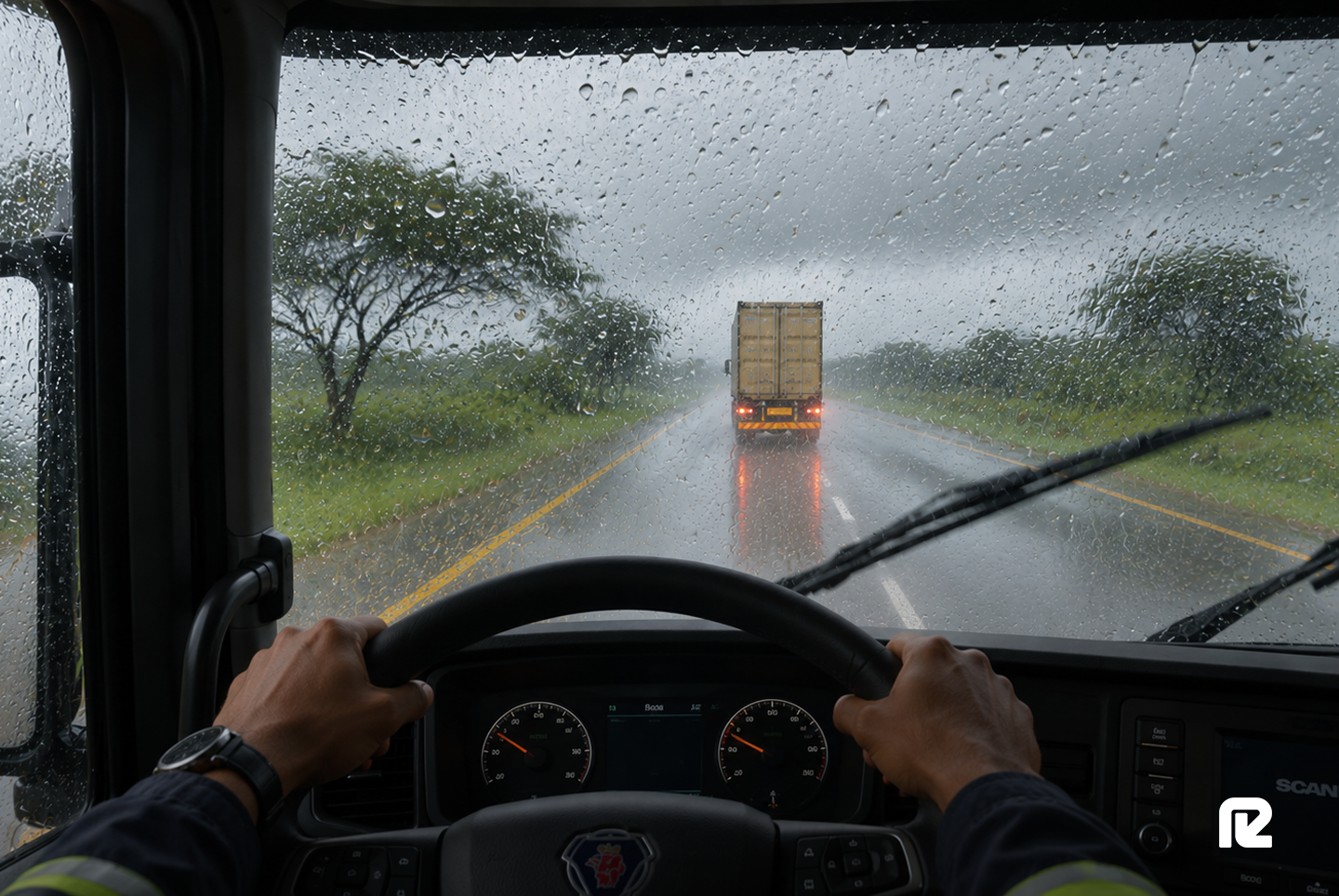

Across most of Southern Africa's interior, the main rains fall between November and March, and some areas stay wet into April. For cargo moving between the coast and the mines of Zambia and the DRC, these months bring washed-out roads, slower loading and longer queues at border posts. Transit times that are reliable in the dry season can stretch by days, and a single damaged bridge can push a corridor's traffic onto a longer route.
The 2026/27 season adds a regional split. A strong El Niño is expected to bring heavier rain to Tanzania and the north of the region, while much of the south is likely to be drier than normal. This article looks at how the rains affect roads, loading points, and border queues, the risks on each main corridor this season, and how to build buffers into transit plans.
The paved trunk roads that carry most corridor freight usually stay open through the wet season. Damage is concentrated at critical points along these roads: bridges and culverts over rivers, low sections across floodplains, and gravel or poorly maintained stretches near borders and mine sites.
The Logistics Cluster's assessment of Zambia's transport network flags road and rail bridges, along with roads through valley bottoms, as at risk between October and March. It also notes that rivers can fill almost overnight during heavy storms.
Rain also speeds up wear on roads already carrying heavy axle loads. Standing water hides potholes, and drivers slow down on sections they would normally cross at speed. Trucks can lose hours on each trip even on a corridor that stays open all season.
Rainy-season risk sits at specific, known locations on each route. A shipper or forwarder who knows where those points are can agree an alternative before a closure, while the detours are still clear of other trucks.
Many mine sites, collection points, and inland yards are reached by gravel access roads. After heavy rain, trucks wait for these roads to dry or get stuck on them, loading slots slip, and a truck that misses its slot often joins the back of the queue. Loading operations on open pads stop during downpours when cargo must stay dry.
Moisture matters most for mineral concentrates. Copper and cobalt concentrates can become unstable in a ship's hold if their moisture content exceeds the transportable moisture limit (TML).
Marine insurer Gard advises against loading these cargoes in rain and recommends retesting moisture after any rain exposure. Concentrate that has been stored uncovered in an inland yard or transported under damaged sheeting may fail moisture testing at the port and wait there until it dries or is reprocessed. The handling and hazard checks for copper concentrate cover the testing and documents in more detail.
Before the heaviest months, it helps to check:
● Access roads. Whether the mine or collection site has a wet-weather plan, such as gravel top-ups or a second gate.
● Storage. Whether cargo that must stay dry can move into covered storage before the peak, ideally with drive-in loading so trucks load under a roof.
● Sheeting. The condition of tarpaulins and covers on every truck, checked at loading and again at handover points.
● Testing. For concentrate, schedule a moisture test after any rain exposure and before the cargo reaches the port.
Most border delays come from causes that exist all year: document errors, customs system downtime, physical inspections, and limited operating hours. Rain makes several of these worse. Inspections in open yards take longer, and waterlogged holding areas and approach roads leave trucks with less room to park and turn.
The bigger effect comes when a crossing closes. In January 2025, the rain-swollen Limpopo River flooded South Africa's Groblersbrug Border Post on the main route into Botswana. Border staff were evacuated, and diverted trucks built up at Kopfontein and Skilpadshek, which were unprepared for the extra volume. A closure on one route lengthens queues on every alternative, so the shippers who move first tend to wait the least.
The Southern African Development Community's seasonal outlook for 2026/27 expects a strong to very strong El Niño to peak between October and December, alongside a positive Indian Ocean Dipole.
The outlook points to contrasting rainfall patterns across the region:
● Wetter. Above-normal rain is favoured over most of Tanzania, eastern DRC, the far north of Zambia, and northern Malawi early in the season, and over eastern Tanzania between January and March.
● Drier. Below-normal rain is likely across southern Zambia, Zimbabwe, most of Mozambique, Namibia, Botswana, and most of South Africa, with the drier signal spreading across most of Zambia and southern DRC from January.
The Tanzania Meteorological Authority expects the heaviest rain between November and January, with above-normal to normal totals in the Iringa, Mbeya, and Songwe regions that the highway to Zambia runs through. It has warned of disruption to roads, railways, and ports.
Seasonal outlooks describe rainfall totals over broad areas and three-month periods. A below-normal season can still include individual storms heavy enough to wash out a culvert, and cyclones in the Mozambique Channel need separate tracking as the season goes on. National weather services issue the short-range warnings that matter for day-to-day decisions.
The table below summarises where each corridor is exposed and how the 2026/27 outlook affects it.
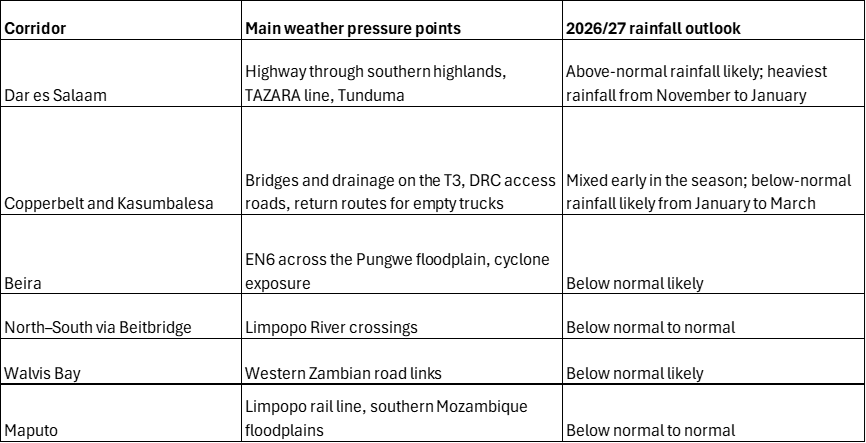
Cargo from Dar es Salaam travels through Iringa and Mbeya to the Tunduma-Nakonde border, with the TAZARA railway running alongside. Both run through the regions where Tanzania expects above-normal rain, which gives this corridor the highest weather risk this season.
In April 2024, landslides between Mlimba and Makambako closed the TAZARA main line for around 50 days, pushing more trucks onto the road to Tunduma. Shippers using rail on this route should agree a road fallback before December.
The T3 through Chingola and Chililabombwe is one of the main routes for DRC copper and cobalt heading south. On 28 February 2026, heavy rain overwhelmed drainage at the Kakoso Bridge on the approach to Kasumbalesa, and the bridge collapsed, leaving trucks on a diversion that authorities warned could be unsuitable for heavy vehicles.
Empty trucks returning through Mokambo face a road to Mufulira that turns to deep mud in the rains, which slows the turnaround for the next northbound load.
The EN6 from Beira crosses the low-lying Pungwe River floodplain on its way to Zimbabwe. In February 2023, floodwater undermined the road near Mafambisse, and authorities halted heavy-truck traffic. The drier outlook lowers the rainfall risk this season, but the corridor sits in the path of Mozambique Channel cyclones, so cyclone warnings remain the signal to watch.
Northbound cargo from Durban and Gauteng crosses the Limpopo River at Beitbridge, or at Groblersbrug for the route through Botswana.
Heavy rain upstream can raise the river quickly, as the Groblersbrug closure showed, but the drier outlook for Zimbabwe and northern South Africa lowers the risk this season. At the Port of Durban, strong wind can suspend vessel movements during the summer months.
Rain risk on the Namibian and Botswana sections is low, and both countries are forecast to be drier than normal. The weaker link is in western Zambia, where the Walvis Bay Corridor Group has warned that the Sesheke–Livingstone road puts cargo and drivers at risk once the rains start. Check its condition before routing loads through it.
Floods in January 2026 closed the Limpopo rail line for three months, cutting the rail link between Maputo and Zimbabwe until it reopened. The outlook for southern Mozambique is normal to below normal, but shippers relying on that line should keep a road or Beira option ready.
Buffers work best when they match the route and the month, with the largest margins on higher-risk corridors during the peak.
● Move time-sensitive cargo before the peak. On the Dar es Salaam Corridor, shipping before December avoids the months Tanzania expects to be wettest.
● Set buffers from your own lane history. Transit times on your own routes during the last wet season provide the most reliable guide to how much extra time each lane needs.
● Clear documents before trucks reach the border. Pre-lodged declarations and correct transit bonds keep trucks moving through crossings that are already slowed by weather.
● Stage cargo near the border or port. Bonded storage lets transit cargo wait out a closure without triggering duty, and covered space keeps it dry while it waits.
● Agree a fallback route or mode in advance. Know which alternative crossing or transport mode you would use if your usual route closes—for example, switching from road to rail or using another crossing into the DRC when Kasumbalesa is blocked. Forwarders that run both road and rail on a corridor can move cargo between them when one is cut, so it is worth asking yours how it handled last season's closures.
● Check your insurance wording. Confirm what the policy says about water damage to cargo and about losses caused by delay.
● Follow national weather warnings. The Tanzania Meteorological Authority, the Zambia Meteorological Department, the South African Weather Service, and Mozambique's national meteorology institute all issue short-range alerts during the season.
The locations most vulnerable to rainy-season disruption are predictable. It concentrates at bridges, culverts, floodplain sections, gravel access roads, and border crossings beside rivers, so each corridor’s weak points can be identified before the rains arrive. This season, the 2026/27 outlook points to the highest risk on the Dar es Salaam Corridor and across the far north of the region. Most southern routes are likely to be drier than normal.
For shippers planning cargo between now and March:
● Allow larger time buffers on northern routes. Plan the largest margins on the Dar es Salaam Corridor, especially between November and January.
● Keep contingency plans for southern routes too. A drier forecast still allows for intense storms and cyclones.
● Protect moisture-sensitive cargo. Mineral concentrate needs covered storage and moisture retesting after any rain exposure.
● Agree fallback routes and storage before the season. A closure on one route lengthens queues on every alternative, and cargo that already has somewhere to go keeps moving.