AfCFTA and Customs Reality: What Free Movement of Goods Requires at the Border
October 19, 2026
Read the story
Please submit your details below and one of our logistics experts will reach out within one business day. Thank you.
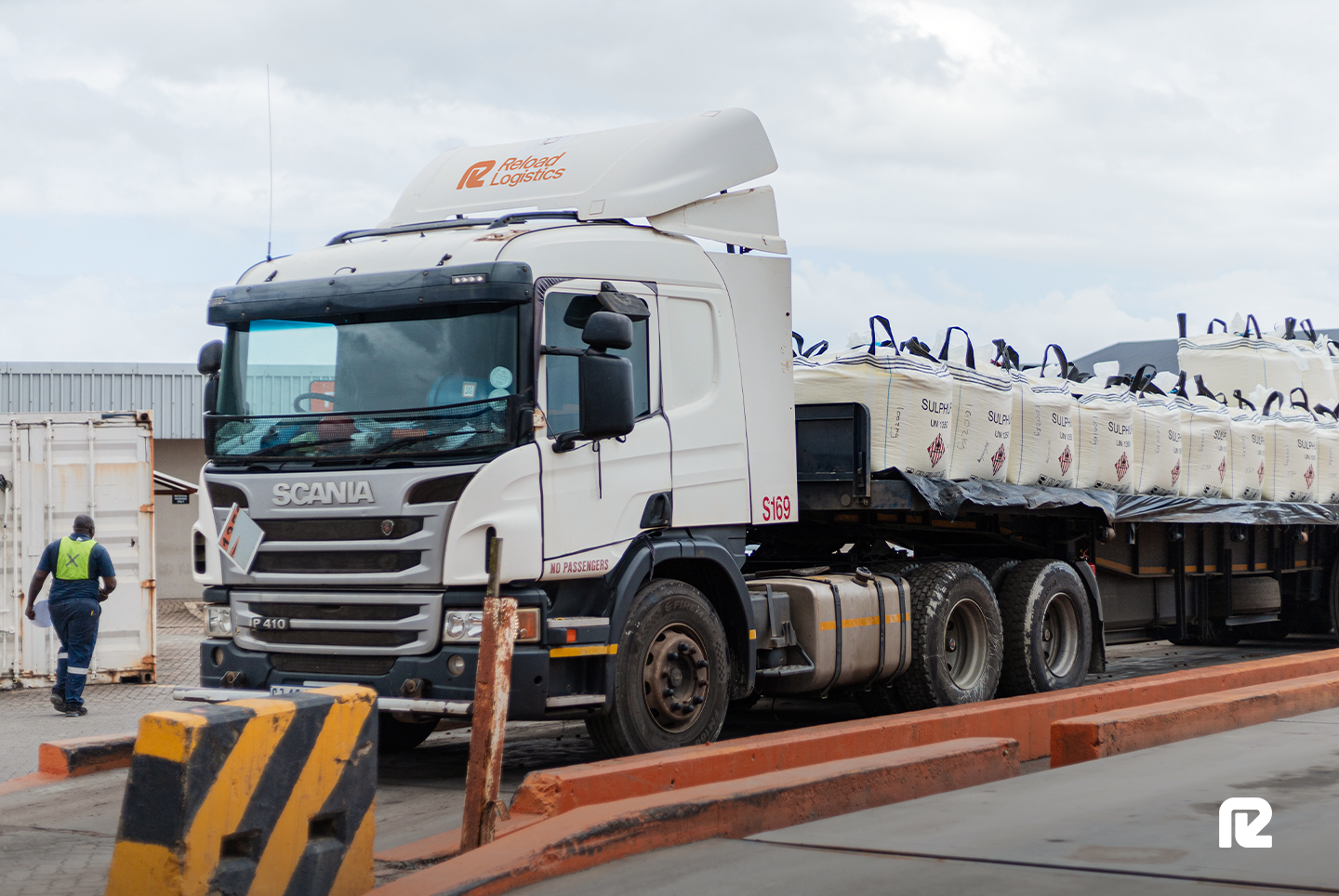

Axle load is the weight carried by a single axle or axle group of a vehicle, as opposed to the total weight of the vehicle and its cargo combined (which is the Gross Vehicle Mass, or GVM).
A simple way to picture it is this: a truck's total cargo weight can sit well within its legal GVM limit, but if that weight is packed unevenly across the trailer, one axle can end up carrying more than its share and exceed its own individual limit, even though the truck as a whole isn't overloaded.
Zambia's Public Roads Act defines it plainly as the weight transmitted to the road by an axle bearing two or more tyres. Regulators care about this measurement separately from total weight because axle load, not overall vehicle weight, is what determines how much wear and damage a truck does to road surfaces and bridges.
That's why weighbridges check both figures.
For operators moving cargo across Zambia, Zimbabwe, Tanzania, Namibia, and neighboring countries, axle load compliance affects transit time as directly as customs paperwork does. A single flagged axle can mean offloading cargo on the spot, and that delay affects the journey ahead.
Axle groups come in three common configurations. A single axle carries weight on one axle line. A tandem axle groups two axles close together, sharing a combined weight limit rather than each axle having its own separate cap. A tridem axle groups three. This is why total cargo weight isn't the only number that matters: a truck's tandem group has its own ceiling regardless of what the front axle or the rest of the trailer is carrying.
Regional harmonization efforts under the old Southern African Transport and Communications Commission pushed most SADC states toward similar single-axle and tandem-axle figures, though not every country adopted them at the same pace. Actual limits still vary by country:
● South Africa: 9,000 kg single-axle limit for most configurations, 18,000 kg tandem-axle limit, under the National Road Traffic Act
● Zambia: kept lower tandem-axle limits for years before raising them to match its neighbors
● Namibia: 7,700 kg on a steering single axle and 9,000 kg on a single axle with four wheels, under its Road Traffic and Transport Act
The practical result for a cross-border operator is that a load legal in one country can be marginal or non-compliant once the truck crosses into the next, depending on that country's specific axle limits and how recently they were updated.
Axle load limits are enforced at weighbridges positioned along the corridor, and a truck can encounter several of them before it ever reaches its destination.
Weighbridges sit in two places along a corridor: fixed installations at major border posts, and static or portable units positioned along inland routes to catch overloaded vehicles before they reach the border.
At Kazungula, on the Zambia side of the bridge connecting to Botswana, any commercial vehicle with a GVM of 6.5 tonnes or more must be weighed before crossing. Zambia runs a wider network of these facilities along its main corridors, including weighbridges at Kapiri Mposhi, Livingstone, Mpika, and near the Nakonde and Mwami border posts, alongside the Kazungula site.
Zambia's Road Development Agency also has legal authority to install both fixed and portable weighing devices anywhere along the road network, which means a truck can be checked well before it reaches a border.
Tanzania runs a similar layered network under the Tanzania National Roads Agency (TANROADS), enforcing the Road Traffic (Maximum Weight of Vehicles) Regulations, 2001 alongside the East African Community Vehicle Load Control Act. Weighbridge stations operate at points including Himo in Kilimanjaro, Morogoro, Kagera, and Longido in Arusha, and any commercial vehicle with a gross vehicle weight of 3,500 kg or more is subject to weighing.
Zimbabwe's Ministry of Transport announced strict, zero-tolerance enforcement of axle load limits in late 2025, specifically flagging the Bulawayo–Victoria Falls corridor as newly rehabilitated infrastructure the government wants to protect from overload damage. Operators running that route should expect closer scrutiny than they may have seen historically.
Namibia's weighbridges sit along its three main freight corridors: the Trans-Kalahari Highway toward Botswana and South Africa, the Trans-Caprivi Highway toward Zambia, and the north-south route toward Angola and South Africa. Vehicles above 3.5 tonnes are required to pass through them.
This layered approach means a load has to stay compliant for the whole route, not just at the single crossing point an operator might be planning around.
At any of these checkpoints, a truck is directed onto the scale, where axle-by-axle and total weight readings are checked against the legal limits for that vehicle configuration and country. If every axle and the total mass fall within the permitted range, the truck proceeds.
Documentation gets checked alongside the weight itself. In Zambia for example, the driver has to carry the original transport permit for the load and present it at the weighbridge, where an officer runs a countercheck against the details on file for that permit, covered under Zambia's road traffic regulations. A missing or mismatched permit can hold up a truck independently of whether the load itself is compliant.
If an axle is over the limit, the outcome depends on how far over it is and what the local regulations allow. Where the regional 5% tolerance applies, a driver can redistribute cargo across the trailer and re-weigh before continuing. Beyond that tolerance, the vehicle is typically held until enough cargo is removed or repositioned to bring every axle back into range.
That tolerance isn't always applied consistently. A formal non-tariff-barrier complaint recorded a case where the Martins Drift weighbridge, on the Botswana side of the corridor, held a truck for an overloaded drive axle without applying the 5% tolerance that South Africa, Zambia, and Botswana otherwise share on the same route.
If axle load is over the limit, the overload liability isn't always the driver's alone, and the rules on this are shifting.
South Africa's National Road Traffic Act now extends responsibility beyond the driver to the vehicle operator, and separate regulations place obligations directly on the consignor and consignee: a consignor cannot legally load or offer cargo that exceeds the vehicle's permissible mass or axle limits, and must obtain a written payload declaration from the operator before the load goes on.
Namibia's reform is further along than a draft amendment. Its Vehicle Mass Act, 2024 shifts liability to the vehicle operator, extends accountability to the consignor and consignee in a similar way to South Africa's rules, and replaces criminal prosecution for overload offenses with an administrative process built around a demerit points and penalty system. The Act was signed into law in April 2024 but has not yet come into force, since it still needs a commencement date set by the Minister.
For an operator running cargo through multiple countries, this means checking who's accountable for a load before it leaves the yard, rather than assuming the driver absorbs the risk everywhere on the route.
The direct cost of failing a weighbridge check is the fine or surcharge attached to the excess weight, which is generally assessed against how far over the limit the vehicle was found to be.
Zambia's road regulations, for instance, provide for a damage compensation surcharge on overloaded vehicles, calculated as part of the permit and enforcement framework administered by the Road Development Agency.
Zambia's Public Roads Act also allows for criminal penalties on top of that administrative surcharge, including a fine of up to 400,000 penalty units or imprisonment of up to five years for exceeding axle weight limits.
The direct cost of failing a weighbridge check is the fine or surcharge attached to the excess weight, assessed against how far over the limit the vehicle was found to be. But the full cost of non-compliance goes further:
● Administrative surcharge. Zambia's road regulations provide for a damage compensation surcharge, calculated as part of the permit and enforcement framework administered by the Road Development Agency
● Criminal penalties. Zambia's Public Roads Act also allows for a fine of up to 400,000 penalty units or imprisonment of up to five years for exceeding axle weight limits
● Time. A truck held at a weighbridge to redistribute or offload cargo can't make up those lost hours, and if that happens close to a border crossing, the delay impacts queue times and clearance windows already built into the schedule
● Future scrutiny. Repeated overload flags on a route draw closer attention from enforcement officers on later trips
Most weighbridge problems trace back to how a load was planned rather than how much it weighed in total.
A few practices reduce the risk before a truck reaches a weighbridge:
● Confirm axle-by-axle distribution during load planning, not just total cargo weight against GVM.
● Check the specific axle load limits for every country the route passes through, since figures vary and not all SADC states apply the same numbers.
● Position heavier cargo toward the center of the trailer rather than concentrated over a single axle group.
● Build weighbridge stops into the route schedule as fixed checkpoints, particularly on corridors with known enforcement activity.
Working with an experienced transport solutions provider that understands axle load requirements on a given corridor helps catch these issues at the planning stage, before a truck is sitting at a weighbridge losing hours it can't recover.