AfCFTA and Customs Reality: What Free Movement of Goods Requires at the Border
October 19, 2026
Read the story
Please submit your details below and one of our logistics experts will reach out within one business day. Thank you.
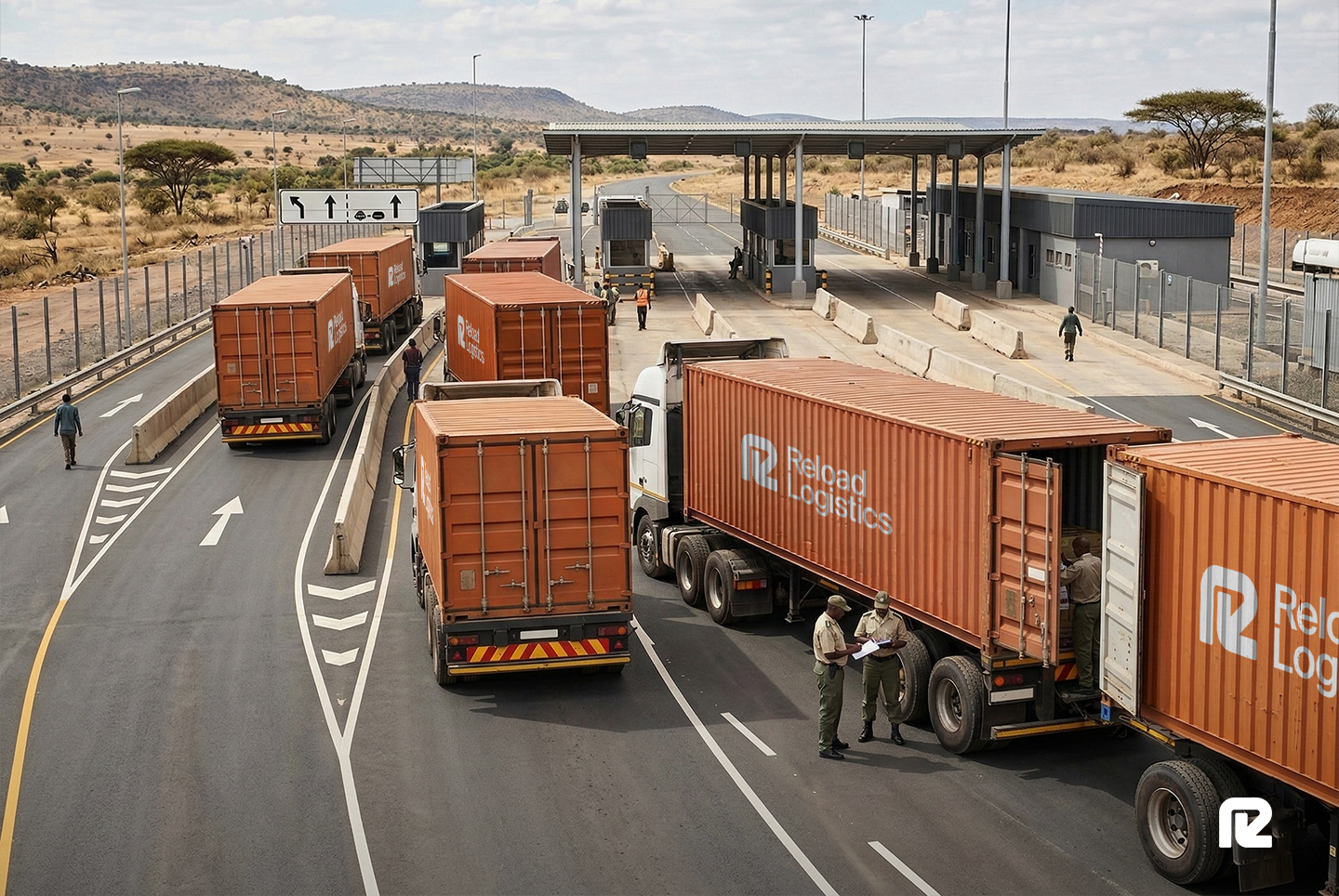

Cross-border logistics refers to the movement of goods between two or more countries, involving coordinated transport, customs clearance, regulatory compliance, and multi-jurisdictional coordination.
Unlike domestic logistics, cross-border transportation introduces additional complexity. Every shipment must comply with export controls, import regulations, documentation requirements, and tariff classifications. Even the smallest administrative errors can result in clearance delays, detention charges, or cargo being held at the border.
For companies operating across regional trade corridors, cross-border logistics is a structured process that requires planning, documentation discipline, and corridor-specific expertise.
When managed correctly, cross-border freight enables market expansion and supply chain diversification. When mismanaged, it exposes businesses to regulatory penalties, cost overruns, and delivery instability.
Cross-border logistics is the end-to-end coordination of transporting goods from one country to another, including compliance with export and import procedures.
The process typically involves multiple steps:
1. Export documentation preparation
2. Cargo movement to the port, airport, rail terminal, or land border
3. Customs clearance at origin
4. International transport (road, rail, air, or sea)
5. Import customs clearance at the destination
6. Inland distribution within the receiving country
Each step introduces administrative and operational risk.
For example, if export documentation contains incorrect HS codes or declared values, customs authorities may delay clearance or impose additional inspections. If transport equipment does not meet local regulations, border crossings may be refused. If tariffs or trade restrictions apply, landed cost calculations may shift unexpectedly.
Hence, cross-border transportation requires coordination not only between carriers and warehouses, but also between customs brokers, regulatory authorities, and freight forwarders.
The complexity increases in regions where infrastructure capacity varies significantly between neighboring countries. Border posts with limited processing capability can create extended transit variability, particularly during peak seasons.
International cross-border transport enables businesses to access new markets, expand distribution networks, and diversify production geography.
In many emerging and developing trade corridors, cross-border freight is essential to connecting inland production hubs with international markets.
Because regulatory frameworks, tariff structures, and transport infrastructure differ by country, effective cross-border logistics requires structured risk planning rather than reactive shipment handling.
A manufacturer sourcing raw materials from one country, processing them domestically, and distributing finished goods to a third country is a clear example of a cross-border supply chain.
Their process may look like this:
· Raw materials are exported from Country A.
· They are transported across a land border into Country B for processing.
· Finished products are then shipped via ocean freight to Country C.
Each stage requires separate customs declarations, transport coordination, and compliance verification.
Another example is regional retail distribution, where imported goods are cleared at a coastal port and then transported by road across neighboring countries to reach inland distribution centers.
In both cases, cross-border trade movement must account for tariff exposure, documentation accuracy, equipment compatibility, and transit variability across jurisdictions.
Cross-border logistics depends on several interdependent components. Weakness in any one of them can delay cargo movement or increase compliance exposure.
Customs clearance is one of the most critical stages in cross-border transportation. Every shipment must be accurately declared according to the importing country’s regulations.
This includes:
· Correct tariff classification (HS codes)
· Accurate valuation
· Country of origin determination
· Application of trade agreements where eligible
· Payment of duties and taxes
Misclassification or under-declaration can lead to inspections, fines, or cargo seizure. Over-declaration may unnecessarily increase duty exposure.
In some trade corridors, customs processing speed varies significantly depending on border infrastructure capacity and documentation accuracy. Clearance is not purely procedural; it is performance-sensitive.
Customs brokers act as intermediaries between importers/exporters and customs authorities.
They are responsible for:
· Preparing and submitting declarations
· Ensuring documentation accuracy
· Managing duty payments
· Responding to customs queries
· Coordinating inspections
In cross-border freight, an experienced broker can reduce clearance time and prevent avoidable delays. In regions with strong and evolving regulatory frameworks, local knowledge becomes particularly important.
Documentation accuracy directly affects multi-country freight operations performance.
Common required documents include commercial invoice, packing list, bill of lading or airway bill, certificate of origin, insurance certificates, and import/export permits (where required)
Even minor discrepancies, such as mismatched quantities or inconsistent values, can trigger customs review. For this reason, documentation discipline is often the difference between predictable transit and extended border dwell time.
Cross-border logistics operates within a framework of international trade laws, bilateral agreements, and regional blocs. Understanding these frameworks helps businesses optimize costs and reduce compliance risk.
Free trade agreements (FTAs) and regional trade agreements reduce or eliminate tariffs between participating countries.
However, preferential tariff treatment usually requires:
· Proof of origin
· Compliance with local content rules
· Accurate documentation
Without proper documentation, shipments may default to standard duty rates even when preferential treatment is available.
Tariffs and duties are calculated based on product classification, declared value, and origin.
In cross-border transportation, tariff structures influence:
· Supplier selection
· Routing decisions
· Consolidation strategy
· Total landed cost
Unexpected duty adjustments can alter margin calculations significantly.
Regional trade blocs such as customs unions or economic communities simplify cross-border movement by harmonizing tariffs and procedures. However, implementation consistency varies. Border infrastructure, digital processing capability, and inspection intensity may differ between member states.
Businesses operating across multi-country corridors must account for these differences during planning.
Mode selection is a core decision in cross-border logistics.
The choice between road, rail, air, and sea transport depends on cost structure, speed requirements, cargo type, and infrastructure quality.
Road transport is usually dominant in land-based cross-border freight. It offers flexibility and door-to-door service but may face border queue delays and regulatory inspections.
Rail transport can offer cost efficiency for bulk or containerized cargo across established corridors, but it depends on rail infrastructure compatibility between countries.
Air freight provides speed but at significantly higher cost. It is typically reserved for high-value or time-sensitive goods.
Sea freight remains the primary option for long-distance international trade, often combined with inland road or rail legs.
In multi-corridor environments, intermodal coordination becomes critical.
Cross-border logistics requires balancing cost against transit time stability.
Lower-cost modes may involve longer border dwell time or additional handling. Faster modes may reduce inventory exposure but increase transport expense.
The right decision depends on:
· Cargo value
· Shelf-life constraints
· Production dependency
· Working capital tolerance
In this evaluation, a structured analysis prevents reactive decision-making when delays occur and allows for better organization and planning.
Cross-border shipping costs are influenced by multiple variables beyond base freight rates, including distance and routing complexity, border processing fees, duties and taxes, fuel costs, equipment availability, seasonal congestion, documentation errors, and insurance premiums.
Cross-border transportation costs also fluctuate due to corridor congestion and regulatory variation.
Understanding these cost drivers allows procurement and logistics teams to model more accurate landed cost scenarios.
Cross-border logistics introduces a layered risk that does not exist in domestic transport. Regulatory variation, infrastructure constraints, equipment compatibility, and multi-jurisdictional coordination all increase exposure to delay and cost volatility.
Regulatory and compliance risk is often the most immediate concern. Incorrect tariff classification, incomplete certificates of origin, mismatched commercial documentation, or non-compliant labeling can trigger inspections or clearance delays. In some trade corridors, enforcement practices vary between border posts, meaning the same documentation may be processed differently depending on location.
Infrastructure variability is another key risk factor. Border crossings differ in processing capacity, inspection infrastructure, and digital customs systems. During peak seasons, congestion can extend transit times significantly. In certain African and emerging trade corridors, queue time rather than transport distance becomes the dominant driver of delay.
Equipment and carrier risk must also be considered. Vehicle licensing rules, axle-weight restrictions, and trailer compatibility standards may differ between countries. If equipment does not meet destination regulations, shipments may require transloading at the border, adding handling exposure and cost.
Financial risk arises through currency fluctuation, fuel price variability, and unexpected duty reassessments. Without structured cost modeling, landed cost projections can shift mid-shipment.
Political and policy risk is less frequent but more disruptive. Trade restrictions, temporary border closures, or new regulatory requirements can interrupt established routes without warning.
Effective risk management in cross-border transportation, therefore, requires more than reactive problem-solving. It involves diversified routing options, structured documentation control, realistic transit time modeling, and clear accountability between freight forwarders, customs brokers, and transport providers.
Organizations that integrate risk planning into their cross-border logistics strategy experience fewer unexpected cost escalations and more stable delivery performance.
Cross-border logistics involves multiple stakeholders: carriers, customs authorities, warehouses, brokers, regulators, insurers, and inland transport providers. Without structured coordination, even well-planned shipments can become delayed or misaligned.
Freight forwarders act as central coordinators within this network.
In cross-border transportation, their role typically includes:
· Selecting appropriate transport modes and routes
· Coordinating export and import documentation
· Managing carrier bookings across borders
· Aligning customs clearance timing with transport schedules
· Monitoring cargo movement across jurisdictions
· Handling exceptions when disruptions occur
The value of a freight forwarder becomes most visible when something does not go according to plan.
A customs query, missed vessel cutoff, border inspection delay, or equipment shortage requires rapid coordination across multiple parties. In cross-border freight, response time often determines whether disruption remains contained or escalates into demurrage charges, storage exposure, or missed delivery windows.
Experienced freight forwarders also provide corridor-specific knowledge. They understand:
· Border processing variability
· Infrastructure limitations
· Regulatory enforcement patterns
· Alternative routing options
· Seasonal congestion trends
In emerging or infrastructure-constrained corridors, this local insight is particularly important.
Beyond execution, freight forwarders contribute to risk mitigation. By structuring transport plans around realistic transit times and compliance requirements, they reduce volatility in cross-border logistics operations.
In complex multi-country supply chains, the freight forwarder is not simply a booking intermediary. They become an operational extension of the procurement and logistics function, ensuring that cross-border transportation remains controlled rather than reactive.
Cross-border logistics requires more than booking transport across national boundaries. It demands structured planning, documentation discipline, regulatory awareness, and corridor-specific execution.
When procurement, freight forwarding, customs coordination, and inland transport operate in alignment, cross-border freight becomes predictable rather than reactive.
Reload Logistics supports businesses operating across African and international trade corridors with structured cross-border transportation planning, customs coordination, and multi-modal freight execution. If your cross-border supply chain requires stronger risk control, clearer visibility, or improved transit reliability, speak with our team about building a more resilient cross-border logistics framework.
Cross-border freight refers to the movement of goods between two or more countries. It involves international transportation, customs clearance procedures, regulatory compliance, and coordination across multiple jurisdictions. Unlike domestic freight, cross-border freight requires documentation review and duty assessment at each border crossing.
An example of cross-border supply is when raw materials are exported from one country to another for manufacturing, and the finished goods are then distributed to a third country. Another example is retail distribution, where imported products cleared at a coastal port are transported across neighboring countries to reach inland markets.
Cross-border goods are products that move from one country to another through international trade. These may include raw materials, industrial components, finished consumer goods, or project cargo. Once goods cross a national boundary, they are subject to import and export regulations, duties, and compliance checks.
Cross-border supply chains are networks of suppliers, manufacturers, transport providers, customs authorities, and distributors operating across multiple countries. These supply chains require coordinated logistics planning, documentation accuracy, and risk management to ensure goods move efficiently between jurisdictions.