AfCFTA and Customs Reality: What Free Movement of Goods Requires at the Border
October 19, 2026
Read the story
Please submit your details below and one of our logistics experts will reach out within one business day. Thank you.
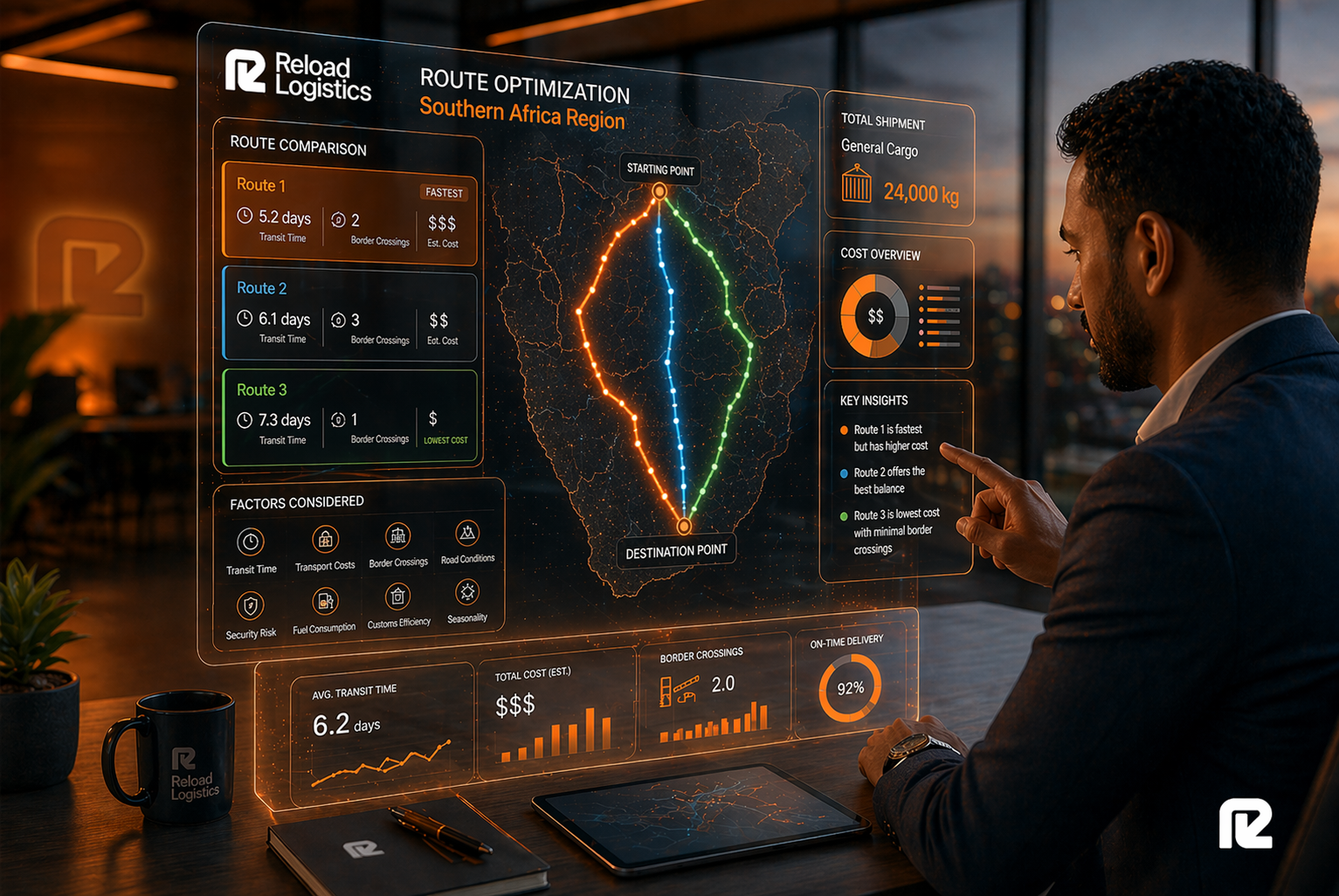

Route optimization in logistics is often treated as a technology question, but in practice, it is an operational one. The real issue is whether the right vehicles, routes, and decisions are being made consistently and at speed, across a network that may change daily.
Poor routing decisions have consequences, so a missed slot at one depot creates delays at the next, vehicles run underloaded, drivers backtrack, and demurrage (fees) accumulate. The cost of each individual error may be small, but the overall impact shows up in the margins. Route optimization exists to prevent these issues.
Logistics route and transportation optimization is the process of determining the most efficient path or sequence of stops for vehicles to follow when moving cargo from one point to another. Efficiency may mean the shortest distance, fastest time, lowest cost, using the right vehicles, or even a combination of all four. The specific goal will depend on the individual organization.
For example, a transport operation serving five delivery points could theoretically complete those stops in any sequence. The number of possible routes grows rapidly as more stops are added.
Route optimization tools evaluate those combinations against factors such as vehicle capacity, time windows, road conditions, and driver hours, and can identify the optimal solution faster and more reliably than manual planning allows.
There are more complex examples, such as multi-leg routes where vehicles move between countries, change modes, or group loads into fewer runs during the route. In this scenario, route optimization aims to coordinate the whole chain so that each leg is ready as the previous leg is completed.
Route optimization works in stages:
• All delivery requirements are pulled together
• Confirmation of vehicle availability and capacity
• Time windows and access restrictions are applied
• A route plan is generated and reviewed by planners, with adjustments for exceptions.
• Approved routes are then dispatched to drivers. At this point, live tracking begins, and any issues are flagged and rerouted as they arise.
The first step is the most important, as effective route optimization depends on reliable data, as gaps in data, such as inaccurate vehicle capacity records, will produce a plan that does not work on the ground.
Optimization becomes especially valuable when used in larger freight operations. Multi-depot optimization plans deliveries across multiple starting points, and balances load between depots to avoid issues such as locations running below capacity.
Multi-depot networks are only as efficient as the decisions connecting them. When demand spikes unevenly across sites, solutions at the individual depot level simply move the problem around.
Route optimization addresses this by looking at the whole network at once, improving fleet utilization and cutting empty runs across the board.
Route planning generally moves through four stages:
1. Demand capture. Gathering all delivery requirements, volumes, destinations, and service constraints.
2. Feasibility assessment. Checking what is physically possible given vehicle availability, driver hours, and time windows.
3. Route generation. The production of a plan that takes into account the factors mentioned above.
4. Execution and adjustment. Once the plan has been dispatched, performance is monitored, and any deviations are dealt with as they occur.
Route planning produces a plan with assigned vehicles, a sequence of stops, and expected times. It can be done manually, on a spreadsheet, or through a basic mapping tool.
Route optimization takes that further by using automation to evaluate multiple possible plans and identify the best option against defined objectives within a set of constraints.
The practical difference matters most when the scale increases. A planner managing five routes can work effectively without transportation optimization tools, but a planner managing fifty routes across multiple depots, cargo types, and time windows cannot. At that point, manual planning introduces inconsistency and misses the efficiency gains that optimization would identify.
Routing problems in logistics fall into several standard types. The Vehicle Routing Problem (VRP) considers the optimal set of routes for a fleet of vehicles to use to deliver to a given set of customers.
From this point, a variety of factors add additional constraints. For example, load-limited routing accounts for vehicle capacity, time window routing adds constraints around the delivery window, while some operations will require collection and delivery routing, where vehicles pick up and drop off cargo at various points along the same route, not simply dispatching from the same point.
Reliable order data on locations of stops, delivery priorities, service time requirements, cargo volumes, and any special requirements is needed for route optimization to be effective. Missing or inaccurate order data is the most common reason a technically sound optimization produces an unusable plan.
Fleet data covers availability of vehicles, the kinds of load they can carry, when they're on the road, restrictions such as driving limits or road access, as well as any specialized requirements. Optimization in logistics is only as accurate as the fleet data it is working from.
Single-depot routing assumes all vehicles originate from one location. The planning problem is self-contained and works well for operations with a concentrated delivery region.
Multi-depot routing distributes that logic across several starting points and is more representative of how larger freight operations work. The system must decide not only how to route vehicles, but which depot should serve which area, and how to balance load between locations.
Static optimization is based upon a fixed plan that is produced before operations begin. This approach is well-suited to delivery patterns that are regular and predictable, and where conditions don’t change between the planning and execution stages.
By contrast, dynamic route optimization is more reactive, with the ability to change routes in real time in response to changing conditions, such as delays, road closures, and breakdowns.
Most freight operations benefit from a combination: a well-constructed static plan as the baseline, with dynamic adjustment available for material exceptions.
Route planning software approaches the problem in different ways depending on scale and complexity. Exact methods find the best possible solution, but slow down significantly as the number of stops and constraints grows.
Rule-based approaches to planning find solutions more quickly by using logical shortcuts. Perfection is sacrificed in the name of speed.
Larger and more complex networks require more advanced techniques that consider a broader range of options to find solutions that wouldn’t be possible using simpler methods.
Shortest path algorithms are a component of full route optimization, and they identify the lowest-cost route between two points on a network.
In full route optimization, the entire delivery plan is considered, and this includes factors such as multiple vehicles and stops, capacity limits, and time windows. The plan will determine the stops each vehicle makes, the sequence, and any constraints upon this.
Exact optimization guarantees the best possible solution but is only practical for small problems.
In large freight networks, a near-optimal solution produced in seconds is more useful operationally than a provably perfect one that takes hours to compute.
Most commercial route optimization platforms use these faster approaches rather than exact methods, accepting a marginal trade-off in precision for a significant gain in speed.
Load planning interacts with route sequencing, so the cargo loaded last must be delivered first. Transit times across long corridors involve driver hours regulations, border crossings, and overnight stops.
The primary optimization objective is often ensuring that vehicles move with full or near-full loads, minimizing empty kilometres, and coordinating return loads. The impact of these decisions grows across a fleet, which is why optimization tools built for parcel delivery do not translate directly to bulk or truckload freight.
Better vehicle utilization means fewer trips to move the same volume, less empty running lowers fuel and driver costs directly, and tighter sequencing improves throughput per vehicle per day. Fewer planning errors also mean fewer failed deliveries and penalty charges.
On-time performance improves because the plan is more realistic. Manual planning tends to underestimate actual travel and service times, but transportation optimization tools work from accurate data and real vehicle speeds, producing plans that drivers can execute rather than plans that need to be renegotiated once the day begins.
The choice of real-time and static routing is dependent on various factors:
• Static routing is better suited to operations where demand can be predicted, any costs incurred through deviation are acceptable, and the network is stable.
• In operations where demand is liable to change within the planning window, the cost of delay is higher, and deviation is likely, real-time routing is the best option.
The best approach is to begin with a static plan built based around accurate data and realistic constraints before adding dynamic capabilities where required due to specific routes and types of cargo.
By consistently measuring real-world performance against the plan on a regular basis and using the data to improve future static planning, reliance on dynamic adjustments can be reduced.
A route plan starts with complete order data on destinations, volumes, time windows, and any access or handling requirements.
During the planning process, data on the availability and capacity of vehicles is verified, constraints are considered, and a sequence is generated that meets delivery requirements within these limits. The resulting plan should be reviewed before dispatch and subsequently tracked against performance.
A freight operator making deliveries from four depots can use route optimization to assign shipments, plan a sequence of stops to minimize total distance, and balance loads across the available fleet.
The result will be fewer vehicles running under load capacity, and a higher proportion of deliveries completed within time windows.
The main factors to consider are cargo type and handling requirements, weight and volume, urgency and delivery timeline, cost and budget, origin and destination accessibility, regulatory and compliance requirements, and the availability of infrastructure on the intended route.
Transportation problems come down to the same few factors. These are where goods are coming from, where they need to go, the costs to move them, and the constraints (capacity, time windows, regulations) that any solution has to work within.
The objective is to meet all demand at minimum total cost while staying within those constraints.