Kazungula Bridge: What It Means for Zambia-Bound Freight
September 15, 2026
Read the story
Please submit your details below and one of our logistics experts will reach out within one business day. Thank you.
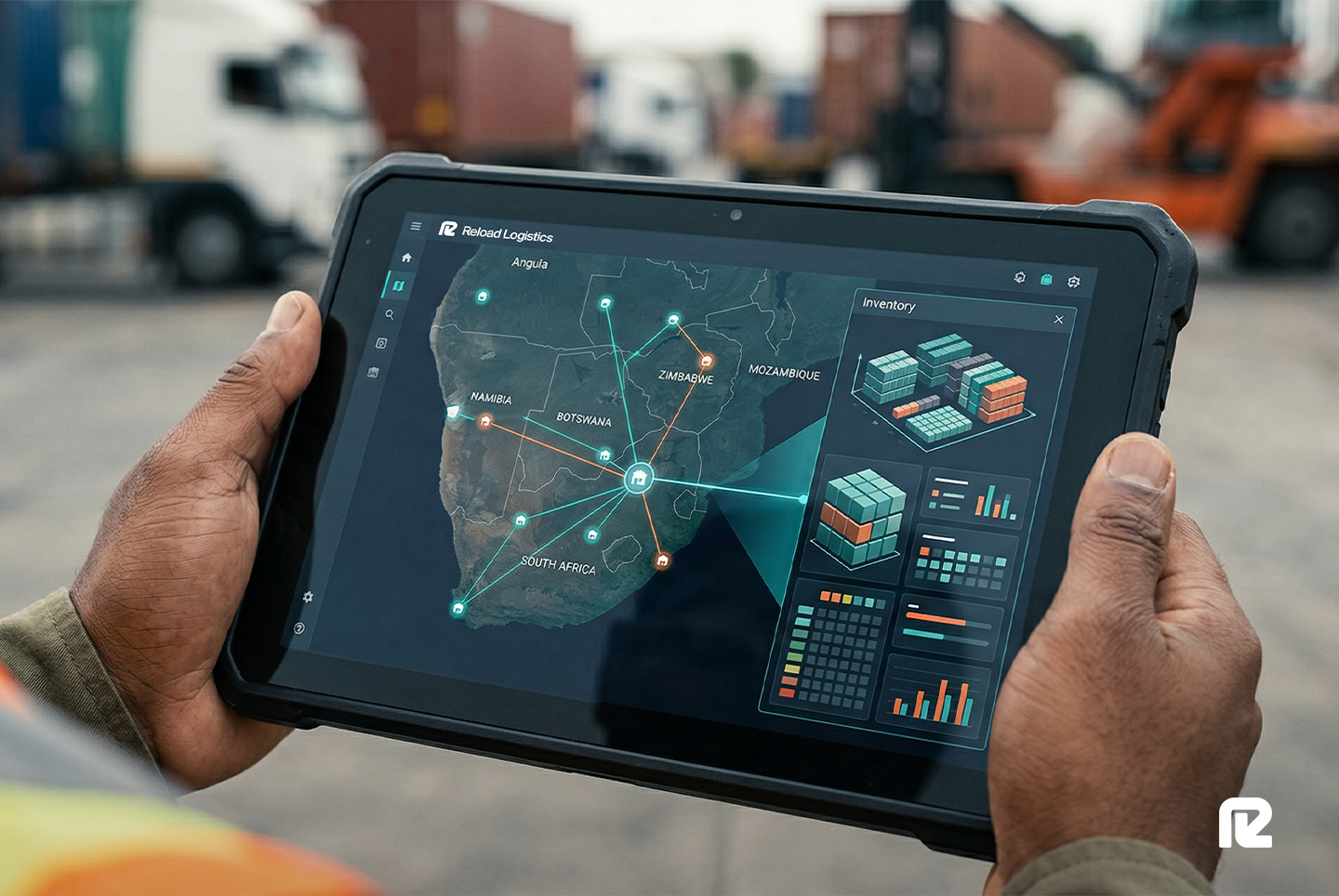

The term "inventory management in logistics" usually masks a broader operational question: how do you keep the right stock in the right place at the right time, without tying up too much capital or causing service failures?
That question is also the real issue. Inventory in logistics includes stock sitting on shelves, goods in warehouses, goods moving between facilities, safety stock held to absorb uncertainty, and sometimes bonded or compliance-sensitive stock that cannot be handled like ordinary domestic inventory.
Warehouse and logistics teams use inventory management to balance availability, cost, speed, and control. Modern systems increasingly rely on barcodes, RFID, warehouse management systems, and event-based visibility standards to improve accuracy and traceability.
Inventory management in logistics is the planning, tracking, control, replenishment, and movement of stock across the supply chain. In simple terms, it is the discipline that decides what inventory is held, where it is held, how it is counted, when it is replenished, and how it flows into fulfillment or production.
The reason this is important is that inventory is both an asset and a risk. Too little creates stockouts, missed sales, and service disruption. Too much creates working-capital drag, storage pressure, markdown risk, and obsolescence. Good inventory management is not simply about maximizing stock but about matching stock position to demand, lead times, and service goals.
In 2026, warehouse management is more and more about building an operating model around visibility, orchestration, and automation.
In practical terms, the main warehouse needs are clearer location accuracy, faster receiving and dispatch, better cycle counting, more reliable replenishment signals, and stronger visibility across the warehouse and in-transit stock.
The technology stack supporting that increasingly includes WMS and warehouse execution layers, barcode scanning, RFID where justified, mobile workflows, and selective automation.
The important nuance is that technology should solve a warehouse problem, not create a more expensive version of the same weak process.
Inventory works in logistics by acting as a buffer between supply and demand. Goods are purchased, received, stored, moved, counted, allocated, picked, shipped, and sometimes returned.
At every stage, logistics teams need to know what stock exists, where it is, whether it is available, and when it should move next. That sounds straightforward, but the challenge is that inventory does not sit in one stable state.
Some stock is on hand, some is reserved, some is damaged, some is in quality hold, some is in transit, and some may already be committed to an order before it physically leaves the building.
This is why inventory management is tightly connected to warehouse operations, transport planning, order management, and returns handling.
Inventory management works as a sequence of operating decisions. First, the business identifies what it is stocking and how important each item is. Then it sets control rules, tracks movement, replenishes when thresholds are reached, fulfills demand, and deals with returns or exceptions. Each may include multiple sub-steps, based on the company's needs.
Once inventory crosses borders, the job becomes more complex. A business may need to distinguish between domestic stock, in-transit stock, bonded inventory, goods held in a foreign-trade zone, and stock that cannot be released until customs conditions are met.
Inventory controls, recordkeeping, and customs status are not optional details in these environments. Cross-border inventory is, therefore, not only a storage issue, but also a compliance and documentation issue that needs to be addressed properly.
The first step is to classify stock by importance, demand pattern, value, velocity, perishability, or risk. This is where methods such as ABC analysis become useful. Not every SKU needs the same control intensity. High-value or high-velocity stock usually needs tighter tracking and more frequent review than slow or low-impact stock.
Once stock is classified, the business sets reorder points, safety-stock levels, service targets, min/max logic, and exception rules. These rules turn inventory from a passive record into an active control system. Without them, replenishment becomes reactive and inconsistent.
Stock accuracy depends on disciplined capture. RFID is particularly useful where businesses need faster, less manual visibility, while barcodes remain the most widely used baseline for practical warehouse control.
Replenishment moves inventory from origin to the next stocking point based on forecast, actual demand, min/max rules, or vendor-managed arrangements. This can be simple in a domestic network and much harder in a cross-border one, where lead time, customs release, and transport variability affect when stock is truly available.
Once inventory is allocated to demand, it shifts from storage logic to fulfillment logic. At this stage, accuracy matters just as much as speed. Poor pick discipline turns inventory errors into customer-facing errors.
Inventory management does not end at dispatch. Businesses still need visibility into what is moving, what is delayed, what has been delivered, and what is coming back. Returns can distort availability if they are not inspected, reclassified, and re-entered into stock correctly.
Inventory sits at multiple points in the supply chain: with suppliers, in origin facilities, in warehouses, in transit, at cross-docks, in retail (especially in hyperlocal settings) or distribution nodes, and sometimes in returns streams. The key point is that inventory is not only warehouse stock, but it needs to be approached as a network stock.
A business can look well-stocked in aggregate and still fail operationally if the stock is in the wrong place. Inventory management is therefore partly about quantity and partly about positioning.
Warehouse stock is inventory physically located in a storage or fulfillment facility and generally available for allocation, counting, and operational handling. In-transit stock is inventory that has left one node but has not yet arrived at the next. It may be visible in the system, but it is not yet available in the same way as on-hand stock.
This distinction is especially important in international logistics. In-transit goods may still be subject to customs, carrier delay, port congestion, or documentation issues. That means treating in-transit stock as if it were warehouse stock can distort availability planning and create false confidence around supply.
Different inventory methods exist because different stock profiles create different operational needs. There is no single best model for every business. The right method depends on demand stability, lead-time reliability, SKU mix, margin structure, and service expectations.
JIT aims to keep inventory lean by receiving goods closer to the moment they are needed. The advantage is lower holding costs and less excess stock. The downside is that JIT is only as strong as supplier reliability, transport predictability, and demand stability. In volatile or cross-border environments, it can become fragile quickly.
Peak season cost control is not a classic inventory method, but it belongs here because inventory policy directly affects shipping spend. Companies reduce peak-season shipping costs by pulling forward replenishment, improving forecast accuracy, using slower and cheaper modes earlier, and avoiding last-minute replenishment that forces premium freight. In practice, weak inventory planning is one of the main reasons businesses end up paying peak-season transport premiums.
Economic Order Quantity, or EOQ, is designed to balance ordering cost against holding cost. Instead of reordering too often or carrying too much stock, the business tries to identify a practical order size that minimizes total cost. EOQ works best when demand and ordering patterns are reasonably stable. It becomes less reliable when volatility, short product life cycles, or sharp demand swings dominate.
ABC analysis prioritizes inventory control by grouping stock according to importance, usually by value, demand, or business impact. In practical warehouse language, businesses often translate this into something like star stock, stable stock, and slow stock. The point is not the label. The point is that fast-moving and high-impact items deserve more attention than marginal inventory.
Periodic counting means the inventory is checked at set intervals. Continuous counting, often through cycle counts, spreads checks across the year and keeps accuracy under closer control. Continuous counting is generally a stronger operationally because it identifies drift earlier and avoids the disruption of relying only on big annual counts.
When inventory records are wrong, problems spread quickly. Replenishment signals become unreliable. Warehouse teams pick stock that is not really there. Customer promises become unstable. Finance and operations start working from different numbers.
This is why inventory accuracy is not an administrative detail. It is a service and control issue. Even small mismatches can cascade into emergency purchasing, backorders, missed dispatches, and lost confidence in the system.
Modern inventory techniques combine traditional control logic with better visibility and faster data capture. In practice, that usually means integrating WMS workflows, barcode scanning, RFID where appropriate, event-based traceability, better forecasting, and more dynamic replenishment logic.
The important shift is that modern inventory techniques are less about doing counts faster and more about reducing uncertainty. Better visibility lets businesses carry less unnecessary stock while still protecting service.
FIFO means first-in, first-out. LIFO means last-in, first-out.
From a logistics perspective, FIFO usually aligns more naturally with physical flow, especially for perishable, dated, or obsolescence-sensitive goods. LIFO is more of an accounting method than a warehouse movement discipline in many operations.
So when businesses discuss FIFO vs LIFO in logistics, the real distinction is often between physical stock rotation and financial cost treatment.
Vendor Managed Inventory is a collaborative model in which the supplier takes responsibility for monitoring stock levels and triggering replenishment based on agreed rules and shared data.
SAP and CIPS both describe VMI as a model where the supplier manages inventory decisions at the customer’s location or within an agreed stock arrangement.
The strength of VMI is that it can improve replenishment discipline, reduce stockouts, and align the supplier and customer more closely. The risk is that VMI only works well when data quality, service agreements, and inventory ownership rules are clear.
Cross-docking and flow-through inventory reduce storage time by moving goods quickly through a facility rather than into longer-term stock. Goods are received, sorted, and sent onward with minimal dwell time.
This can reduce handling and storage costs, but it requires timing discipline and strong coordination between inbound and outbound flows.
It works best where demand is predictable, the network is synchronized, and the operation is designed for speed rather than buffer stock.
Manual planning can work in smaller, simpler operations with stable SKU counts and experienced teams. Its advantage is flexibility and local judgment. Its weakness is that it does not scale well and often depends too heavily on individual knowledge.
Automated planning is stronger when the business needs faster visibility, larger SKU control, repeatable replenishment logic, and better exception handling. But automation is not automatically better. McKinsey’s warehouse guidance is clear that technology has to match the real operational needs. Otherwise, the business ends up automating poor decisions faster.
Manual planning is often easier to start with, cheaper at the beginning, and more adaptable in edge cases. It also tends to break first when volume, complexity, and turnover rise.
Automated planning improves consistency, speed, and scalability. It usually supports better traceability and stronger integration with warehouse systems. But it requires cleaner data, clearer processes, and more disciplined governance. The trade-off is not human judgment versus software. It is whether the business has reached a level of complexity where informal planning is no longer reliable.