Beitbridge: Southern Africa's Busiest Border Post
September 1, 2026
Read the story
Please submit your details below and one of our logistics experts will reach out within one business day. Thank you.

Freight class is one of those concepts that looks simple on paper and becomes complicated the moment a shipment moves.
On a sheet, it is just a number between 50 and 500. In real operations, it is one of the main reasons shipments get reweighed, reclassified, delayed, or repriced after the fact.
The reason is straightforward. LTL networks are not designed around individual shipments. They are designed around how different shipments interact with each other inside the same trailer and across multiple terminals. Freight class is the mechanism carriers use to make that system workable.
If you understand freight class only as a definition, you will still get surprises. If you understand how it behaves inside the network, you can control cost, avoid disputes, and ship more predictably.
Freight class is a standardized way to describe how “difficult” a shipment is to move within an LTL network.
That difficulty is not subjective. It is based on four operational factors:
· Density: how much space the shipment takes relative to its weight
· Handling: whether it can be moved easily with standard equipment
· Stowability: how well it fits with other freight in a trailer
· Liability: risk of damage, theft, or value-related exposure
The National Motor Freight Classification (NMFC) system translates these factors into classes ranging from 50 (most efficient) to 500 (least efficient).
In practice, freight class is about how the product behaves once it enters the network. Two identical items can fall into different classes depending on packaging, palletization, or density.
LTL only works if carriers can mix freight efficiently.
A single trailer might carry dense machinery, boxed consumer goods, fragile equipment, and irregular freight all at once. Some of it can be stacked. Some cannot. Some can sit at the bottom of a load. Some must stay isolated.
Freight class is what allows carriers to make those decisions consistently.
When a shipment is booked, its class informs:
· how much trailer space it is expected to consume
· how it can be positioned relative to other freight
· how many handling touches it can tolerate
· how much revenue it must generate for the carrier
In real operations, this becomes visible at the terminal level. If a shipment does not match its declared class, it disrupts load planning.
Freight class is one of the strongest cost drivers in LTL, often more than distance.
Low-class freight is dense and compact. It allows carriers to maximize trailer utilization and reduce handling complexity. This translates directly into lower rates.
High-class freight behaves differently. It may be light but bulky, fragile, or difficult to stack. It occupies space that could otherwise be used for heavier freight, and it often requires more careful handling. That inefficiency is priced in.
In fact:
carriers price space and risk, not just weight.
This is why two shipments at the same weight can have materially different costs.
It is also why reclassification happens. If a shipment is declared as dense but shows up bulky, the carrier is effectively losing trailer efficiency. The rate is then corrected after inspection.
Freight class and NMFC are often used interchangeably, but they serve different roles.
· Freight class is the numerical category assigned to a shipment
· NMFC is the system that defines how that classification is determined
NMFC includes detailed commodity codes, packaging rules, and classification logic. Freight class is simply the output of applying those rules.
In practice, classification issues often come from using the wrong NMFC code rather than misunderstanding the class itself. That is where many disputes originate.
Density is the most measurable and increasingly dominant factor in freight classification.
It is calculated as weight divided by volume. But in real operations, the challenge is measuring volume correctly, especially with irregular or poorly palletized freight.
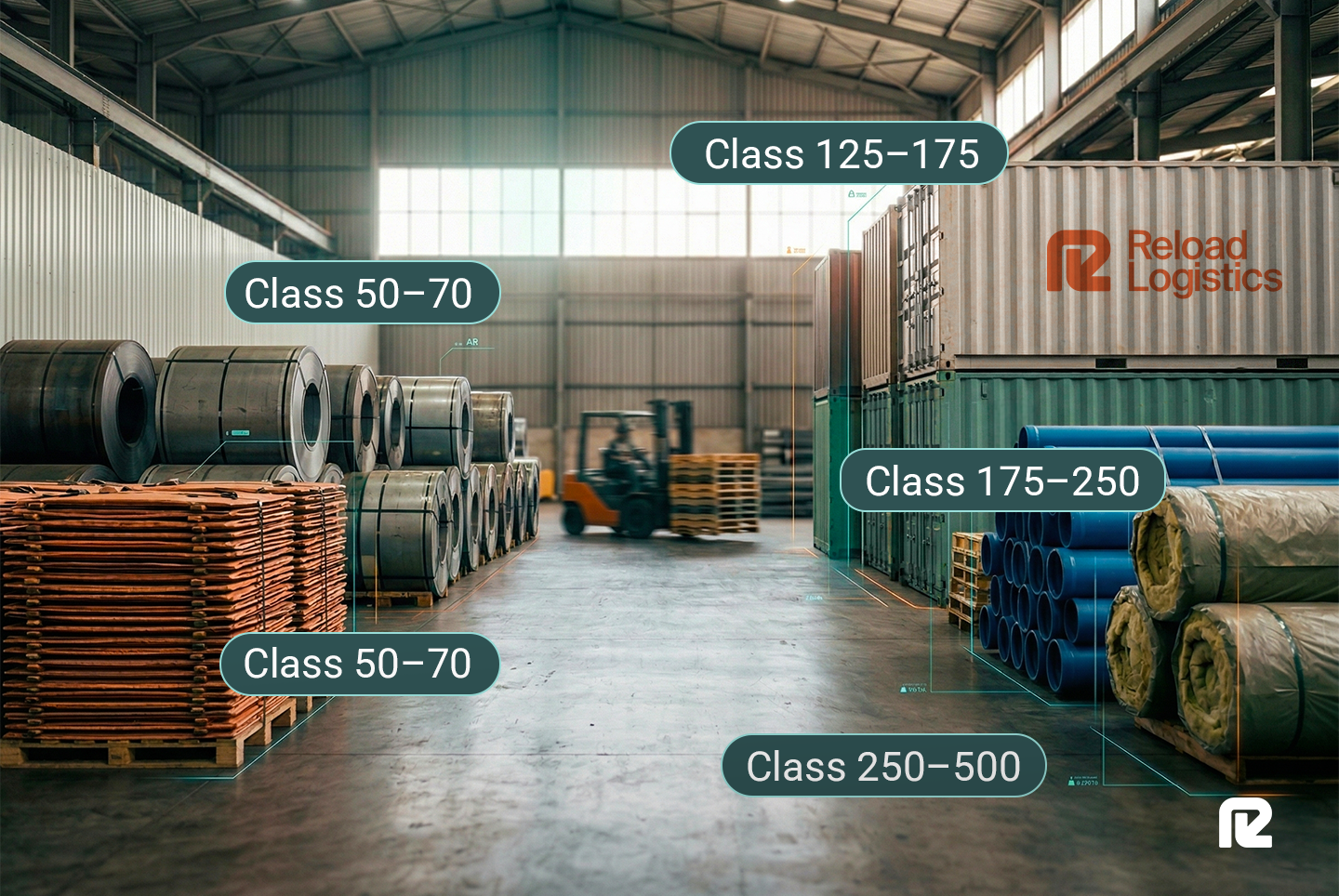
This class includes compact, heavy freight such as metal components or machinery parts.
These shipments are highly efficient for carriers. They stack well, remain stable, and maximize weight per cubic foot. From a network perspective, they are ideal.
This range includes a wide variety of industrial and packaged goods.
They are still efficient but slightly less compact. They can usually be stacked and handled without special considerations.
A large share of LTL freight sits here.
These shipments are more sensitive to packaging quality. Poor palletization at this level often pushes freight into higher classes or increases damage risk.
At this level, inefficiencies become more visible.
Freight may be bulky relative to its weight or require spacing. It reduces load flexibility and increases handling attention at terminals.
This is the least efficient category.
Freight here consumes significant space relative to weight or introduces high handling constraints. It limits how the rest of the trailer can be built, which is why it carries the highest rates.
Finding the correct NMFC code is often more complex than expected.
Some commodities are straightforward. Others depend on:
· packaging type
· density thresholds
· whether the freight is palletized or loose
· specific handling characteristics
This is why the same product may not always fall under the same classification.
In practice, companies rely on:
· NMFC databases
· broker or carrier guidance
· internal classification references
· 3PL support
Misclassification is one of the most common sources of downstream issues.
Is LTL a freight class?
No. LTL is not a freight class.
LTL is the shipping model. Freight class is the mechanism used to make that model work.
Freight class exists because LTL combines different shipments in a shared network. Without it, pricing and load planning would be inconsistent and difficult to manage.
Experienced 3PLs treat freight class as a control lever, not just a data field.
They look at:
· whether the declared class matches actual density
· how packaging can be improved to reduce class
· which carriers are more competitive for certain classes
· where reclassification risk is likely
In real scenarios, this often means identifying issues before the shipment moves. Once freight is already in the network, correcting classification becomes more expensive.
Most unexpected LTL charges are classification-related.
Over classification increases cost upfront. Under classification leads to corrections later, often with additional fees.
To avoid both:
· measure dimensions at the pallet level, not product level
· weigh shipments accurately
· ensure packaging reflects the declared density
· use the correct NMFC code
· validate classification before booking
Packaging decisions directly influence freight class.
A shipment that could qualify for a lower class may be pushed higher simply because of inefficient palletization or excess empty space.
At the same time, weak packaging increases the likelihood of damage and claims, especially given the number of handling touches in LTL networks.
Good packaging improves both cost and reliability and it's always good to follow best practices:
· tight, uniform pallet builds
· no overhang beyond pallet edges
· proper weight distribution
· packaging that supports stacking
· secure load containment
NMFC provides a shared reference point across the entire LTL ecosystem.
Carriers use it to standardize pricing. Brokers use it to quote accurately. Warehouses and terminals use it to anticipate handling requirements.
Without this system, every shipment would require case-by-case evaluation, which is not scalable in high-volume networks.
Freight class and rates are directly linked because class reflects network efficiency.
Lower-class freight fits easily into trailers, supports stacking, and reduces handling complexity. Higher-class freight does the opposite.
For shippers, this creates an opportunity. Small changes in packaging or density can move a shipment into a lower class. Over time, those changes can have a measurable impact on total transport spend.
Freight class is often treated as a technical detail, but in practice it is a source of cost variability, disputes, and operational friction.
Reload Logistics supports businesses in aligning freight classification with real shipment characteristics, reducing reclassification risk, and improving how LTL freight shipping performs across different lanes, carriers and trasports.
If your team is dealing with inconsistent rates or frequent post-shipment adjustments, reviewing how freight class is applied is often the first place to start.
Class 70 freight usually refers to moderately dense shipments that are still efficient for LTL carriers to move, but not as compact as lower-class freight such as metal parts or machinery. It is common for standard palletized commercial goods that are reasonably easy to handle and stack within the network.
Class 50 is one of the lowest and most cost-efficient freight classes. It typically applies to very dense, heavy items such as machinery parts, metal products, or other compact industrial goods that take up relatively little space compared with their weight.
Freight class is determined by looking at density, handling requirements, stowability, and liability. In practice, shippers usually identify the correct classification by using the appropriate NMFC code and verifying how the shipment is packaged, measured, and prepared for transport.
Freight class matters because it directly affects LTL shipping rates, handling expectations, and the likelihood of reclassification. If the class is incorrect, the shipment may be repriced after inspection, which can create unexpected charges and service friction.
Lower freight classes, such as class 50 or class 55, are generally the cheapest because they represent dense, stable freight that is efficient for carriers to load, stack, and move through the network.
Yes, freight classification is evolving, particularly as the industry places more emphasis on density-based pricing for certain commodities. While NMFC remains the core framework for LTL classification, carriers and shippers are paying closer attention to actual shipment characteristics rather than relying only on broad commodity descriptions.