DRC Mineral Export Documents: A Checklist for Copper and Cobalt Shippers
November 19, 2026
Read the story
Please submit your details below and one of our logistics experts will reach out within one business day. Thank you.


Take a truckload of copper cathode leaving a warehouse near Kolwezi, in the Democratic Republic of the Congo (DRC), bound for Zambia through Kasumbalesa.
On the way, it stops at the Kanyaka truck park outside Lubumbashi, where customs and other agencies compare the paperwork with the load. If a weight or seal number on one document differs from another, the truck can sit there while someone traces the error back to the office that issued it.
That paperwork is a file built for each lot, with certificates from several government agencies issued in a set order. Below, we follow one lot through the DRC export documentation process, look at the extra steps for cobalt, and finish with a full checklist.
A 29 June 2026 order prohibits the export of copper and cobalt concentrates, with one-year waivers at the mines minister's discretion. Our cathode falls outside it. Shippers of less processed material have more to check, because the order also repealed the 2023 framework and its exemptions. Operators relying on an older exemption have to re-establish their right to export.
The Oregon Group's analysis treats cobalt hydroxide as a processed intermediate outside the ban, a reading worth confirming with the mines office. In every case, make sure the assay and the sale contract describe the product the same way, since concentrate and cathode now face different export rules.
The exporter's own paperwork comes next. The traceability manual published by the Mines and Finance ministries in 2014 sets out the sequence followed here. Later circulars have added steps, so confirm current practice with your clearing agent. The manual asks exporters for:
● Company identity. Commercial registration, a national identification number, an import-export number, and a tax number.
● Right to the material. A current mining title, processing approval, or trading approval.
● Financial standing. A valid tax attestation and proof of bank accounts in the DRC and abroad.
● Commercial basis. The sale contract for the shipment.
These documents go to the provincial mines office with a request to start export operations 48 hours before sampling.
The office then has up to 48 hours to determine whether the request is complete, so an exporter with a lapsed tax attestation can lose the sampling date. At the same stage, the exporter asks the Foreign Trade service for a non-objection certificate. Every other export requirement still applies once that certificate is issued.
On sampling day, officers from the mines office, the Office Congolais de Contrôle (OCC), the Centre d ’Expertise, d ’Evaluation et de Certification (CEEC), and the Commissariat Général à l’Energie Atomique (CGEA) sample our cathode lot together, with customs and the exporter present.
Sampling produces three certificates:
● Quality certificate from OCC, which the bank will ask for later.
● Analysis and evaluation certificate from CEEC, recording the grade and value.
● Radioactivity certificate from CGEA.
If a lot exceeds the legal radioactivity limit, its export is suspended and the lot is seized. Exporters with any doubt about a stockpile should test it before committing trucks.
The same agencies weigh and seal the lot on sampling day, in an approved bonded warehouse or customs facility. The resulting record lists the seal numbers, and the exporter or a representative signs it alongside the officers. A joint loading record follows when the lot goes onto the truck. OCC issues an export verification certificate 24 hours after the quality certificate and loading record are in place.
These are the numbers the officers at Kanyaka will compare with our truck. Before it leaves, check the seals against the weighing record, and check the recorded weight against the packing list and invoice.
After analysis and fee payment, CEEC issues a certificate of origin naming the destination, exit post, and transit customs post. Two days before export, the exporter files a declaration of origin and sale, with the analysis results attached, for a mines office visa. False statements on quantity, quality, origin, or price carry customs penalties.
The royalty and bank registration follow in this order:
1. Collect a debit note from the mines office and a collection note from the state revenue agency, then pay at a commercial bank.
2. Return the proof of payment to the mines office for a liberatory receipt.
3. OCC inspects the lot and issues a ready-lot report.
4. Obtain the export declaration, known as the EB, through an approved bank.
The EB goes to the bank, the Central Bank of Congo, customs, OCC, and the tax directorate, so all of them will see any gap between its value and the invoice. Check that the contract, invoice, EB, and customs entry match before filing any of them. The fixed notice periods set the earliest realistic loading date, so work backwards from the truck booking and leave room for a retest.
Mineral exports run through the Guichet Unique Intégral du Commerce Extérieur (GUICE), a single window for trade documents with offices in Kolwezi, Lubumbashi, Kasumbalesa, Sakania, and Mokambo.
A licensed customs broker files the customs declaration with the Direction Générale des Douanes et Accises (DGDA), the DRC customs authority, which grants release once it has confirmed payment.
Our truck also needs its own paperwork:
● Transport attestation from the mines office, valid for a single exit and recording the truck registration and route.
● Electronic export information form from the national freight office.
● Health control note.
● Provincial road tax note, with an exit visa on the truck statement.
At the border, DGDA issues release and exit vouchers, and its brigade records the goods leaving the country.
A customs clearing agent working on both sides of the border can compare the whole file with the truck before it leaves the loading site, while the offices that issued the documents are still close at hand.
The GUICE procedure names the Mutaka and Kanyaka truck parks as checkpoints for customs, other agencies, and the provincial government, so a file problem can surface well before the border. Kanyaka also operates a scanner with a $100 scanning fee. In May 2026, the Zambia Revenue Authority (ZRA) linked congestion at Kasumbalesa to the extra inspections there. Check current conditions with your agent before quoting transit times.
Once a truck is on the road, errors take time to fix. A guide for Kasumbalesa transporters reports that wrong HS codes, quantity mismatches, and missing OCC signatures hold cargo until corrections arrive from Lubumbashi or Kinshasa. Export files repeat these details across multiple documents.
A bridge failure in March 2026 pushed cargo toward the Mokambo and Sakania crossings. The certificate of origin and the transport attestation both record the exit route, so ask your agent whether a new exit post needs amended documents before you redirect a truck.
After crossing at Kasumbalesa, the load usually continues under transit clearance. Under ZRA’s transit procedure, bonded road cargo has five days to report at the exit border.
Cobalt hydroxide follows the same path, with further steps under the export quota run by the Authority for the Regulation and Control of Strategic Mineral Substances’ Markets (ARECOMS).
● Quota verification certificate (AVQ). ARECOMS issues this, and it travels with the export documents.
● Prepaid royalty. Exporters pay a 10% royalty on allocated quotas within 48 hours of filing the declaration of origin and sale.
● Liberatory receipt. Proof of that payment has to be in hand before customs clearance.
The 48-hour window means the funds need to be ready before the declaration goes in.
Quota deadlines can also shut exporters out. In June 2026, ARECOMS forfeited unused first-half quotas and set 5 July as the cutoff for shipments to reach the customs system. Exporters then reported that they could not register declarations after 1 July because the regulator had yet to send customs the notification it needed. Register well ahead of any quota deadline, and plan the storage and classification of cobalt hydroxide in case a shipment has to wait.
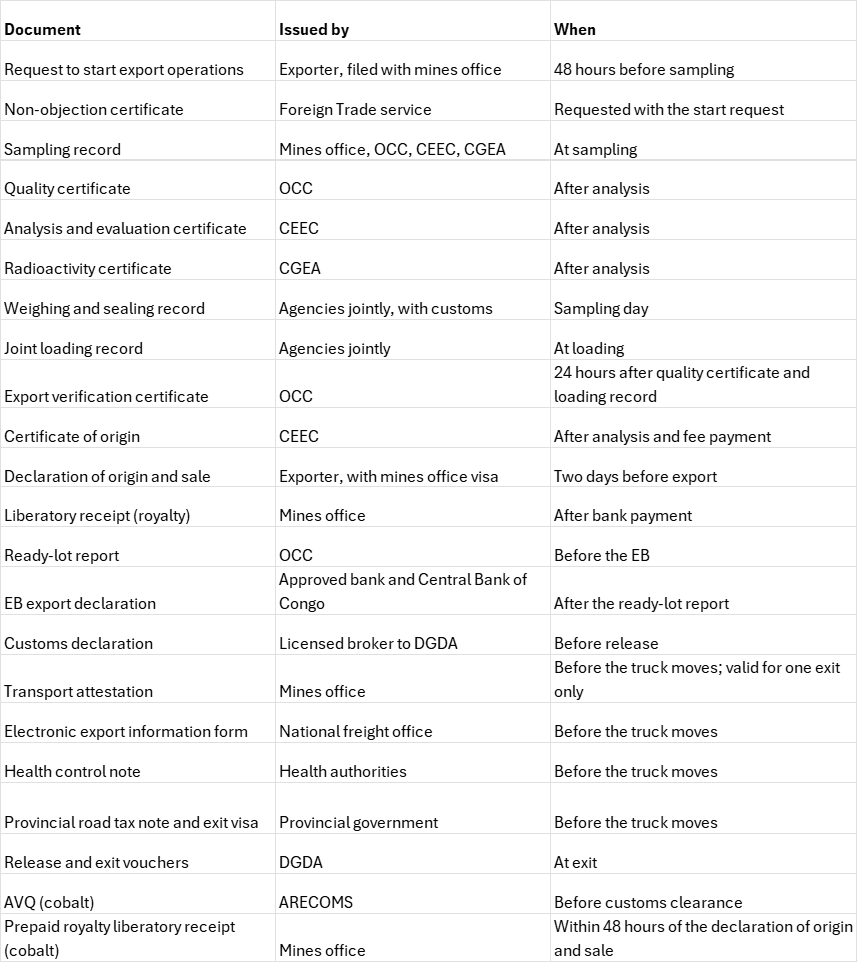
This table lists every document covered above, in the same order, with the issuing agency and the point at which each is required.
When a lot is booked, assign an owner and a target date to each line, then check off each document as it arrives.
Each agency in this process relies on documents issued before its own, so a mistake made early travels through the rest of the file. A few habits address most of the risks above:
● Settle product status first. Confirm where the lot stands under the concentrate ban and keep any waiver with the file.
● Keep one set of numbers. Lot references, weights, seal numbers, and values should match on every document.
● Have cobalt royalty funds ready. The 48-hour payment window opens when the declaration is filed.
● Leave margin before quota deadlines. Exporters were locked out of the customs platform in July.
● Check the file at the loading site. Corrections are quickest when made close to the agencies that issued the documents.
The cobalt rules have changed twice since the November 2025 circular, and the concentrate order replaced the earlier framework in 2026. Confirm the current checklist with your customs agent whenever a contract, product, or route changes.