AfCFTA and Customs Reality: What Free Movement of Goods Requires at the Border
October 19, 2026
Read the story
Please submit your details below and one of our logistics experts will reach out within one business day. Thank you.
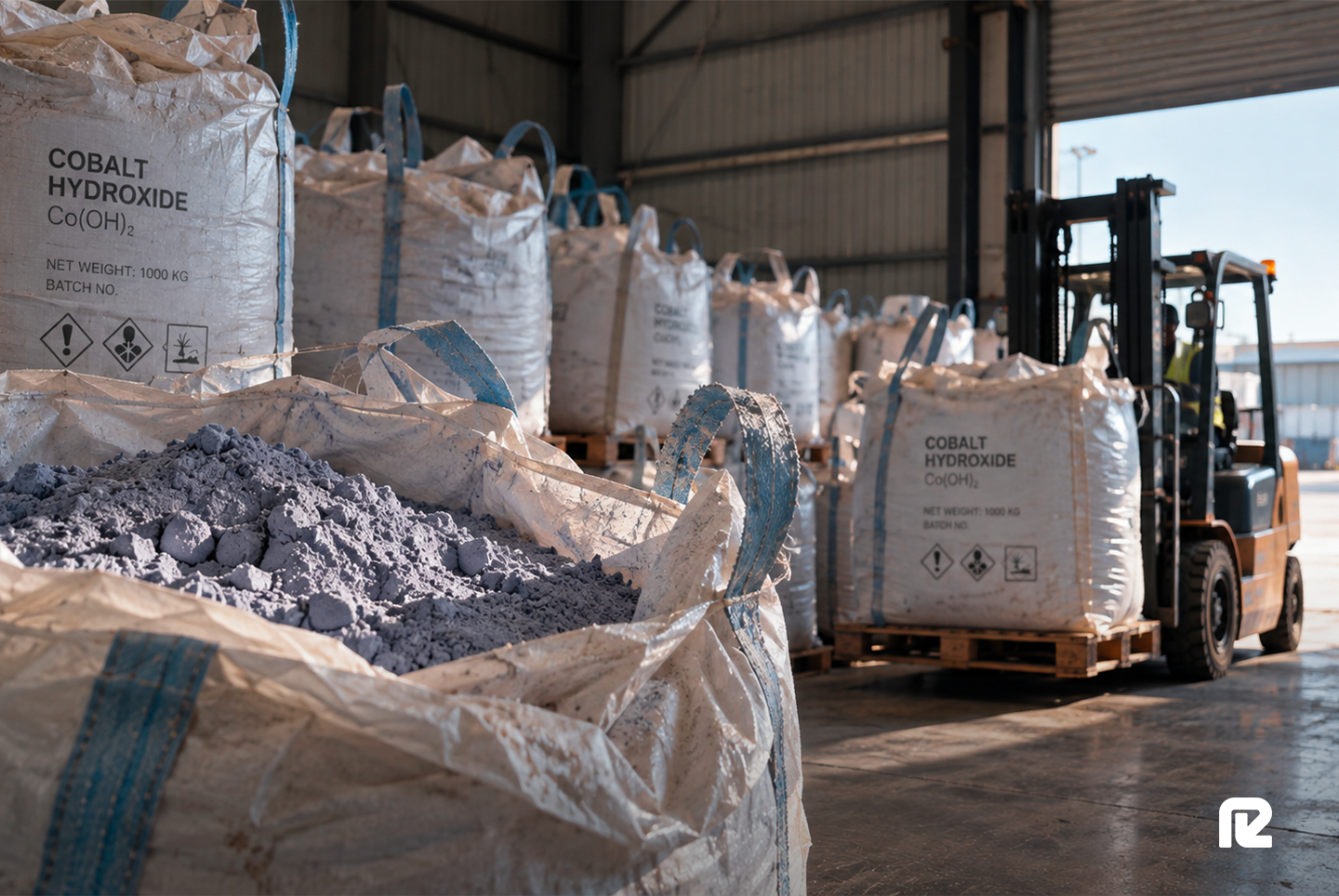

Copper and cobalt are often produced at the same DRC mines and move along the same corridors, so it is tempting to plan for them in the same way. They should not be treated the same. Copper cathode is a refined, stackable metal product. Cobalt hydroxide is a moist intermediate product that is generally treated with a HAZ IMO class as a dangerous good, with its own classification, storage approvals, permits and export controls.
• DRC copper is exported mainly as refined cathode. DRC cobalt is exported mainly as crude cobalt hydroxide.
• Published safety data sheets do not necessarily agree on how cobalt hydroxide is classified for transport. The UN number, class and packing group for a shipment must come from the producer’s official safety data sheet (MSDS) for that specific commodity & grade.
• In South Africa, storing dangerous goods above set quantities requires municipal approval. SANS 10263 is the reference standard for dangerous goods warehousing.
• The DRC order dated 29 June 2026 prohibits exports of copper and cobalt concentrates. Separately, cobalt hydroxide exports are subject to the DRC’s cobalt export quota system.
• Heavy reliance on Durban poses potential storage risks, not only a routing risk.

Cobalt is rarely refined to metal or high-purity salts in the DRC. It leaves as feedstock, and the final refining takes place at final destination, mainly in China.
Source: export figures as reported by TimesLive, 6 August 2026; share of production from Manzuk and Philippe, Nature Communications, 30 July 2026.
Cobalt hydroxide is generally treated as a dangerous good for transport, but published safety data sheets classify it differently. For example:
• Some list it as UN 3288, Toxic solid, inorganic, not otherwise specified, Class 6.1, Packing Group I (example).
• Others list it as UN 3077, Environmentally hazardous substance, solid, not otherwise specified, Class 9, Packing Group III (example).
These examples relate to laboratory-grade material. Crude cobalt hydroxide from DRC operations differs in composition and moisture content, so neither example should be relied on for a shipment. The classification must be taken from the producer’s current safety data sheet for the specific product and confirmed with the carrier.
The difference between UN 3288 and UN 3077 for cobalt hydroxide centers entirely on the physical particle size (respirability) and the severity of the acute inhalation hazard.
• UN 3288 (Class 6.1): Used when the cobalt hydroxide is a fine, refined, or highly respirable powder. Cobalt ions are highly toxic when inhaled deeply into the lungs, triggering an acute inhalation toxicity rating of Category 1. Because it is classified as Packing Group I for inhalation, flexible intermediate bulk containers (fIBCs / big bags) are generally prohibited, requiring rigid drums or specialized automated infrastructure to avoid occupational dust exposure.
• UN 3077 (Class 9): Used when the material consists of a coarser blend or granular concentrate paste where respirable particles make up less than 10% of the total mass. Because the dust risk is low, it bypasses the strict Class 6.1 toxic classification and falls into Class 9 strictly because it is a Marine Pollutant / Environmentally Hazardous Substance.
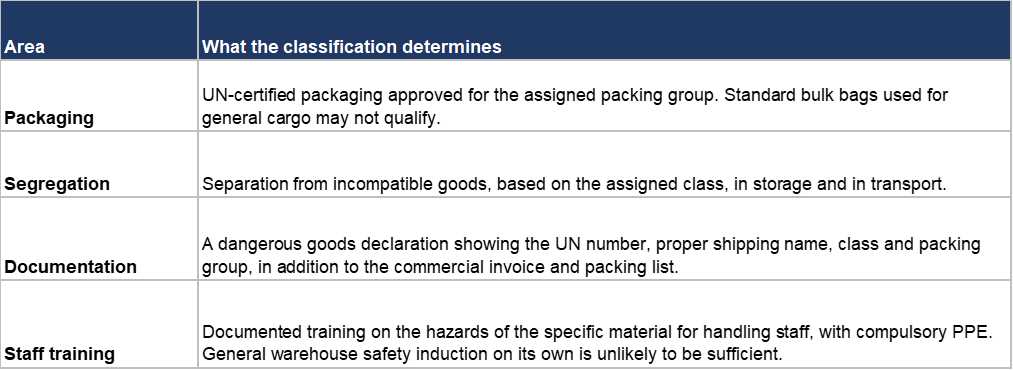
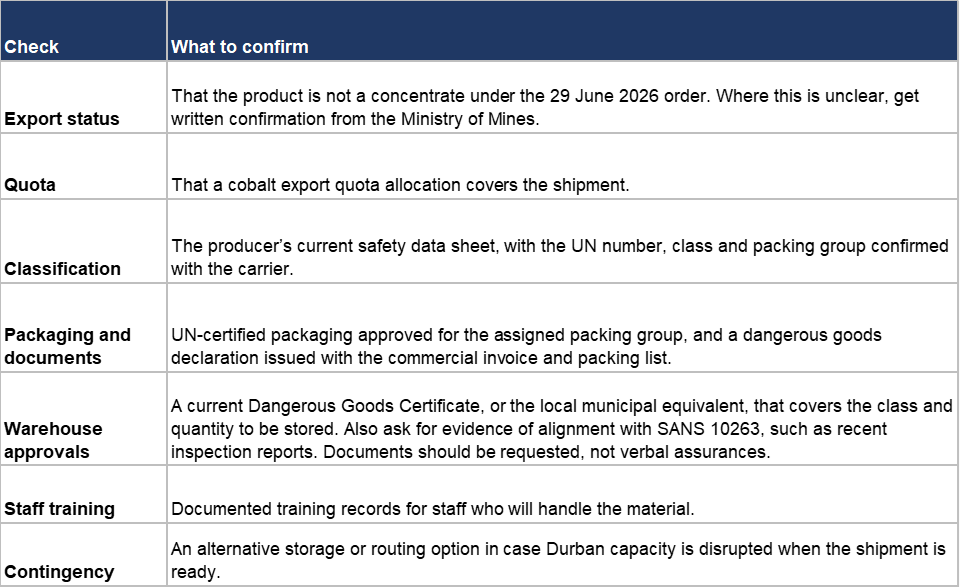
Once the classification is confirmed, it drives the following requirements, which a copper-only operation may not already meet:
Much of the DRC’s cobalt hydroxide moves by road to Durban for export and is held in South African warehouses before shipping. Experience in storing metal cargo does not, on its own, show that a facility meets dangerous goods storage requirements.
• Municipal approval. Municipal fire by-laws control dangerous goods storage. In Durban, the eThekwini Fire By-law, 2022 requires a Dangerous Goods Certificate before dangerous goods above threshold quantities may be stored on a premises. Other municipalities have similar requirements.
• SANS 10263. SANS 10263, The warehousing of dangerous goods, is the national standard for dangerous goods storage, and the eThekwini by-law refers to it.
• Consequences. The July 2021 fire at an agrochemical warehouse in Cornubia, Durban, which was set alight during civil unrest, released more than 1,600 chemicals and polluted a nearby river, soils and marine life. It shows why dangerous goods storage is closely regulated.
Concentrate ban. An order dated 29 June 2026, signed by the Ministers of Mines, Foreign Trade and Economy and reported publicly in August 2026, states that “the export of copper and cobalt concentrates is prohibited”, with immediate effect. The Minister of Mines may grant one-year waivers in cases considered strategically important. The order repeals the 2023 order and its exemptions. Earlier concentrate bans were imposed in 2013, 2019 and 2023.
Scope. The reported text of the order refers only to concentrates, and cathode and cobalt hydroxide are not named in it. However, under the 2013 restrictions, cobalt hydroxide exports relied on a ministerial waiver. Shippers should therefore check each product against the text of the June 2026 order rather than assume it falls outside the ban.
Cobalt export quotas. Since October 2025, cobalt exports have been subject to quotas administered by the Authority for the Regulation and Control of Strategic Mineral Substances Markets. The 2026 quota is reported at 87,000 tonnes of cobalt contained in hydroxide, with up to 9,600 tonnes of additional strategic quota at the government’s discretion. Exports have been reported as running below allocated volumes due to clearance delays.
Clarifications. Laboratory analysis establishes a product’s composition, but whether it counts as a concentrate under the order is a matter for the Ministry of Mines. In past bans, the ministry issued waivers and clarifications by letter or statement, including a 2019 letter to the Fédération des Entreprises du Congo, the national business federation. Where classification is uncertain, shippers should ask the Ministry of Mines for written confirmation.
Source: TimesLive, 6 August 2026; Mining Weekly, 6 August 2026.
Durban is the main export port for DRC cobalt hydroxide, and that dependency has already caused a loss event at warehouse level. Heavy rainfall across KwaZulu-Natal from 8 April 2022 damaged cobalt hydroxide inventory in a Durban warehouse and disrupted logistics. As a result, stakeholders declared force majeure on contractual deliveries of cobalt hydroxide from the DRC.
An export schedule that assumes Durban will be available on a fixed date carries the same exposure. Flood risk at the storage site should be assessed as well as port & transport capacity.
Source: S&P Global Commodity Insights, 19 April 2022.
This article is general information only. It is not legal, regulatory or dangerous goods classification advice. It does not state or imply that any particular facility, consignment, packaging or procedure complies with the requirements described. Requirements depend on the specific product, the quantities involved, the location and the regulations in force at the time, and they may change. Before acting, confirm requirements with the relevant authorities, carriers and qualified dangerous goods advisers. Information is current as at 30 September 2026.