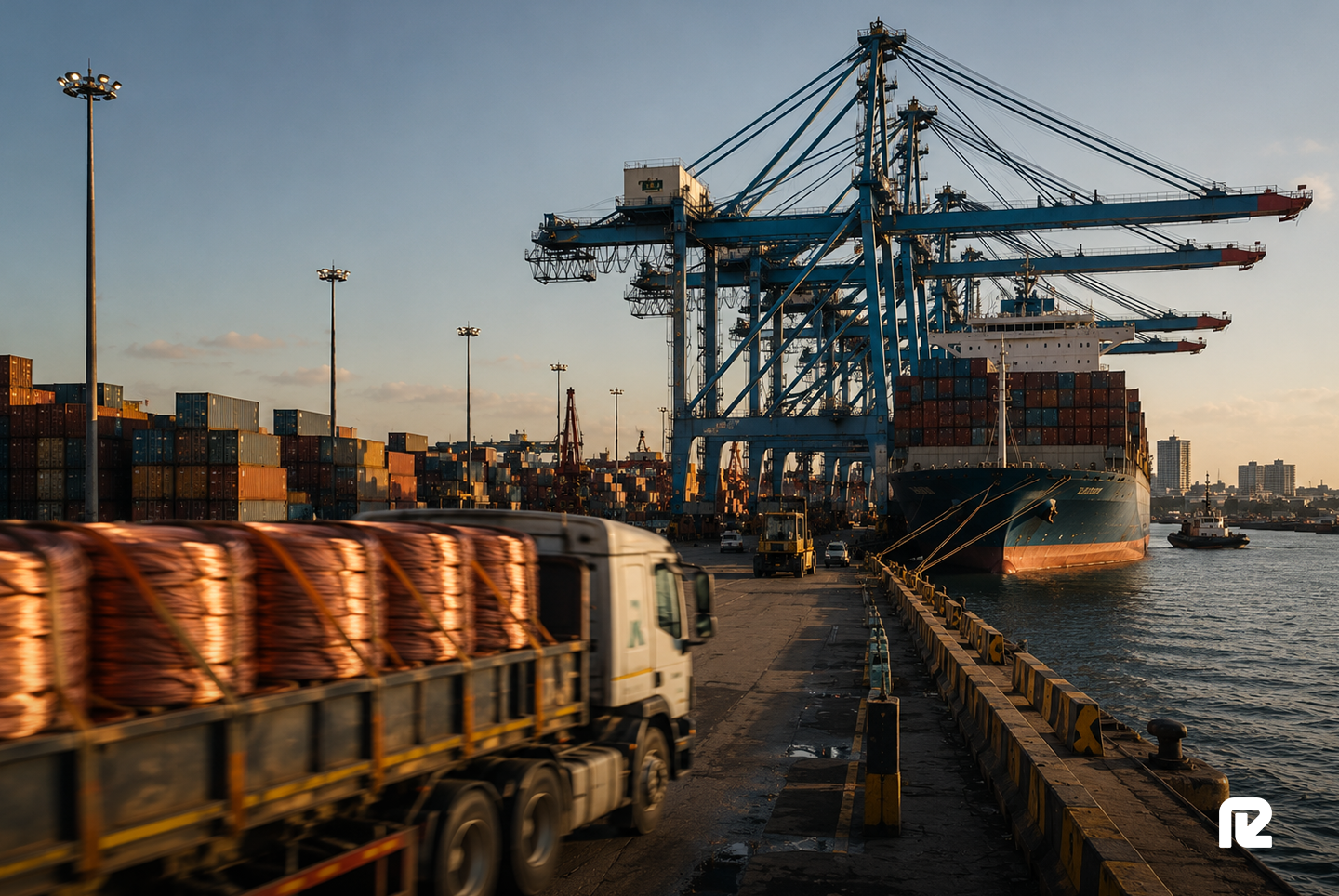
Dar es Salaam Port Delays: What They Mean for Cargo Moving to Zambia and the DRC
August 28, 2026
Read the story
Please submit your details below and one of our logistics experts will reach out within one business day. Thank you.


Freight data is the reporting a logistics provider gives its customers about how their cargo moved: where it went, how long each stage took, what it cost, and what went wrong along the way. Almost every provider now offers some form of tracking, but not all give shippers a record they can plan from.
The difference matters more than most shippers realize when they sign. A tracking link can give real-time updates on container location, but it doesn’t provide deeper information on which border cost you three days last quarter, which corridor runs closest to its promised transit time, or whether the demurrage on your last shipment was avoidable.
This article covers the data a logistics provider should be giving you, the questions worth asking before you commit, and what that reporting can and cannot tell you.
Several decisions a shipper makes each year rest on information only the provider holds. These include:
● Which corridor to route the next program through.
● How much time to build into a delivery commitment.
● Whether a rate increase is justified by conditions or is simply being passed on.
Without a record covering past shipments, each of those becomes a judgment call made on impression and whichever delay happens to be freshest in memory.
The most common cost is finding out too late. A shipper without cost visibility during transit learns what a shipment costs when the invoice lands, by which point the demurrage and detention charges are fixed.
The second cost is misattribution. When a shipment runs late, and the reporting does not show where the time went, the shipper cannot tell whether the provider handled it badly or a border stalled everyone equally. That distinction decides whether to fix the relationship or change it.
The third cost is planning against the wrong numbers. Shippers without corridor-level data to optimize route planning tend to plan on general assumptions about transit times.
The World Bank rebuilt its Logistics Performance Index in 2025 around shipment-level tracking data instead of surveys, and the 2023 to 2024 dataset found substantial time penalties tied to transshipment and border procedures, with unpredictability concentrated at ports, transshipment hubs, and inland checkpoints. Averages hide that. Your own shipment record does not.
The baseline is current status against a planned schedule, so a shipment can be seen running to plan or falling behind while there is still time to act. Beyond the live view, the more valuable output is the transit time record: how long each shipment actually took, leg by leg, across a season.
That record shows the spread as well as the average, and the spread is what a shipper plans around. A corridor that averages nine days but ranges between six and twenty is a different proposition from one that reliably takes eleven.
Dwell time is how long cargo sits at a fixed point rather than moving. It is where the cost concentrates and where the World Bank's findings put the unpredictability. A provider should be able to tell you how long your cargo waited at each port, each border crossing, and each warehouse, broken out separately.
Aggregated into a single transit figure, that information is useless for decisions. Broken out, it tells you which chokepoint to route around and where to push for improvement.
A freight invoice showing one line and one number tells you nothing you can act on. The reporting should separate the base rate from the accessorials: demurrage, detention, storage, border charges, and handling.
Seen per corridor over time, that breakdown reveals which routes carry hidden costs the headline rate never showed, which is what landed cost analysis depends on. It also puts a number on avoidable charges, which is the first thing to raise in a rate conversation.
An exception record logs what went wrong, when, and what was done about it. This is the reporting shippers ask for least and benefit from most, because patterns only surface across many shipments. One late truck is an incident. The same crossing running late in eight of twelve months is a routing problem. A provider willing to hand over its own exception record is showing a level of confidence worth noting in itself.
Most providers will say yes when you ask if they offer visibility. These questions get you a more useful answer:
● What reporting comes as standard, and what is available on request? Providers differ in what they include by default. Ask at the contract stage, when it is easier to agree than to add later.
● Are costs visible before the invoice? Charges that appear only at settlement are charges you had no chance to prevent.
● How will I hear about a problem, and how quickly? An alert during transit is worth more than a report after the fact, because one leaves time to act and the other does not.
● How does reporting hold up on remote stretches? Connectivity is patchy on parts of most African corridors, so it is worth asking what happens to the record when a vehicle is out of signal.
● What does the provider measure itself against? A provider tracking its own on-time performance is easier to hold to account than one that measures nothing.
The reporting earns its keep when it changes what a shipper does. Corridor comparison is the clearest case: with dwell and transit records across more than one route, routing stops being a habit and becomes a decision based on how each corridor has performed for your cargo.
Delivery commitments improve for the same reason. A shipper who knows the real spread of transit times can promise dates it will hit rather than padding every quote to cover a worst case that rarely happens. Rate conversations change too, because a shipper arriving with a corridor cost record is negotiating from evidence.
Then there is the provider review itself. Freight data is the basis for judging whether the provider is doing what it said it would, which connects directly to how vendor and supplier risk gets managed. Our guides to freight analytics and logistics KPIs cover the wider discipline of turning that record into measurement.
Three limits are worth holding in mind.
The first is that a provider reporting on its own performance has an interest in how that performance looks. This is not a reason to distrust the data, and most providers report accurately, but it is a reason to ask how figures are calculated. A transit time measured from collection reads better than one measured from booking.
The second is coverage. A provider can report on the legs it controls. When cargo passes to another party, the record often thins out, which is one of the arguments for running the full chain under one operator rather than stitching reports together from several.
The third is that data describes rather than decides. UNCTAD's 2025 review found that congestion and long waiting times remain a problem for developing countries even as African port connectivity grew faster than any other region. Knowing a port is congested does not clear it. The record tells you where the problem sits and how big it is, and someone still has to act.
Freight data is the part of a logistics relationship where shippers most often accept whatever they are given. Asking better questions about it before signing costs nothing and changes what you can see for the length of the contract. A provider that reports well is easier to work with, easier to hold to account, and easier to improve alongside.