Kazungula Bridge: What It Means for Zambia-Bound Freight
September 15, 2026
Read the story
Please submit your details below and one of our logistics experts will reach out within one business day. Thank you.

Logistics operations generate around 8% of global carbon emissions, and businesses everywhere are looking to reduce their environmental footprint. Many shippers believe that focusing on sustainability conflicts with operational priorities like cost control and delivery reliability, but the reality is very different.
Sustainable freight transportation focuses on eliminating waste, optimizing routes, and using data to move goods more efficiently. When businesses implement these strategies, they more than often find they begin to reduce both emissions and costs at the same time.
This article explores the practical approaches to sustainable freight forwarding, goes through the modes and strategies that deliver measurable impact, and how environmental goals can be met without compromising performance.
At its core, sustainable logistics is all about better planning. Consolidating shipments eliminates running partly empty trucks, making sure to choose appropriate transport modes depending on the type of cargo and its needs, while using data to prevent inefficient last-minute solutions are all techniques designed to reduce environmental impact and improve bottom-line performance.
Freight forwarders make decisions daily related to transport modes, routing, consolidation, and timings, all choices that affect sustainability in freight forwarding. The three forces driving this are:
Regulatory pressure: Carbon reporting requirements, taxes on emissions, and environmental compliance standards are expanding across major trade lanes.
Customer requirements: Major manufacturers increasingly demand emissions data from logistics providers, affecting long-term partnerships.
Economic incentives: Strategies that reduce fuel consumption like consolidation, optimized routing, and appropriate modal selection, deliver environmental and financial returns together.
Understanding sustainable freight transport requires clarity on several interconnected concepts:
1. Environmental sustainability: Minimizing emissions, pollution, and resource consumption throughout the transport process.
2. Economic sustainability: Maintaining cost-effective operations that support business viability while investing in efficiency improvements.
3. Social sustainability: Ensuring safe working conditions, fair labor practices, and positive community impact across supply chains.
These dimensions reinforce each other. Fuel-efficient operations reduce costs and emissions, and reliable transport networks support both business performance and community development.
Sustainable logistics operates on several foundational principles:
1. Efficiency first: A half-empty truck using alternative fuel is still less sustainable than a full truck using conventional fuel.
2. Modal optimization: Not every shipment needs the fastest option; make sure to match transport modes to cargo characteristics.
3. Data-driven decisions: Measure emissions, track performance, and use visibility to improve sustainable practices.
4. Systemic thinking: Address root causes rather than symptoms. Late shipments requiring air freight often reflect upstream planning failures more than transport problems.
Transport mode selection is one of the most impactful sustainability decisions shippers make. Each mode offers different trade-offs between speed, cost, flexibility, and environmental impact.
Road freight provides flexibility but generates a lot more CO2 emissions per ton-kilometer, depending on vehicle type and utilization.
Road transport sustainability includes:
· Improved route planning
· Optimizing vehicle space to run fewer partially loaded trucks
· Fleet modernization with fuel-efficient vehicles
Rail freight offers one of the lowest emissions of CO2, making it highly efficient for long-distance transport.
Rail transport optimization includes:
• Using electrified rail networks
• Working on better integration with road transport for first and last mile
Ocean freight is the most carbon-efficient option for international transport, though actual impact usually varies significantly based on vessel size, age, and speed.
Ocean freight efficiency includes:
• Full container utilization
• Route optimization considering weather
• Modern vessel technology to improve fuel efficiency
Air freight is the least sustainable transport option but can be necessary for time-critical cargo.
Air freight impact reduction includes:
• Limiting use to genuinely time-critical cargo
• Consolidation of urgent shipments
• Efficient routing and aircraft selection
• Carbon offset programmes
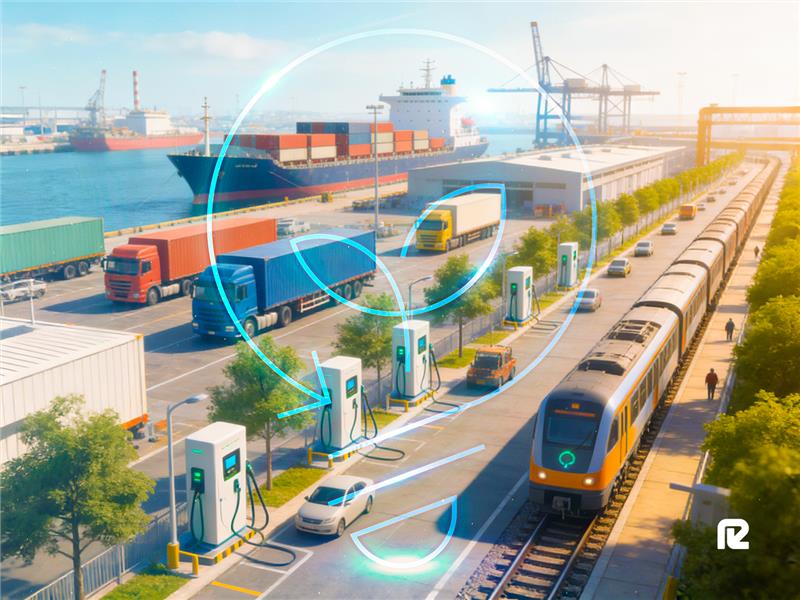
Intermodal transport combines the strengths of different transport types, offering several advantages:
Environmental benefits: Ocean or rail for long distances combined with road for final delivery can create lower overall emissions than road-only transport.
Cost optimization: Intermodal strategies match each journey segment to the most cost-effective appropriate mode.
Flexibility and resilience: Multiple mode options provide alternatives when disruptions occur, this reduces reliance on single transport types.
The complexity of managing multiple modes often deters businesses from pursuing intermodal strategies, but this complexity can be managed through proper planning and partnerships.
Timing and synchronization represent the first challenge as shipments must be planned around vessel schedules, rail departure times, and road availability to avoid costly delays. Missing a departure window can add days to transit times. Avoiding this requires sophisticated planning systems and buffer times that balance efficiency with reliability.
As planning complexity increases, visibility becomes more critical to track. Digital platforms that provide this visibility across different transport modes are essential for managing this as they enable proactive management when delays threaten connection. Without this integrated visibility, intermodal operations become difficult to manage.
So much of the success of intermodal transport relies on strong partnerships between different carriers, operators, handlers, and providers, all who need to coordinate seamlessly and align goals. The best logistics partners strengthen these relationships and improve coordination, allowing shippers access to intermodal benefits without having to directly manage the complexity and moving parts themselves.
Warehousing sustainability extends to operational practices that affect both environmental impact and costs. While energy-efficient buildings and renewable power sources receive significant attention, the way warehouses operate, including how goods flow through them, how inventory is managed, and how systems are configured, often deliver sustainability improvements that are just as important.
Modern warehouses increasingly use solar panels, wind energy, or grid-supplied renewables to power operations. While this requires a higher spend upfront, energy cost savings and sustainability credentials often justify the expense.
Operational technology improvements deliver immediate impact:
Automated systems: Modern warehouse automation often reduces energy consumption per unit handled through optimized movement and reduced equipment during idle time.
Temperature control optimization: Cold storage facilities use significant energy. Improved insulation, efficient refrigeration systems, and smart temperature management reduce consumption.
Layout optimization: Efficient warehouse layouts reduce travel distances for forklifts and personnel, decreasing equipment operation time and energy use.
Supply chain optimization creates sustainability through efficiency. This includes:
• Freight consolidation: Combining multiple shipments reduces the amount of transport movements, emissions, and per-unit costs.
• Network design: Strategic placement of warehouses and distribution centers reduce the distance transport needs to travel to the end location. Facilities located near ports, production sites, or end markets minimize unnecessary miles.
• Inventory optimization: Maintaining inventory levels reduces warehousing requirements and eliminates waste.
Operational energy efficiency supports both sustainability and cost control:
• Process streamlining: Reducing handling, dwell times, and optimizing workflows decrease energy consumption and processing costs.
• Technology integration: Digital platforms built to improve visibility automate documentation and optimize planning, reducing manual processing time, and enabling better decision-making.
• Predictive maintenance: Maintaining equipment before failures occur improves efficiency, reduces downtime, and extends asset life.
Despite clear benefits, sustainable freight faces practical challenges:
Not all regions have reliable rail networks, modern port facilities, or integrated intermodal systems that can support sustainable freight transport, meaning strategies must adapt to the infrastructure available throughout the regions shippers operate in and use techniques that optimize within constraints, rather than applying textbook solutions that require infrastructure that may not be available.
There can be inconsistent emissions data, limited visibility across complex supply chains, and varying calculation methodologies that make accurate measurement difficult. Sometimes there is limited visibility into supply chains, keeping emissions from upstream activities invisible, and preventing clear improvements.
Sustainability fails when transport, procurement, and operations teams pursue conflicting objectives. Cross-functional coordination supported by shared metrics and aligned incentives is essential for successful sustainability initiatives to span across entire supply chains.
Some sustainability investments require upfront capital that delivers returns over time, creating tension with short-term cost reduction targets. Resolving this can require clear return timelines and leadership teams willing to support investments that may not deliver immediate results, but more long-term financial benefits.
Global supply chains involve multiple parties with varying capabilities and priorities. As discussed above, coordinating sustainability efforts across this complexity requires clear communication.
Sustainable freight forwarding requires expertise, coordination, and operational insight across complex supply chains. Reload Logistics helps businesses implement practical sustainability strategies that deliver measurable environmental and economic results.
We work with clients to identify efficiency opportunities across their supply chains, including freight consolidation, transport optimization, smarter route planning and data-driven decision-making. Reload provides the guidance and execution needed to achieve your goals without compromising performance.
Contact us to discuss how we can optimize your supply chains while staying sustainable.
Sustainable freight transport moves goods with minimal environmental impact while maintaining efficiency, reliability, and cost effectiveness.
Consolidating multiple shipments into full truckloads instead of running half-empty vehicles, shifting appropriate cargo from road to rail for long distances, or using ocean freight instead of air freight for non-urgent shipments.
Road freight, rail freight, ocean freight, and air freight. Each offers different trade-offs between speed, cost, flexibility, and environmental impact.
Ocean freight is the most carbon-efficient for international transport. For inland distances, rail freight offers the lowest emissions. Efficiency depends on cargo characteristics, distance, and available infrastructure.