Dar es Salaam Port Delays: What They Mean for Cargo Moving to Zambia and the DRC
August 28, 2026
Read the story
Please submit your details below and one of our logistics experts will reach out within one business day. Thank you.

Infrastructure logistics is the movement of materials and equipment to construction sites: steel, cement, machinery, transformers, pipe, cable, and the oversized components that arrive in sections and are assembled where they will stand. Much of it travels a long way first.
On a Southern African project, imported equipment lands at a port, clears customs, and moves inland by road or rail, often crossing a border before it reaches the site.
Whether that flow works decides whether a project runs to schedule. A site cannot pour foundations without cement and reinforcing steel on hand, and it cannot install a turbine still sitting at a quayside. This article covers what infrastructure projects need from logistics, how the materials move, and where the process most often breaks down.
Infrastructure work draws on two broad categories of cargo. The first is bulk construction material: cement, aggregate, reinforcing steel, and pipe, usually needed in large volumes and often over a sustained period.
The second is capital equipment: generators, transformers, turbines, cranes, boilers, and the heavy plant a project needs to build and then to operate. The two behave differently in a supply chain. Bulk material arrives repeatedly, and the challenge is keeping the flow steady. Capital equipment arrives once, costs a great deal, and cannot be replaced quickly if something goes wrong with it in transit.
Much of the capital equipment on an African project is imported, which brings freight forwarding, customs, and inland transport into the picture before a single component reaches the site.
Construction runs on sequence. Foundations before structure, structure before mechanical installation, mechanical before commissioning. Materials that arrive out of order are not early; they are in the way, occupying space and needing handling twice. Materials that arrive late stop the work entirely and hold up every trade waiting behind that step.
This is what separates project logistics from ordinary freight. The measure of success is delivery on the date the build program calls for, not the fastest possible transit. A component that arrives three weeks early on a site with no space to store it has created a problem, not solved one.
South Africa's 2026 budget committed more than a trillion rand to infrastructure over the medium term, described by the president as the largest such allocation in the country's history, spread across transport, energy, water, and digital projects.
A new agency housed within the Development Bank of Southern Africa began operating in April 2026 with a mandate to bring private finance into infrastructure delivery and reduce the fragmentation that had slowed earlier projects.
For anyone planning around this pipeline, Infrastructure South Africa publishes a construction book listing funded projects expected to reach tender within eighteen months, which is a more reliable planning document than announcements alone.
Worth keeping in proportion: the construction sector contracted in both 2024 and 2025, and forecasts point to modest annual growth from 2026 rather than a sudden surge. The pipeline is funded and substantial. The activity is arriving gradually.
Transport carries the largest share of that spending, covering road building and maintenance, rail rehabilitation, and port upgrades. Energy follows, including transmission grid investment and renewable connections, and water infrastructure takes a significant portion for bulk supply and sanitation work.
Each type of project has its own logistics profile. Transmission and renewables work bring transformers, cable drums, turbine sections, and solar module volumes. Water projects bring large-diameter pipe, valves, and pumping equipment. Port and rail rehabilitation brings cranes, track material, and heavy plant. The common thread is that the specialized components are usually imported and the bulk material is usually local.
Some of the largest projects in the region are the trade corridors themselves. Rail rehabilitation, border post upgrades, and port expansion all require their own inbound freight, and they carry an additional complication: the route being improved is often the route the materials have to travel. Delivering to a corridor project can mean working around the disruption the project itself is causing.
Bulk construction material moves in volume and competes for the same transport capacity as everything else on the corridor. The planning problem is rate rather than quantity: how much arrives each week, matched to how fast the site consumes it.
Break bulk cargo, meaning items too large or awkward for containers but not requiring specialist heavy lift, covers a great deal of project material including steel sections, pipe, and machinery on skids.
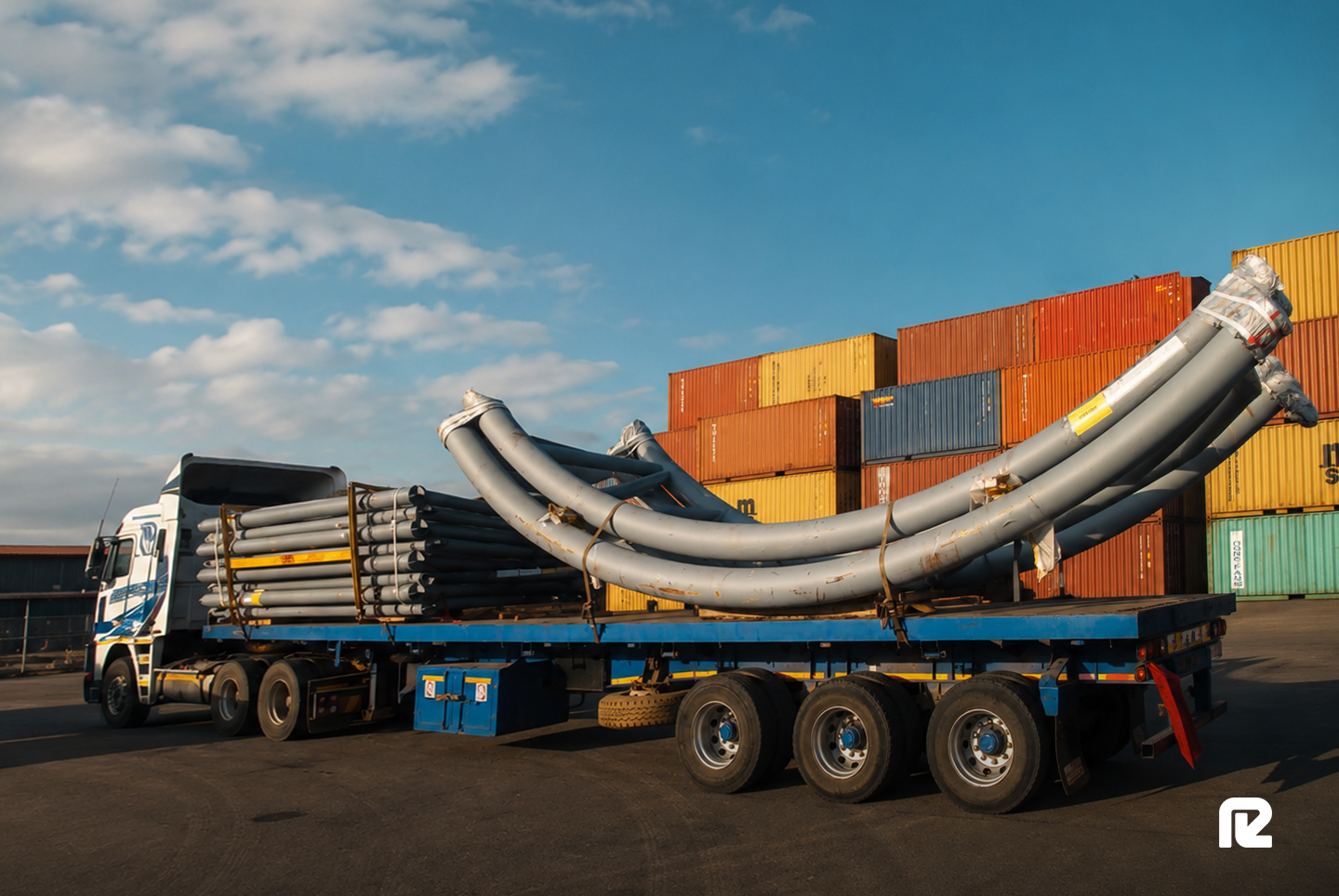
Some project components exceed the legal limits for road transport and need permits, escorts, and route surveys. An abnormal load may require a route checked in advance for bridge weight limits, overhead clearances, and turning radii, and permits from each authority along the way. On a cross-border move, that means separate permission in each country.
This is the specialist end of the discipline, covered in more depth in our guide to project cargo. The planning lead time is what surprises people most. A route survey and permit process can take weeks, so the transport arrangements for an oversized component need to begin well before it arrives at the port.
Imported project equipment carries customs obligations that can be substantial on high-value plant. Many countries offer duty relief or rebates on capital equipment for approved projects, and those arrangements have their own documentation and approval processes. Getting the classification and the paperwork right before the cargo arrives is what keeps equipment moving through the port rather than accruing storage charges while a query is resolved.
Documentation errors are a common cause of project delay, and they are among the most avoidable.
Construction sites rarely have room to hold everything they will eventually need, and leaving high-value equipment on an open site carries security and weather risk. So project material is usually held somewhere else and released as the build calls for it.
That staging point is often a warehouse or yard positioned between the port and the site, close enough to deliver within a day or two but away from the constraints of the construction area.
Bonded facilities add a further option, allowing imported equipment to sit under customs control until duty falls due, which matters on projects where equipment arrives well ahead of installation.
Done well, staging turns an unpredictable arrival pattern into a controlled one. Equipment lands when the vessel lands, and it reaches the site when the program calls for it, which are rarely the same date.
A few failure points recur across infrastructure projects in the region:
● Lead times underestimated at planning stage. Permit processes, route surveys, and customs approvals take longer than most build programs assume, and the assumption is usually made months before anyone checks.
● Port delays absorbed by the site. Cargo held at a congested port or waiting on clearance accrues demurrage and storage charges while the site waits, so a delay at the coast becomes a cost and a schedule problem inland.
● Border crossings not built into the schedule. A border that adds days to a routine shipment adds the same days to a project delivery, and few build programs allow for it.
● No contingency on single-source components. When one transformer or one turbine section is delayed, and there is no alternative, the whole commissioning date moves. Risk planning on those items is worth more than on anything else in the shipment.
Infrastructure projects reward experience over general capability, and a few questions distinguish the two:
● Ask about abnormal load experience on your specific route. Route surveys and permits are country-specific and corridor-specific, so a record elsewhere means less than a record on the road your cargo will travel.
● Ask how they handle the port-to-site sequence. Clearing, staging, and timed release to a build program is a coordinated operation, and providers who handle only one leg of it will hand off the rest.
● Ask what happens when the program moves. Construction schedules change. A partner who can hold cargo and re-sequence deliveries is worth more than one quoting the cheapest single move.
● Ask about customs relief on capital equipment. A provider who understands project duty arrangements can save a substantial amount on high-value plant, and one who does not will simply pay the standard rate.
Infrastructure projects across Southern Africa depend on freight arriving in the right order, at the right time, through ports and borders that do not always cooperate.
The logistics planning that makes that work belongs at the start of a project rather than as something arranged once the equipment is already on the water.