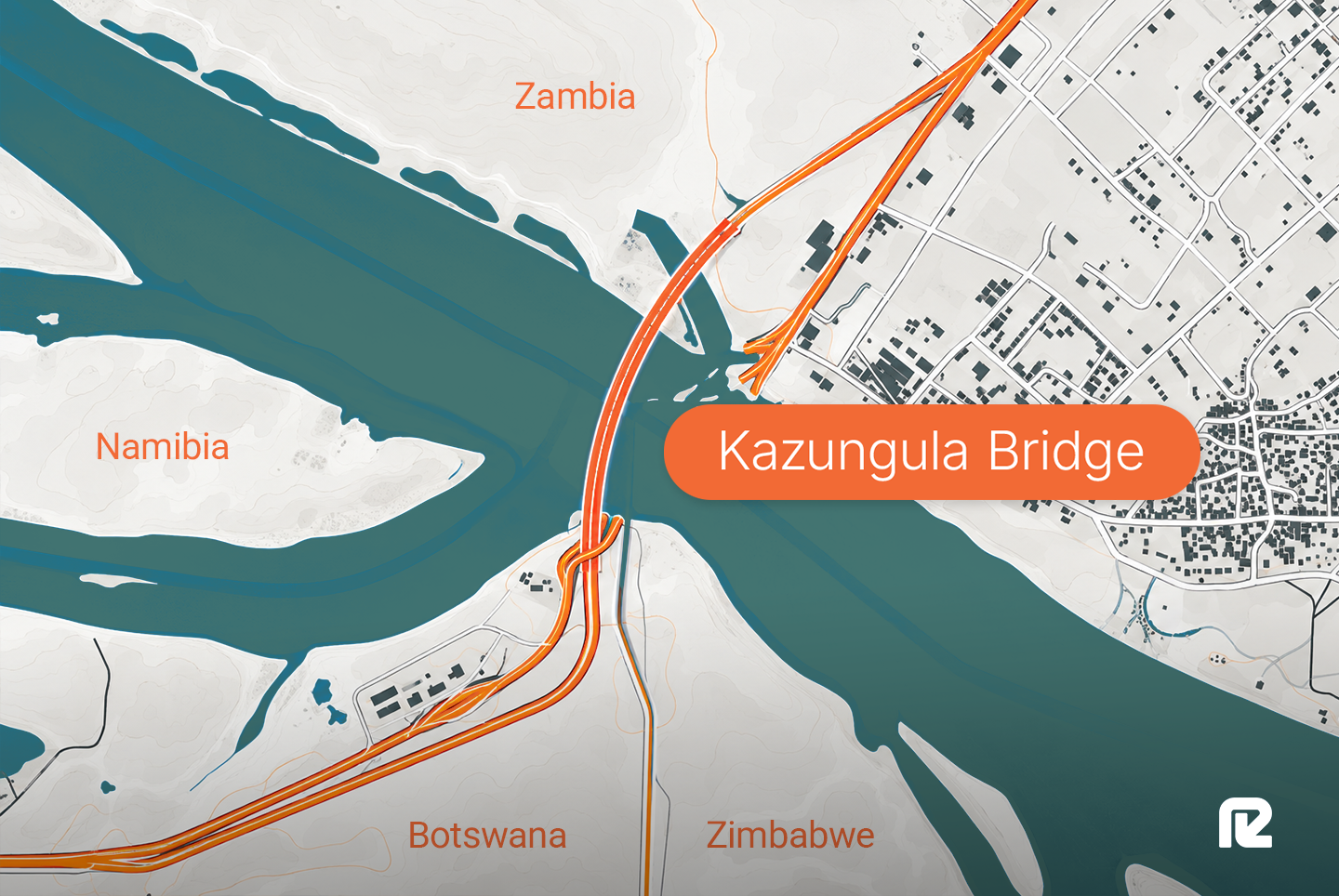
Kazungula Bridge: What It Means for Zambia-Bound Freight
September 15, 2026
Read the story
Please submit your details below and one of our logistics experts will reach out within one business day. Thank you.


Shipping lines and freight forwarders both appear in the same supply chains, often on the same invoices, and are sometimes treated interchangeably, but they aren't.
They do different jobs, carry different responsibilities, and the choice between them, or the decision to use both, has real consequences for how a shipment moves and what it costs.
A shipping line owns or operates vessels and sells space on them. That's the business: invest in ships, containers, and port infrastructure, then fill that capacity with paying cargo.
The major players, Maersk, MSC, CMA CGM, Hapag-Lloyd, run global networks of scheduled services across hundreds of ports. Alongside them, smaller regional lines serve specific trade lanes, including routes along the African coast.
Booking space with a shipping line means buying a slot on a vessel for a specific route and sailing. The carrier takes responsibility when it receives the cargo at the port of loading and hands it back when it arrives at the destination port. Everything before and after that is outside their scope.
A freight forwarder is an intermediary that organizes the movement of cargo on behalf of a shipper. A freight forwarder typically doesn’t own the vessels, trucks, and aircraft that transport goods. What the freight forwarder provides is the expertise, relationships, and the ability to coordinate multiple service providers into an end-to-end logistics solution.
In practice, a freight forwarder handles the complexity that most businesses don't want to manage themselves: booking cargo space with carriers, arranging inland transport, managing customs documentation, coordinating warehousing, and keeping the shipper informed throughout.
For a business moving goods across multiple countries and modes of transport, a freight forwarder is the single point of contact that ties everything together.
A straightforward example: a mining company in Zambia needs to export a consignment of copper cathodes to a buyer in Rotterdam. The freight forwarder arranges inland transport from the mine to Durban, books space on a vessel, manages export customs clearance in South Africa, handles the documentation required at the destination, and coordinates delivery to the buyer's warehouse. The shipping line moves cargo across the ocean. The freight forwarder manages everything else.
Freight forwarding is fundamentally a coordination job. A forwarder works across a network of carriers, customs brokers, port agents, and warehouse operators to move a shipment from origin to destination.
On a multi-leg international movement that might involve road freight to an export port, ocean freight to a transshipment hub, onward sea freight to the destination port, and final inland delivery, each leg involves a different service provider, a different set of documents, and a different regulatory environment.
The forwarder's value is in managing that complexity, so the shipper doesn't have to.
Most forwarders have a primary specialism, though many work across more than one mode. Ocean freight forwarders handle sea freight and are the most relevant for businesses trading into or out of Sub-Saharan Africa, where the bulk of international cargo moves by sea.
Air freight forwarders deal with time-sensitive shipments where speed justifies the higher cost. Multimodal forwarders work across road, rail, sea, and air and are more appropriate for complex movements crossing multiple countries and modes.
Some forwarders operate as NVOCCs (Non-Vessel Operating Common Carriers). The model works like this: the NVOCC buys space in bulk from shipping lines and resells it to individual shippers.
Legally, it acts as a carrier to its customers, issuing its own bills of lading and taking on carrier liability, despite owning no vessels.
For shippers, the practical benefit is straightforward. An NVOCC can often offer competitive rates through its volume of purchasing power, while still providing the coordination and documentation services of a traditional forwarder. You get the pricing advantages of scale without having to generate that scale yourself.
The list of what a full-service forwarder handles is longer than most shippers expect. Cargo booking, customs clearance at both ends; documentation including bills of lading, certificates of origin, and commercial invoices, inland transport, cargo insurance, warehousing, consolidation, and shipment tracking are all part of the picture.
In practice, the scope depends on the forwarder and what's been agreed with the client. Some manage the entire movement from collection to delivery, while others focus on specific legs or particular functions within the chain.
The distinction between the two is around assets, scope, and responsibility.
The most fundamental difference between a shipping line and a freight forwarder is what they own. A shipping line's business is built around physical assets: vessels, containers, and, in many cases, port terminals. Filling that capacity efficiently is how it makes money.
A freight forwarder owns none of those things. No vessels, no containers, no guaranteed cargo space. What it brings instead is the ability to access and coordinate other people's assets on a shipper's behalf. Different models, different value propositions.
The vessel and the containers are owned by shipping lines or operated under long-term leases. When a shipper works with a freight forwarder, the forwarder arranges space on a shipping line's vessel. The shipper may never interact directly with the shipping line at all.
Book directly with a shipping line, and you have a contract for one thing: space on a vessel between two ports. The sea leg, nothing more.
A freight forwarder contract works differently. The forwarder takes responsibility for the end-to-end movement and sub-contracts the individual legs, including the sea freight, on your behalf. One contract, multiple services, one point of accountability.
Shipping lines charge a freight rate for the sea leg, then add surcharges for fuel, port handling, documentation, and a range of other costs. The bill can look deceptively simple until the surcharges arrive.
Freight forwarders charge service fees on top of the carrier costs they pass through. Their quotes tend to come as a bundled all-in figure covering multiple services and legs. That makes door-to-door comparisons easier, but if you want to understand what each component actually costs, you'll need to ask.
Direct booking with a shipping line puts the shipper in the driving seat. Vessel selection, sailing schedules, and documentation are all decisions that sit with the shipper rather than an intermediary.
Working through a freight forwarder means handing those decisions over. For most businesses, that's a relief rather than a problem, particularly when the alternative is managing the detail across multiple carriers, ports, and regulatory environments. For those who want to stay close to every operational decision, it's worth factoring in.
How cargo loss and damage claims work is dependent on whether you have used a shipping line or a freight forwarder.
Shipping line liability is governed by international conventions, most commonly the Hague-Visby Rules. The coverage is limited, often to a relatively low figure per unit, which rarely reflects the actual value of the cargo. Freight forwarder liability is set by the terms of its own contract with the shipper, and those terms vary considerably.
Neither arrangement is a substitute for cargo insurance. Arranging cover separately, specific to the shipment and its value, is the only reliable way to make sure you're actually protected.
Benefits of Booking Direct with Ocean Carriers Benefits of Booking Directly with Ocean Carriers
There are situations where going directly makes sense. Cutting out the forwarder removes their margin from the sea freight cost, gives the shipper a direct line to the carrier's scheduling and capacity, and keeps the contractual picture simple for straightforward port-to-port movements.
Shipping lines reward volume. Shippers who can commit to consistent freight flows on specific lanes are in a position to negotiate contract rates that reflect that commitment.
At sufficient volume, those rates can be competitive with what a forwarder offers, even after the forwarder's margin is taken out of the comparison.
The sea leg is covered, but everything else isn't. Inland transport, customs clearance, documentation, and port coordination are not covered with a shipping line booking.
For businesses that don't have the in-house capability to manage those functions, the savings on the freight rate can disappear quickly once the true cost of handling everything else is added up.
Large commodity exporters with their own port operations, businesses that run dedicated logistics teams, and shippers moving high volumes on a handful of fixed lanes tend to get the most out of direct carrier relationships.
The common thread is that they already have the infrastructure and expertise to handle what the shipping line doesn't cover.
International trade has a steep entry price for businesses without existing carrier relationships, customs knowledge, or logistics infrastructure. Most smaller businesses and first-time exporters don't have those things in place. A freight forwarder does
The more moving parts a shipment has, the stronger the case for a freight forwarder. Multiple borders, multiple modes, regulated cargo, and specialist handling requirements each add coordination complexity that compounds quickly.
A multimodal movement across Sub-Saharan Africa, touching several countries with different customs procedures, border requirements, and documentation standards, is not a problem that manages itself, but it's where an experienced forwarder is worth paying for.
Most full-service forwarders offer more than cargo coordination. Warehousing, cargo insurance, customs brokerage, consolidation of smaller shipments into full container loads, and shipment tracking are all commonly part of the offering.
For businesses that want one partner handling multiple logistics functions rather than managing several relationships separately, that breadth of service matters.
Freight forwarding tends to be the default choice for businesses without dedicated logistics teams, shippers moving cargo across multiple countries and modes, anyone dealing with regulated or high-value cargo, and companies moving into new markets where local knowledge is genuinely hard to replicate.
In Sub-Saharan African trade specifically, where a single cross-border movement can touch several jurisdictions with different rules and procedures, having an experienced forwarder in your corner is less optional than it might appear.
Most businesses that move goods internationally end up working with freight forwarders and shipping lines.
The shipping line provides the vessel capacity, while the freight forwarder provides everything else. Understanding where one ends and the other begins is what allows businesses to make better decisions about who they engage, on what terms, and for which parts of the journey.
In Sub-Saharan African trade, where the logistics chain is rarely simple, and the cost of getting it wrong is high, that clarity is worth having.