AfCFTA and Customs Reality: What Free Movement of Goods Requires at the Border
October 19, 2026
Read the story
Please submit your details below and one of our logistics experts will reach out within one business day. Thank you.
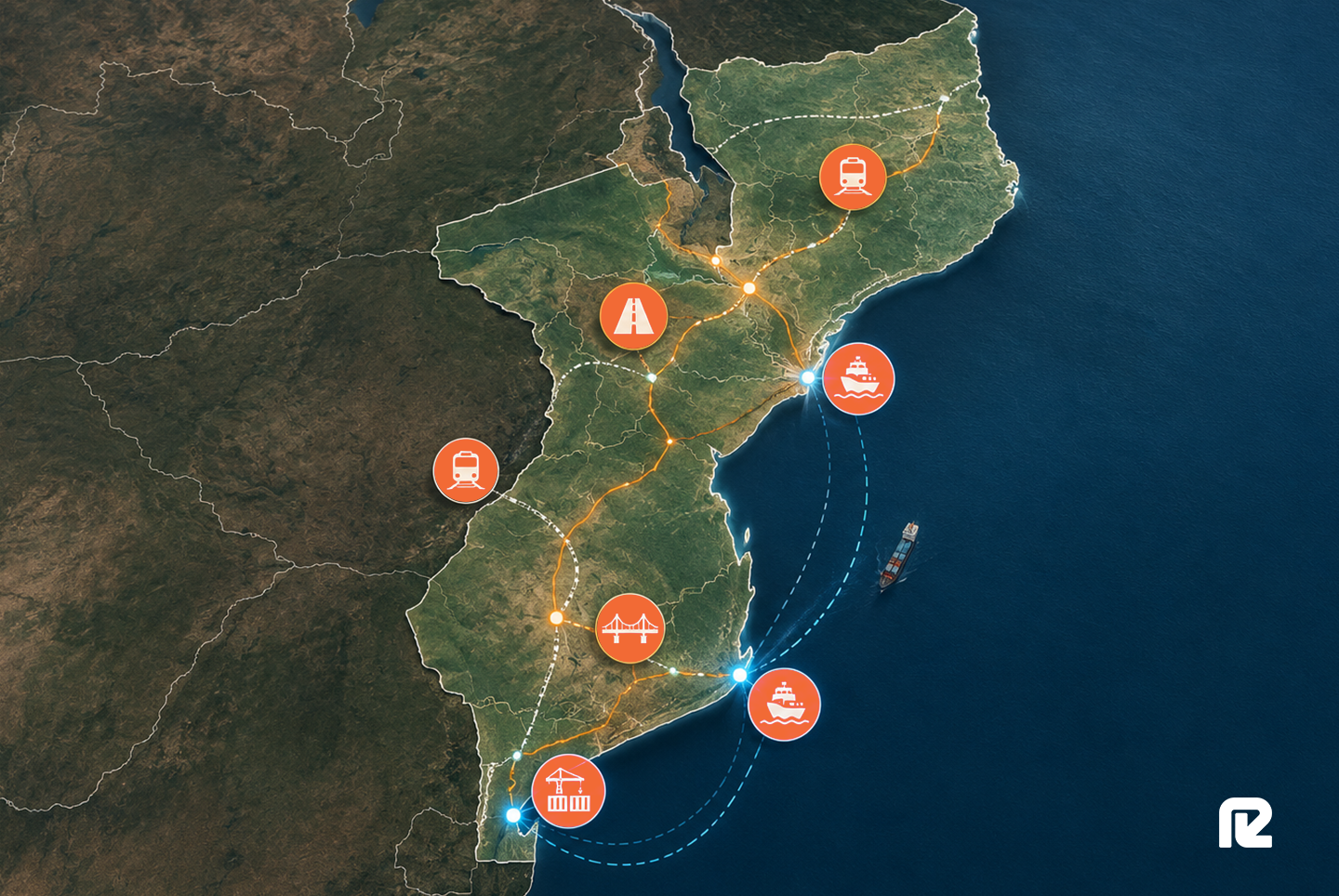

Mozambique's two main trade corridors are undergoing their most significant infrastructure investment in decades. For freight forwarders, logistics operators, and businesses that depend on reliable access to landlocked markets in Southern and Central Africa, the changes happening along the Beira and Nacala corridors are worth understanding in detail.
This article sets out where each corridor stands, what is being invested in and why, and how to think about choosing between them for different freight types and destinations.
Mozambique's geographic position gives it a role in African trade that no other country can replicate. Its Indian Ocean coastline provides the shortest sea access for several landlocked countries, including Zimbabwe, Zambia, and Malawi, and the two corridors that run from its ports into the interior are among the most strategically important freight routes on the continent.
The country is not just a transit nation. Its own economy is growing, driven by commodity exports, agricultural production, and the long-term development of significant natural gas resources. But for regional logistics, Mozambique's value is its corridors, and the infrastructure investment currently underway is directly targeted at making those corridors more competitive.
The Beira and Nacala corridors serve different geographies and different freight profiles, but they share a common function: connecting productive inland regions to global shipping lanes.
The Beira Corridor runs from the Port of Beira westward through Zimbabwe into Zambia and the DRC. It is the shortest sea route for Zimbabwe and parts of Zambia, and it handles a mix of bulk cargo, fuel, agricultural commodities, and containerized goods. The corridor includes the N6 road from the Machipanda border to Beira, and the Machipanda and Sena railway lines operated by CFM, Mozambique's state ports and rail company.
The Nacala Corridor runs from the deep-water Port of Nacala in northern Mozambique through Malawi into Zambia, with ambitions to extend further into the DRC. It was developed primarily to export coal from the Tete province mines, backed by a $4.5 billion investment from Vale, Mitsui, and CFM, and became operational in 2016. The corridor includes a 912-kilometer railway and one of the deepest natural harbors in Africa.
Together, these two corridors give Mozambique a multi-port logistics strategy that is increasingly recognized as a regional strength.
For landlocked SADC members, Mozambique is not optional. It is the most direct route to the Indian Ocean for Zimbabwe, Malawi, and parts of Zambia, and the regional integration agenda has consistently identified corridor development as a priority investment area.
AfCFTA adds weight to that argument. As intra-African trade grows, the corridors that work reliably will attract more of it. Mozambique's government has made clear that it wants the country to be a regional logistics hub rather than simply a transit state. The infrastructure investments currently underway are how that intention gets tested against reality.
The scale of current investment across both corridors is significant. Key projects include:
● A direct access road to the Port of Beira, currently in the financing and design phase
● A dry port in the district of Dondo, intended to decongest the Port of Beira and improve inland distribution
● One-Stop Border Posts at Machipanda and Cassacatiza on the Beira Corridor, designed to reduce clearance times
● A €8.6 million investment by Cornelder de Moçambique in Port of Beira equipment and yard capacity upgrades
● A tender process opened in early 2026 for the Nacala port expansion and concession
● A ministerial agreement signed in December 2025 between Mozambique, Malawi, Zambia, and the DRC to extend the Nacala Railway Corridor by approximately 2,400 kilometers to Chipata in Zambia and onward to Serege in the DRC
The Mozambican government has established a Beira Development Corridor Project Implementation Office to coordinate the delivery of these projects, signaling a more structured approach to managing a complex multi-project program.
The N6 road from the Machipanda border post to the Port of Beira is the primary road artery of the Beira Corridor, and its condition has long been a constraint on corridor performance.
Mozambique's Minister of Transport acknowledged the poor performance of the N6 early in 2026, including long queues at both the border and the port. The direct access road project is intended to address this bottleneck, but financing agreements were only reached in 2026, and construction has yet to begin.
For freight operators using the corridor today, road conditions and border queuing remain significant variables in transit time planning.
The Beira Corridor's rail network has been through a substantial rehabilitation programme. The Machipanda line, which runs 317 kilometers from Beira to the Zimbabwe border, has undergone a US$200 million rehabilitation that reinforced over 300 bridges, modernized signaling, and restored commercial speeds to 60 km/h. The Sena line was expanded in 2024 to a capacity of 20 million tonnes per year.
As part of the 2025 bilateral agreements, CFM now operates 84 kilometers of Zimbabwean track from Machipanda to Nyazura, streamlining cross-border rail flows and reducing the operational friction at the border. Rail on the Beira Corridor is reported to reduce transit costs by 25 to 40% compared to road alternatives, making it particularly relevant for bulk commodity movements where cost per ton matters more than transit speed.
The Port of Beira is the anchor of the corridor and has been subject to ongoing investment. Dredging has restored container handling capacity, and new cranes have improved copper handling efficiency significantly since 2022. Cornelder de Moçambique is investing €8.6 million in equipment and yard capacity upgrades.
The longer-term development plan is more ambitious. A phased expansion programme envisions access channel deepening, terminal expansion, and the development of logistics zones, with full operational capability targeted for 2031. Current waiting times at Beira reach over 60 days at the cargo terminal and around 90 days for fuel, according to the Minister of Transport, making the case for investment clear.
Nacala's most significant competitive advantage is its harbor. The port features a navigable channel over 18 meters deep, without requiring dredging, making it one of the deepest natural harbors in Africa. That depth allows larger vessels that cannot call at shallower ports, which is increasingly relevant as shipping lines deploy larger vessels on African trade lanes.
The port’s capacity is 10 million tonnes a year, but in 2024 it operated at just 35% of total capacity. This means Nacala has room for substantial volume growth without capacity constraints, which sets it apart from more congested ports in the region.
The port has three terminals:
● A modern container terminal with a capacity for 252,000 containers
● A general cargo terminal.
● A liquid terminal.
In early 2026, a tender process opened for further port expansion, which showed the government's intention to develop the port’s remaining capacity through private investment.
The 912-kilometer railway linking Nacala to the Moatize coal mines through Malawi is the backbone of the corridor. It was built as part of the original $4.5 billion Vale-Mitsui-CFM investment and remains the primary infrastructure asset of the Nacala Corridor.
In December 2025, ministers from Mozambique, Malawi, Zambia, and the DRC signed a declaration to extend the Nacala railway by approximately 2,400 kilometers, reaching Chipata in Zambia and continuing into the DRC.
The ambition is significant: a fully extended corridor would give Central African mineral exporters a direct Indian Ocean outlet that doesn't currently exist at scale. Ministers are committed to identifying a strategic construction partner in the first quarter of 2026, which will be the moment the plan either gains real momentum or stalls.
If delivered, this extension would make Nacala the primary Indian Ocean gateway for a significantly larger share of Central African trade, including DRC copper and cobalt exports that currently move through longer southern and eastern routes.
Nacala's deep-water capability makes it well-suited to bulk commodity exports, particularly coal, copper, and agricultural commodities moving in large volumes. Its container terminal handles containerized imports and exports for Malawi and Zambia. As the corridor's cargo base diversifies beyond coal, the infrastructure is increasingly positioned to handle a broader range of freight types.
One-Stop Border Posts at Cassacatiza on the Mozambique-Zambia border are among the corridor's identified priority investments, expected to reduce clearance times and improve efficiency for cross-border movements.
The two corridors are complementary rather than directly competitive, because they serve different geographic catchment areas and different cargo profiles.
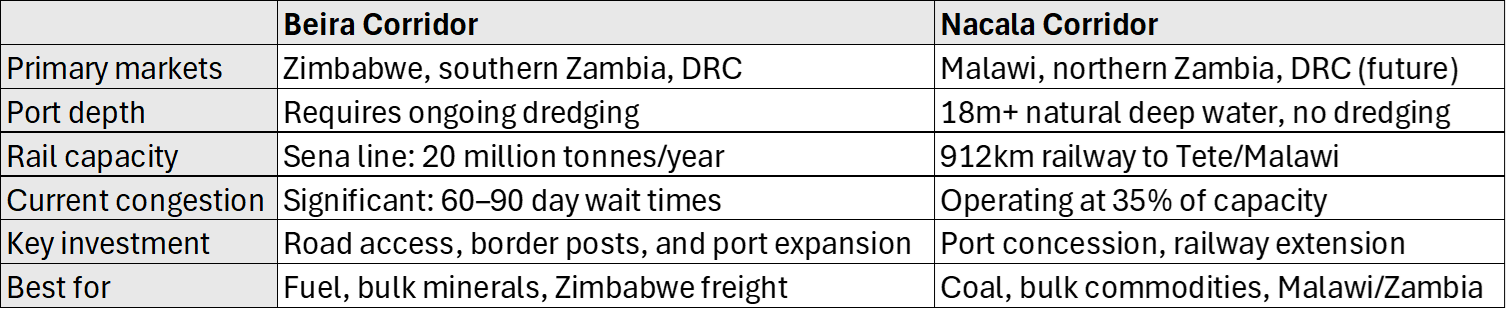
The table below summarizes the key differences:
Beira is the natural choice for:
● Freight moving to or from Zimbabwe, which handles approximately 70% of corridor volumes
● Fuel imports into the Zimbabwean and Zambian markets, served by the pipeline and fuel terminal
● Bulk minerals from Zimbabwe, including chrome and lithium
● Cargo where the shorter distance to Zimbabwe's economic centers outweighs current congestion
The ongoing investment programme at Beira is directly targeted at the congestion and road quality issues that currently limit corridor performance. Operators planning medium to long-term logistics strategies should monitor progress on the direct access road and border post projects, as these will materially change the corridor's competitive position when delivered.
Nacala is the better option for:
● Cargo moving to or from Malawi, for which Nacala is the most direct sea access
● Northern Zambia freight, particularly as the corridor's rail and border infrastructure develops
● Large bulk vessels that cannot call at shallower ports
● Shipments where port congestion and waiting time are critical variables, given Nacala's current spare capacity
● Coal and bulk commodity exports from Tete Province
The corridor's underutilization relative to its capacity is currently an advantage for shippers: less congestion, faster turnaround, and more predictable transit times than at Beira. That advantage may narrow as the corridor attracts more traffic following the port expansion and railway extension.
Both corridors serve significant mining export flows, and the infrastructure upgrades underway directly affect the competitiveness of those exports in global markets.
For Zimbabwe's chrome and lithium exports, the Machipanda railway rehabilitation and the improved crossing arrangements with CFM reduce the cost and improve the reliability of the land leg. For Zambian and DRC copper exports, the ongoing development of both corridors as alternatives to the heavily used North-South routes through South Africa gives exporters more routing flexibility and reduces exposure to bottlenecks on any single corridor.
The long-term significance of the proposed Nacala railway extension to Chipata and the DRC cannot be overstated for the mining sector. If delivered, it would create a new, shorter Indian Ocean routing for DRC copper and cobalt that would compete directly with the established southern routes. The investment required is substantial, but the strategic rationale is compelling given the volumes of critical minerals that will need to move from Central Africa to global markets over the coming decade.
The Nacala Corridor currently connects Mozambique, Malawi, and Zambia through its rail and road network, with the Port of Nacala as the Indian Ocean gateway. A December 2025 ministerial agreement adds the DRC as a future member, with plans for a railway extension from Chipata in Zambia to Serege in the DRC.
The Mozambique Channel is the body of water between Mozambique and Madagascar. The countries with coastlines on the channel include Mozambique, Madagascar, Comoros, and the French territory of Mayotte. Tanzania and South Africa border its northern and southern approaches, respectively.
Nacala's navigable channel runs to over 18 meters, putting it among the deepest natural harbors on the continent. What makes that depth commercially valuable is that it needs no dredging to maintain, which is a meaningful advantage over ports like Beira, where dredging is an ongoing operational cost.
Beira is a Mozambican city, sitting on the central coast at the mouth of the Pungwe River. It's Mozambique's second-largest city and the provincial capital of Sofala.
The port sits on Mozambique's central coast, roughly 1,000 kilometers north of Maputo, at the western edge of the Mozambique Channel. It's the seaward anchor of the Beira Corridor, which reaches inland through Zimbabwe into Zambia, Malawi, and the DRC.