AfCFTA and Customs Reality: What Free Movement of Goods Requires at the Border
October 19, 2026
Read the story
Please submit your details below and one of our logistics experts will reach out within one business day. Thank you.

The global energy transition runs on minerals. Electric vehicles, battery storage systems, solar panels, and wind turbines all require lithium, cobalt, and copper in quantities that conventional energy infrastructure never did. The countries that hold those minerals, and the logistics networks that move them, sit at the center of one of the most strategically significant supply chain questions of the decade.
For Africa, and for the logistics operators that serve its mining sector, this is both an opportunity and a pressure point. The continent holds a disproportionate share of the world's critical mineral reserves.
What it does with that position, and how reliably it can move those minerals from mine to market, will shape its role in the global economy for a generation.
Clean energy technology doesn't run on goodwill. It runs on minerals, and three in particular sit at the foundation of the transition away from fossil fuels.
Lithium powers rechargeable batteries. Every electric vehicle, grid storage system, and lithium-ion device on the market depends on it. Demand rose by nearly 30% in 2024, well ahead of the 10% annual growth rate of the previous decade. The IEA predicts fivefold growth by 2040, with near-term supply broadly keeping pace before deficits are expected to emerge in the 2030s.
Cobalt sits in the cathodes of many lithium-ion battery chemistries, particularly the high-performance variants used in EVs. The industry is working to reduce the amount of cobalt in each battery, but demand still grew by 6 to 8% in 2024, driven almost entirely by energy applications.
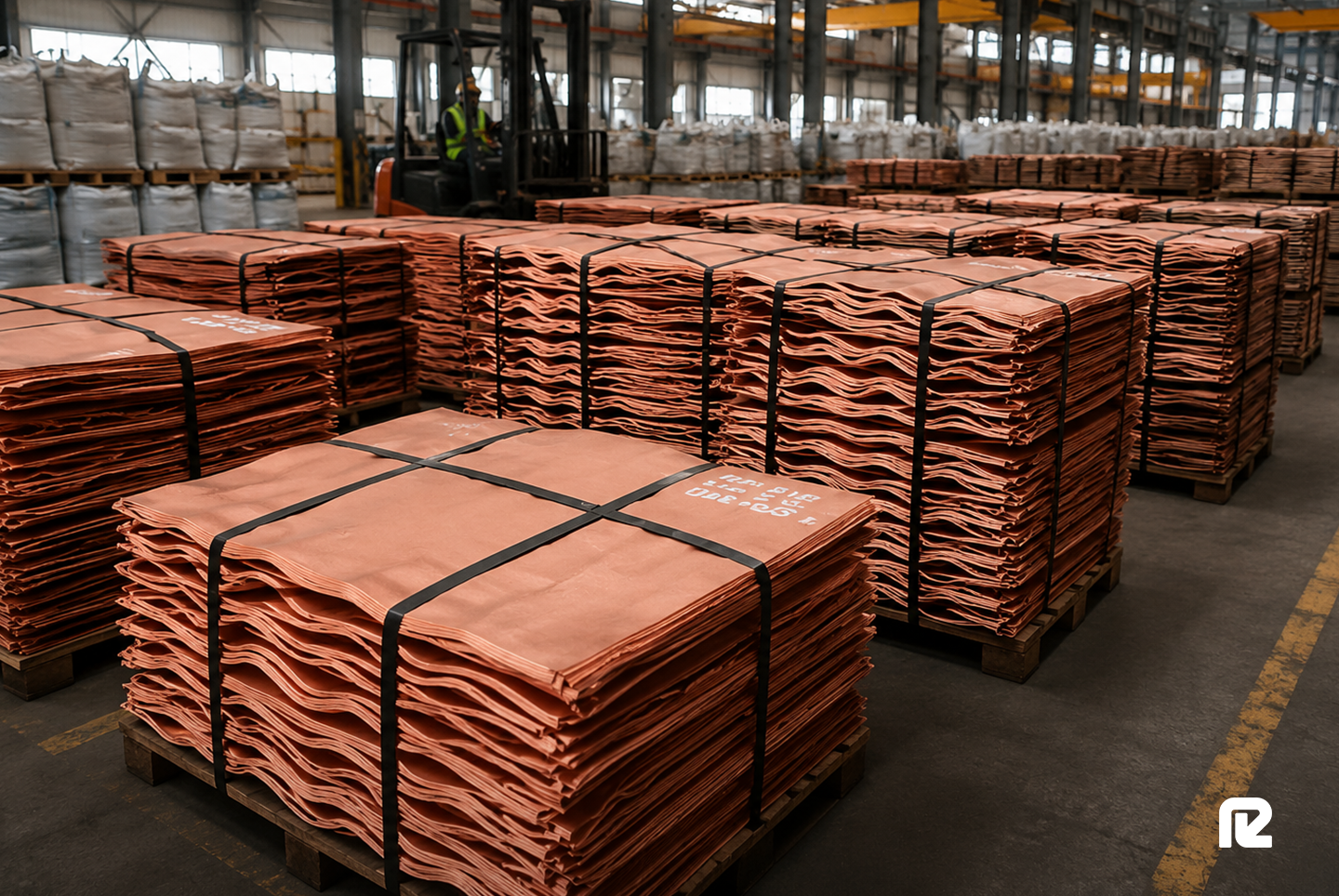
Copper connects everything. EV motors, wind turbines, solar installations, grid upgrades - all of it moves electricity through copper. Demand is projected to grow by 30% by 2040, with China's grid expansion alone being the largest single driver of demand over the past two years. Unlike battery metals, copper has no real substitute at scale, which is why supply security attracts as much attention from energy planners as it does from commodity traders.
The critical minerals market has a concentration problem that is getting worse, not better. For copper, lithium, nickel, cobalt, graphite, and rare earth elements, the average market share of the top three refining nations rose to 86% in 2024, up from around 82% in 2020, with almost all supply growth coming from the single top supplier: China, for most minerals.
Such concentration can be a geopolitical risk for the many countries and industries that depend on these supply chains, as disruptions from policy decisions, infrastructure failures, or political instability all add up quickly.
African governments have worked out that exporting raw minerals and importing processed materials is not a winning economic strategy. Zimbabwe has enforced export limits on raw lithium since 2022, continuing through 2025 and into 2026, pushing companies to process domestically rather than ship ore.
The DRC took a different approach and imposed temporary cobalt export bans in 2025 to stabilize falling prices, and it is now weighing flexible export quotas to balance market stability against producer revenues.
The direction is consistent across both cases: more value capture in-country, more complexity in the supply chain. For logistics operators and international buyers, that means processing steps that previously happened offshore are now happening before material leaves the continent.
Capital is flowing into African critical minerals, but with conditions attached. The DRC is building refining capacity to convert cobalt hydroxide into higher-value cobalt metal and is staking its position as a responsible supplier on ethical production standards, traceability, and environmental compliance.
That ESG pressure doesn't stop at the mine gate. It runs through the logistics chain. Buyers want documentation that follows the cargo: traceability records, compliance reports, and environmental monitoring data. Logistics providers that can support that documentation trail are increasingly more valuable than those that simply move the goods.
Global lithium production is concentrated in three main geographies: Australia, which dominates hard rock spodumene mining; Chile and Argentina, which produce lithium from brine deposits in the Atacama region; and China, which leads in refining regardless of where the ore originates.
Data from the African Energy Chamber's State of African Energy 2026 Outlook shows that Africa produced 124,230 tons of lithium carbonate equivalent in 2024. Zimbabwe leads continental output, with Mali, Namibia, South Africa, Ghana, and the DRC all ramping up production.
Processing is the number one logistics challenge in the lithium supply chain. This is because converting spodumene ore or lithium brine into battery-grade lithium carbonate or lithium hydroxide requires chemical processing that is currently dominated by Chinese facilities.
Most African lithium leaves the continent as ore or concentrates and returns as processed material at a significantly higher value.
Zimbabwe's export restrictions are a direct response to this dynamic, attempting to force processing investment onshore. Whether that strategy succeeds depends on whether the investment follows, which in turn depends on infrastructure, power supply, and regulatory stability.
Lithium ore and concentrate are bulky, relatively low-value per ton at the mine gate, and need to move in volume to be commercially viable. Road transport to a rail or port connection, then bulk sea freight, is the standard logistics model for most African lithium. The inland transport leg, from mine to port, is where African logistics networks face the most significant constraints.
Cobalt's supply chain has a concentration problem that dwarfs even the broader critical minerals market. Around 70% of the world's cobalt is produced in the DRC alone. That makes cobalt uniquely exposed to political, regulatory, and infrastructure risks in a single country.
For international buyers, this concentration is a known risk that has driven investment in alternative battery chemistries that reduce cobalt content. For African logistics operators, it means that cobalt corridor performance, particularly the routes from the Copperbelt through to Durban, Dar es Salaam, Beira, and the emerging Lobito Corridor, is watched closely by global commodity markets.
The DRC's cobalt production doesn't all come from large industrial mines. A significant share comes from artisanal and small-scale mining, where individual miners work with basic tools and sell to local buying houses that aggregate material into the formal supply chain. By the time that cobalt reaches an export terminal, the documentation trail is often patchy at best.
International buyers, particularly EV manufacturers and battery producers, are under increasing pressure to demonstrate that their cobalt supply chains are free from child labor and unsafe working conditions.
That pressure translates into traceability requirements that affect every party in the chain, including logistics operators who need to be able to account for custody of material from the collection point to port.
Getting cobalt out of the DRC is not straightforward. Road quality on the key corridors varies considerably, and not always predictably. Rail is getting better on some routes but remains unreliable on others. Every border crossing adds time, and a movement that touches three or four countries can accumulate days of delay before it reaches a port.
The Lobito Corridor is the most consequential infrastructure development currently changing that picture. The rehabilitated Benguela Railway through Angola gives DRC minerals a western Atlantic outlet that didn't reliably exist before. For producers who have historically depended entirely on the southern routes through Zambia to Durban, or the eastern routes to Dar es Salaam and Beira, it offers a genuine alternative.
Copper is the oldest story in this article. Mining operations in the DRC and Zambia have been running for generations. Chilean and Peruvian production is measured in decades. Smelting and refining infrastructure is mature and globally distributed. The London Metal Exchange has benchmarked the price for over a century. Of the three minerals here, copper is the one where the supply chain is genuinely established rather than still being built.
Africa's copper output is growing fast. Expansions in the DRC and Zambia pushed the continent's annualized production to 4.2 million tons in 2025. The Kamoa-Kakula complex in the DRC, backed by multi-billion-dollar investment from Ivanhoe Mines, is one of the most significant new copper projects anywhere in the world and is targeting substantial further output growth.
The export routes are well-worn. Copper cathodes and concentrate move south to Durban or east through Dar es Salaam, Beira, and Nacala. The Lobito Corridor through Angola is now offering a third option, and producers are paying attention.
The IEA's Global Critical Minerals Outlook 2025 predicts supply from announced projects will fall short of demand by 2035, with a 30% deficit for copper.
Africa holds the majority of the world's cobalt reserves, substantial copper and lithium deposits, and large quantities of platinum group metals and manganese. In 2024, it led global production of cobalt, copper, gold, and platinum group metals, while lithium output was growing across multiple countries at the same time.
This isn't a story about potential. It's already happening. The African Energy Chamber's State of African Energy 2026 Outlook describes the continent as sitting at the heart of the global supply chains that renewable energy deployment and EV adoption depend on. The question is no longer whether Africa matters to the energy transition. It's whether the logistics infrastructure can keep pace with what's being asked of it.
A small number of countries carry the majority of critical minerals production in Africa:
● DRC is dominant in cobalt, significant in copper, and growing in lithium
● Zambia is a major copper producer, increasing output to meet electrification demand
● Zimbabwe has become a rapidly growing lithium producer, enforcing export restrictions to drive domestic processing
● South Africa produces platinum group metals, manganese, chrome, and coal
● Namibia produces uranium, emerging lithium, and has developed green hydrogen infrastructure
Each country presents a different combination of mineral opportunity and logistics challenge.
Foreign investment in African critical mineral projects has accelerated as the strategic importance of these commodities has become clear to importing nations. Chinese investment has been the most significant in volume, with major projects in the DRC, Zambia, and Zimbabwe. Western governments and development finance institutions are now actively competing for access, framing critical mineral investment as a strategic priority.
The Lobito Corridor's development, backed by a 30-year concession to a Trafigura-led consortium, is one of the most visible examples of how international capital is flowing into African mineral logistics infrastructure.
The gap between Africa's mineral potential and its logistics capability is the defining challenge for anyone trying to move critical minerals from mine to market reliably and at competitive cost.
The core constraints are well documented:
● Road infrastructure on key mining corridors is often inadequate for the axle loads involved, leading to rapid deterioration and unpredictable transit times
● Rail capacity and reliability have been a persistent problem, particularly in South Africa, where Transnet Freight Rail underperformance has pushed significant volumes onto roads
● Port capacity and efficiency at major export terminals affect the entire chain upstream, since delays at the port translate into increased costs and working capital pressure throughout
● Border crossing delays add time and cost at every multi-country junction, compounding across the long corridors that connect landlocked mining regions to coastal ports
High transport costs are not just an operational problem for mining companies. They affect the competitiveness of African minerals in global markets. A copper cathode that costs more to move from the Copperbelt to Durban than its competitor from Chilean mining regions to a Pacific port is at a structural disadvantage, regardless of the quality of the mineral itself.
Reducing the logistics cost of African mineral exports requires investment across multiple parts of the chain simultaneously: road rehabilitation, rail improvement, port efficiency, border management, and the digital systems that coordinate them. No single intervention is sufficient on its own.
For mineral exporters, working with a logistics provider that has genuine end-to-end capability across the Southern African corridor network is increasingly a competitive requirement rather than a convenience. Fragmented logistics, where different legs are managed by different parties without central coordination, create exactly the kind of handover failures and information gaps that add cost and delay.
Integrated providers that manage the full movement from mine gate to port, with real-time visibility across the chain, are better positioned to deliver the reliability and documentation quality that international buyers increasingly require.